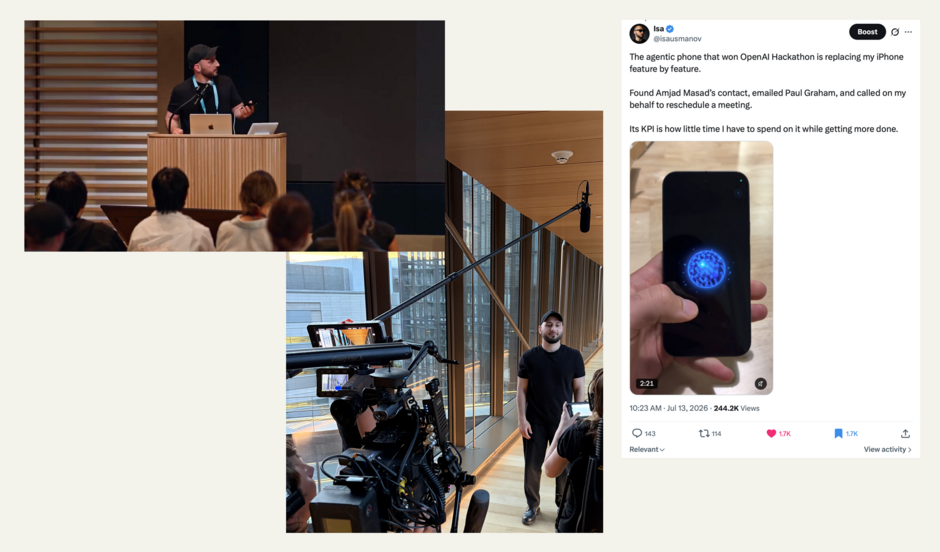
Raven is building a phone for a different interaction pattern: hand a job to an agent, leave it working and return when there is a result. Founder Isa Usmanov wants delegation, rather than moving between apps, to become the organizing idea of the device.
The company's launch announcement says early devices are already with testers. It points to preorders, but does not provide a broad shipping date or enough technical detail to treat the product as a generally available smartphone replacement.
Usmanov describes the intended scope as personal and professional work across tools such as email, calendars, calls and browsing. The wider ambition includes research and creating apps. Those examples describe what Raven is trying to enable, not a verified guarantee that every workflow already works reliably.
Watch Raven's original launch video.
The product starts from a recognizable frustration: a powerful phone can still require the owner to supervise each step of a task. Raven's proposed change is to make the device the place where work is assigned and where agents report back.
That makes attention an important product constraint. An agent-centered phone would need to decide what deserves an interruption, what can continue unattended and what requires explicit approval. The launch emphasizes spending less time on screen but does not provide a detailed account of how every such decision will be handled.
Usmanov says an early version won a hackathon at OpenAI's headquarters in June. He also reports hearing from more than 1,000 people about what they want from a different kind of phone. Those statements describe the company's early development and feedback, rather than device sales or active customers.
Usmanov's public founder profile identifies an earlier company as Droov, a restaurant-software business operating in Germany, Austria and Belgium. He reports more than 32,000 users and $3.4 million in transaction volume for that venture. He also co-founded an education-software company with reported annual recurring revenue above $1.2 million. These figures belong to his previous businesses, not Raven.
The launch describes 12 years building software and hardware and study at the Technical University of Munich and Lapland University of Applied Sciences. His earlier work also included an AI executive assistant for employees at large companies. That gives the phone project a connection to previous attempts at delegated office work, rather than only to smartphone design. YC lists Raven in its Fall 2026 batch.
The hardware choice makes this a larger project than releasing another assistant app. A dedicated device has to give people enough value to change an everyday habit, while the agent software must earn trust through the way it completes work and communicates uncertainty.
Raven has not publicly established that its approach reduces screen time in a controlled comparison. It has, however, put that goal at the center of the product rather than making engagement with a feed the measure of success.
The early testers will encounter the consequential details first: which jobs can be delegated, how results return and when the phone asks its owner to step in. Those interactions will say more about Raven's usefulness than the number of agents it could theoretically run.
Lorem ipsum dolor sit amet, consectetur adipiscing elit. Suspendisse varius enim in eros elementum tristique. Duis cursus, mi quis viverra ornare, eros dolor interdum nulla, ut commodo diam libero vitae erat. Aenean faucibus nibh et justo cursus id rutrum lorem imperdiet. Nunc ut sem vitae risus tristique posuere.

Built for Delaware C-Corps. Trusted by 2,000+ startups.












Copyright © Fondo (BloomJoy, Inc.)