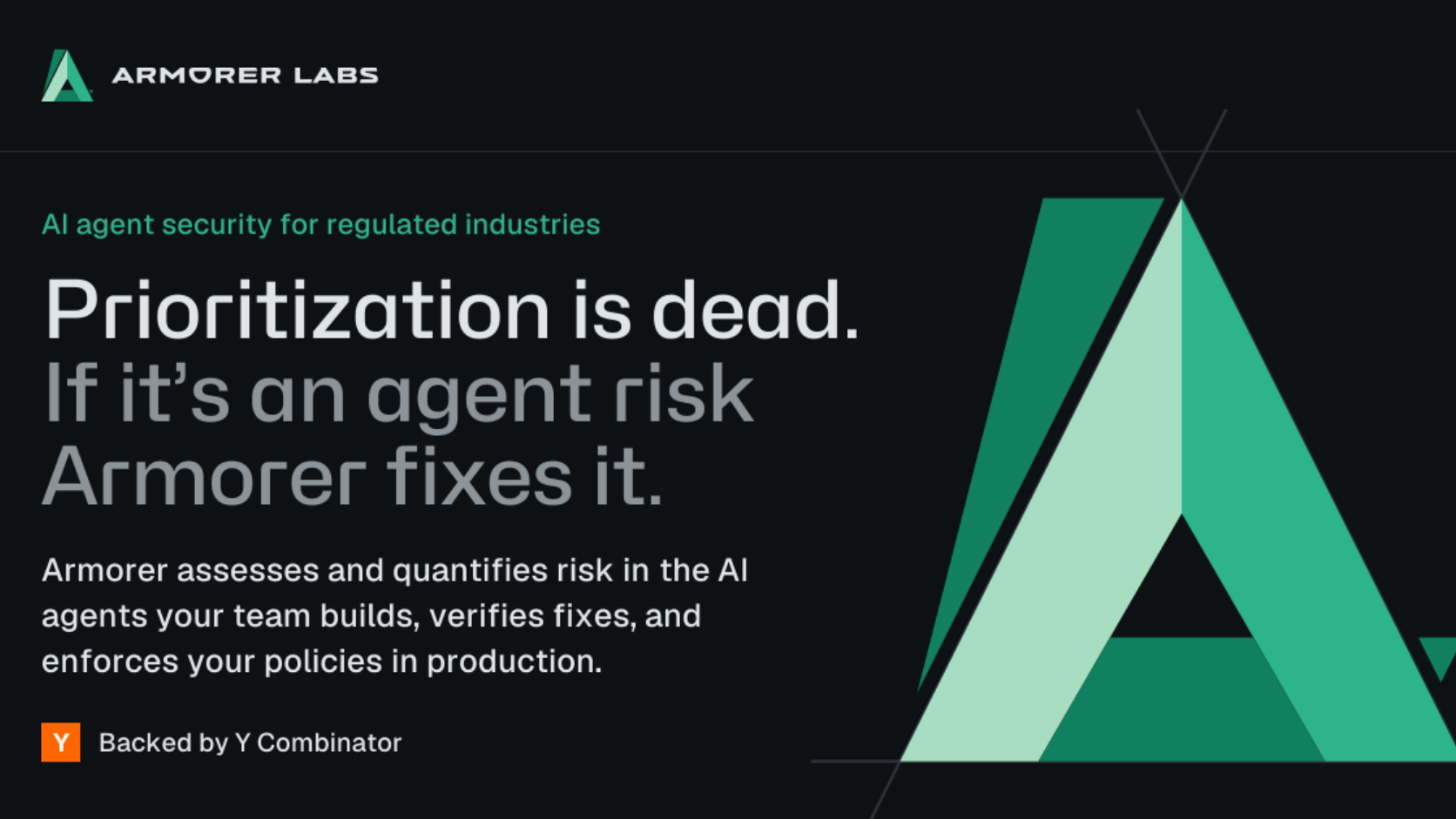
Blocking an AI agent from doing anything dangerous is easy if it can't do anything at all. Armorer Labs is pursuing the harder problem: identify an exploitable path, make a targeted fix, then check that the attack fails while the legitimate workflow still succeeds.
The startup launched its continuous security verification product on October 21, targeting organizations deploying agents in regulated industries. Its approach combines inspection of an agent's environment with attack simulation and proposed changes to code or runtime policy. The output is intended to be a verified repair, rather than another vulnerability added to a queue.
Armorer maps the tools, permissions, identities and data an agent can reach. That matters because a model's response is only part of the risk. An agent with access to a payment system or sensitive files can turn a misleading instruction into an action, depending on the privileges and controls around it.
The company's workflow then tests those exposed paths and proposes small changes, such as a pull request or a policy adjustment. It says it reruns checks against both the attack and the intended business task. Human approval remains part of the process described in the launch.
Watch Armorer Labs demonstrate its agent security workflow.
Its website illustrates the product with a finance agent encountering a poisoned file, a fake invoice and a tampered tool. These are demonstrations of the intended protections, not evidence that a particular customer's production systems have resisted those attacks. The useful distinction is between identifying that an agent has broad access and proving how that access can be abused.
For deployed agents, Armorer also describes runtime decisions that allow, hold or deny an action. The company says those checks operate in milliseconds without a GPU. It offers deployment in customer clouds, on premises and in air-gapped environments, which could matter to teams unable to send their internal data into an external monitoring service.
Founders Daniel Begimher and Cristian Leo previously worked at AWS, according to the public launch announcement. Armorer Labs belongs to Y Combinator's Fall 2026 batch. The company also names Paul Vixie as an adviser and investor in its announcement.
Armorer makes ambitious speed claims, including onboarding in about 30 minutes and fixing risks within four hours. Those figures are company claims, not guarantees established by independent testing. Integration complexity and the scope of an agent's permissions could change what a customer can achieve in that window.
The product's most concrete test is its own proposed closing step. A repair that stops an attack by breaking the application is incomplete. Armorer's verification loop asks security teams to examine both outcomes together: can the malicious instruction still cause harm, and can the agent still finish the job it was deployed to do?
Lorem ipsum dolor sit amet, consectetur adipiscing elit. Suspendisse varius enim in eros elementum tristique. Duis cursus, mi quis viverra ornare, eros dolor interdum nulla, ut commodo diam libero vitae erat. Aenean faucibus nibh et justo cursus id rutrum lorem imperdiet. Nunc ut sem vitae risus tristique posuere.

Built for Delaware C-Corps. Trusted by 2,000+ startups.












Copyright © Fondo (BloomJoy, Inc.)