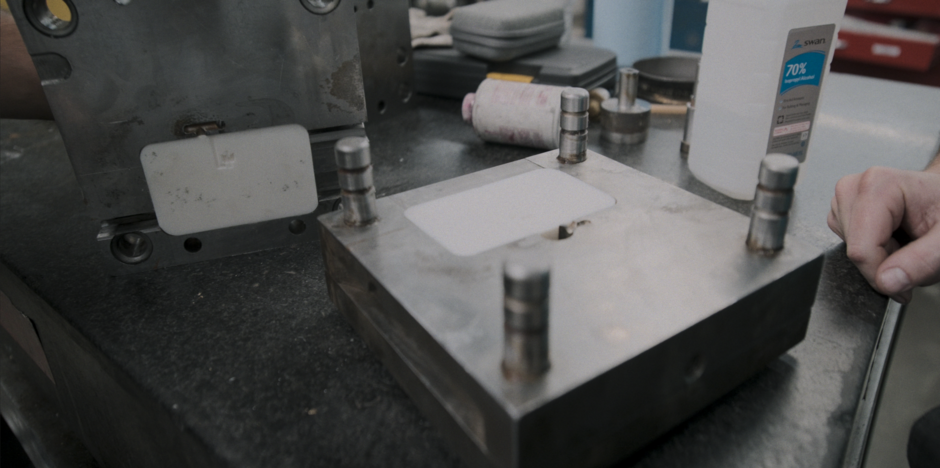
Changing a plastic part can mean waiting for a new mold before testing the change. Sinter is trying to shorten that interval by printing the tooling used in injection molding, instead of relying entirely on traditionally machined molds.
The Y Combinator Fall 2026 company says its photopolymer-resin tooling works with existing molding equipment. In its launch announcement, Sinter describes 48-hour production and claims a tenfold reduction in both time and cost compared with traditional methods. Those figures are company claims, not independently established benchmarks across materials and part designs.
The distinction between printing a part and printing its mold is central. Sinter's proposed process uses additive manufacturing to create tooling, which then shapes the end-use plastic. The attraction for a hardware team is being able to revise a design without committing to the same tooling expense and delay each time.
Sinter says the economics can support runs containing only a handful of parts. That would make injection molding useful earlier in development, when a team may need production-relevant samples but is not ready to lock down a design for a large order.
Watch Sinter's original launch video.
Its founders, Oliver Johnson and Justin Kwon, have an unusually long shared history with plastics. They say they met online at 13 while building custom mechanical-keyboard switches. The business exposed them to manufacturing well before college, which both later left before joining YC.
Their public profiles add experience operating a 3D-printing farm and college makerspace for Johnson, and mechatronics work at Shinkei Systems for Kwon. In the launch, the pair describe spending four months living on a warehouse floor in El Segundo while getting Sinter started.
The company reports helping customers produce more than 500 kilograms of parts during its first month. That measures the volume it says it supported, not revenue, profit or a disclosed number of production customers. The announcement does not name the customers or break down the processes used for that total.
There is also an availability distinction prospective buyers should notice. Sinter's current website offers online quotes for FDM-printed prototype parts, while marking its next-generation polymer tooling and mold-flow simulation as coming soon. A founder post on its company LinkedIn page says it is taking on injection-molding pilots.
Taken together, the materials describe an operating prototype service and early molding work, rather than establishing that every advertised capability is already a broadly available self-service product. The 48-hour molding claim should be evaluated against the actual job and a confirmed production quote.
The website's planned workflow includes reviewing a part's geometry, simulating how material fills the mold and feeding production observations into later tooling. That is a more involved proposition than simply replacing a metal object with a printed one.
For a hardware team, the immediate question is whether a proposed part, material and run size fit the process. Sinter's case rests on reducing the cost of learning from a real molded part before a design becomes expensive to change. Its early pilots are where that claim will have to hold up.
Lorem ipsum dolor sit amet, consectetur adipiscing elit. Suspendisse varius enim in eros elementum tristique. Duis cursus, mi quis viverra ornare, eros dolor interdum nulla, ut commodo diam libero vitae erat. Aenean faucibus nibh et justo cursus id rutrum lorem imperdiet. Nunc ut sem vitae risus tristique posuere.

Built for Delaware C-Corps. Trusted by 2,000+ startups.











Copyright © Fondo (BloomJoy, Inc.)