A robot can pick up an object and still fail the job. SE3 Labs is building a business around finding those failures, then turning them into training material that helps robot developers decide what to fix next.
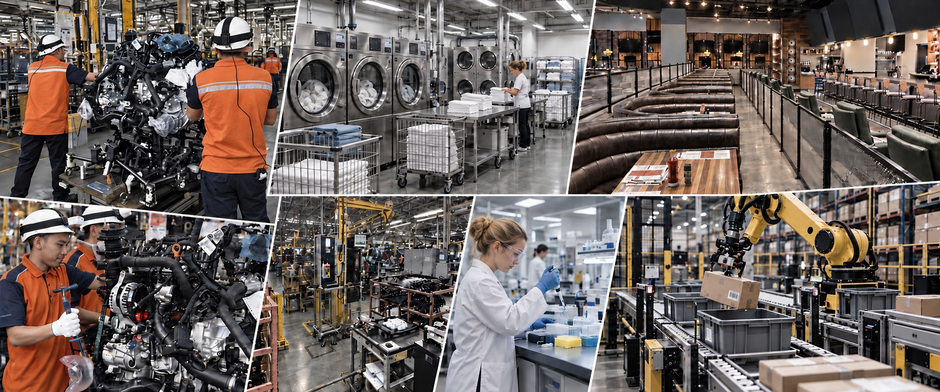
The San Francisco company, part of Y Combinator’s Fall 2026 batch, provides physical environments for testing and improving robot models. Its launch announcement describes a network of factory and hospitality workflows that can become repeatable training tasks, from handling parts to moving objects through real hotel layouts.
The less glamorous work is central to the product. Each attempt needs equipment, a defined task, a way to judge success and someone to put everything back. SE3 says it handles that work, including human corrections when a robot gets stuck. Model developers can concentrate on the software rather than recreate a test facility for each experiment.
Watch SE3 Labs’ original launch video
On its website, the company describes a process that begins with a model checkpoint or an inference endpoint. A customer supplies the task and success criteria. SE3 runs the model on physical equipment, records what happens and packages the results for the next training round.
When a model fails or reaches a safety limit, a trained operator takes over. The company records the transition from the unsuccessful attempt through the correction, preserving evidence of both the mistake and a way out. It then organizes recordings into datasets with synchronized video and sensor timelines, task labels and outcome information.
Keeping the evaluation consistent matters. A higher score is useful only if the next version of a model faces a comparable test. SE3 says it measures successive checkpoints against the same criteria and uses variations in objects and layouts to test whether an improvement carries beyond the original setup.
A research report published by SE3 in October offers a concrete example of what that process can expose. The company ran Dream Labs’ Dream model through 100 episodes across ten physical manipulation tasks without task-specific training. It reported that none completed the entire assigned task, although 57 reached at least one intermediate milestone.
That result came with a more useful diagnosis than a single failure rate. According to SE3, the robot often handled objects competently but struggled with the requested destination or instruction. Performance also varied with objects’ positions on the table. Those are findings from SE3’s own evaluation, under its particular setup, rather than a general verdict on the model.
The founding team combines robotics and infrastructure experience. Paige Xu previously co-founded OpenMind, Mark Chen worked at Amazon FAR and conducted robotics research at Stanford, and Conan Yu built a data infrastructure company. SE3’s launch credits Xu with experience deploying robots in factories.
Its next expansion is physical sandboxes at partner sites, according to the YC company profile. That would bring testing closer to the conditions customers actually care about. For a robot developer, the useful output is a specific account of what went wrong, and a repeatable test that can show whether the fix worked.
Lorem ipsum dolor sit amet, consectetur adipiscing elit. Suspendisse varius enim in eros elementum tristique. Duis cursus, mi quis viverra ornare, eros dolor interdum nulla, ut commodo diam libero vitae erat. Aenean faucibus nibh et justo cursus id rutrum lorem imperdiet. Nunc ut sem vitae risus tristique posuere.

Built for Delaware C-Corps. Trusted by 2,000+ startups.












Copyright © Fondo (BloomJoy, Inc.)