Saccade is putting eye-movement research inside a short VR appointment. The San Francisco startup says its assessment is available in local clinics, using visual tasks and eye-tracking hardware to record signals it hopes will make brain-health screening more accessible.
There’s a crucial limit to that proposition. Although its launch announcement promotes early Alzheimer’s risk detection, Saccade’s own assessment documentation calls the product investigational and says it cannot diagnose, predict or rule out Alzheimer’s disease or another condition. That distinction matters more than the headset.
The appointment starts with staff fitting and calibrating the equipment. Infrared cameras record the participant’s eyes while they follow instructions: hold a gaze on a dot, look toward a new target, look in the opposite direction, or track something moving. Staff review the recording and may repeat a task if needed.
The resulting measures include how quickly a person responds, whether their eyes move in the instructed direction, how accurately they reach a target and how steadily they hold their gaze. Saccade describes a panel of 14 research measures across four categories. The attraction is practical: a brief, noninvasive session can collect a structured record of behavior that would be difficult to describe reliably from memory.
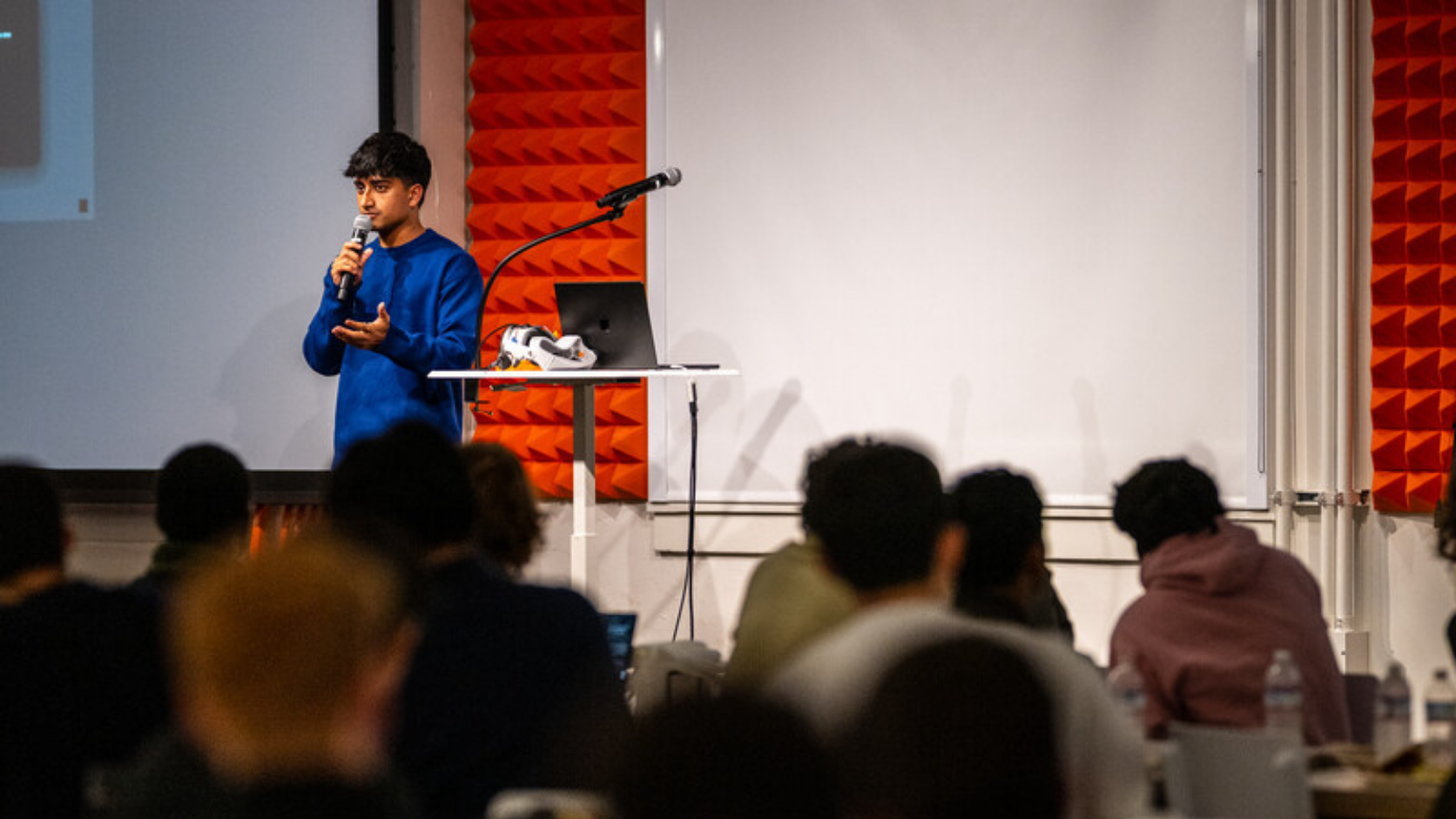
Watch Saccade’s launch demonstration.
The company’s announcement describes a headset attachment and a machine-learning model that turns recordings into a risk score. Its assessment page takes a more restrained view of interpretation. Research showing differences between groups, it explains, does not establish that Saccade’s particular panel can diagnose an individual. Age-based reference ranges are also not yet available in its reporting system.
Those limits complicate the launch’s suggestion that testing could help people start Alzheimer’s drugs years earlier. The FDA’s approval evidence for Kisunla, for example, concerns people with mild cognitive impairment or mild dementia and confirmed amyloid pathology. That is a different clinical situation from an otherwise asymptomatic person seeking a VR screening appointment.
Saccade’s announcement does not supply a clinical validation study, sample size or accuracy figures for the product. It also says testing is available to people in their 30s and older. Availability should therefore be understood separately from evidence that a result predicts a future diagnosis.
Founder Shreyas Bhardwaj brings experience in medical devices and soft-robotics research, according to his public YC profile. Saccade is part of Y Combinator’s Fall 2026 batch and is seeking relationships with longevity practices and clinics in the United States.
The company’s detailed documentation provides another useful constraint on repeated testing: sleep, medication, vision and practice can change a result. A difference between visits does not, on its own, establish that a longevity intervention worked. For now, Saccade offers a way to record eye behavior; proving what that record can reliably tell an individual remains the consequential next step.
Lorem ipsum dolor sit amet, consectetur adipiscing elit. Suspendisse varius enim in eros elementum tristique. Duis cursus, mi quis viverra ornare, eros dolor interdum nulla, ut commodo diam libero vitae erat. Aenean faucibus nibh et justo cursus id rutrum lorem imperdiet. Nunc ut sem vitae risus tristique posuere.

Built for Delaware C-Corps. Trusted by 2,000+ startups.












Copyright © Fondo (BloomJoy, Inc.)