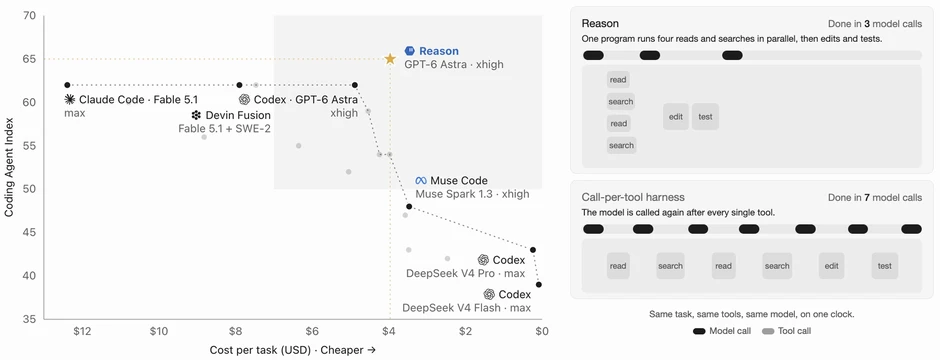
Running a coding agent can involve repeatedly asking a model what to do next, even when the next steps are routine file reads or searches. Reason Machines is targeting the cost of that coordination. Its product wraps models in a relatively lean orchestration layer, or harness, designed to complete work with fewer tokens and fewer unnecessary model calls.
The Fall 2026 Y Combinator company was founded by Adi Singh and Sven Myhre, both Berkeley EECS graduates. Their launch presents Reason as an agent that can work across cloud Linux machines, cloud Macs, local computers and SSH connections. Sessions can persist in cloud virtual machines and move between devices without requiring the user to start the task over.
Reason also exposes its agents through an application, an API and Slack. The website describes asking an agent in a thread to produce a pull request, a presentation or an answer. Users can bring supported model credentials, while the launch describes parallel sessions and longer-running workflows. Those capabilities place the harness inside a broader working environment rather than presenting it solely as a benchmark experiment.
Watch the original Reason Machines launch video
The technical argument is that an agent should be able to group work instead of making a separate model request for every tool interaction. In its Reason 1.1 write-up, the company describes a code-execution tool that can run searches, file reads and tests in parallel and return the relevant results together. A small default tool set keeps platform-specific operations behind tools that are discovered when needed.
Caching is another part of the design. Reason says its prompts and tool definitions remain stable between turns, with subsequent requests appending new content. That makes previously supplied context eligible for caching. The company has not isolated how much of its reported savings comes from each design choice, so the effects should not be assigned to parallel execution or prompt design alone.
The launch's main numerical comparison requires careful qualification. Reason reports a Coding Agent Index score of 65.1 versus 62.5 for Codex using GPT-6 Astra, with a 22% lower cost per solved task. Its write-up describes these as the company's own reproductions of Artificial Analysis's methodology, not official Artificial Analysis results or an endorsement by that organization.
The comparison also uses Coding Agent Index v1.5. The write-up explicitly notes that the index moved to v2.0 on October 22, changing tasks and grading, and says its figures are not directly comparable with the current leaderboard. That makes the result evidence for the company's stated experiment, not a basis for declaring Reason the cheapest or highest-scoring agent available today.
Reason says it attracted more than 20,000 users in four weeks. That is company-reported adoption, not a disclosed count of paying customers. The founders' launch also mentions a seed fundraising effort without announcing a completed round or amount.
For developers evaluating the product, the substantive proposition is narrower than a universal efficiency claim: keep the underlying model, change how tools and context are organized, and examine the resulting bill on the work that matters. Reason publishes benchmark methodology and links to public jobs for its comparison, giving that proposition a more inspectable starting point than the headline numbers alone.
Lorem ipsum dolor sit amet, consectetur adipiscing elit. Suspendisse varius enim in eros elementum tristique. Duis cursus, mi quis viverra ornare, eros dolor interdum nulla, ut commodo diam libero vitae erat. Aenean faucibus nibh et justo cursus id rutrum lorem imperdiet. Nunc ut sem vitae risus tristique posuere.

Built for Delaware C-Corps. Trusted by 2,000+ startups.












Copyright © Fondo (BloomJoy, Inc.)