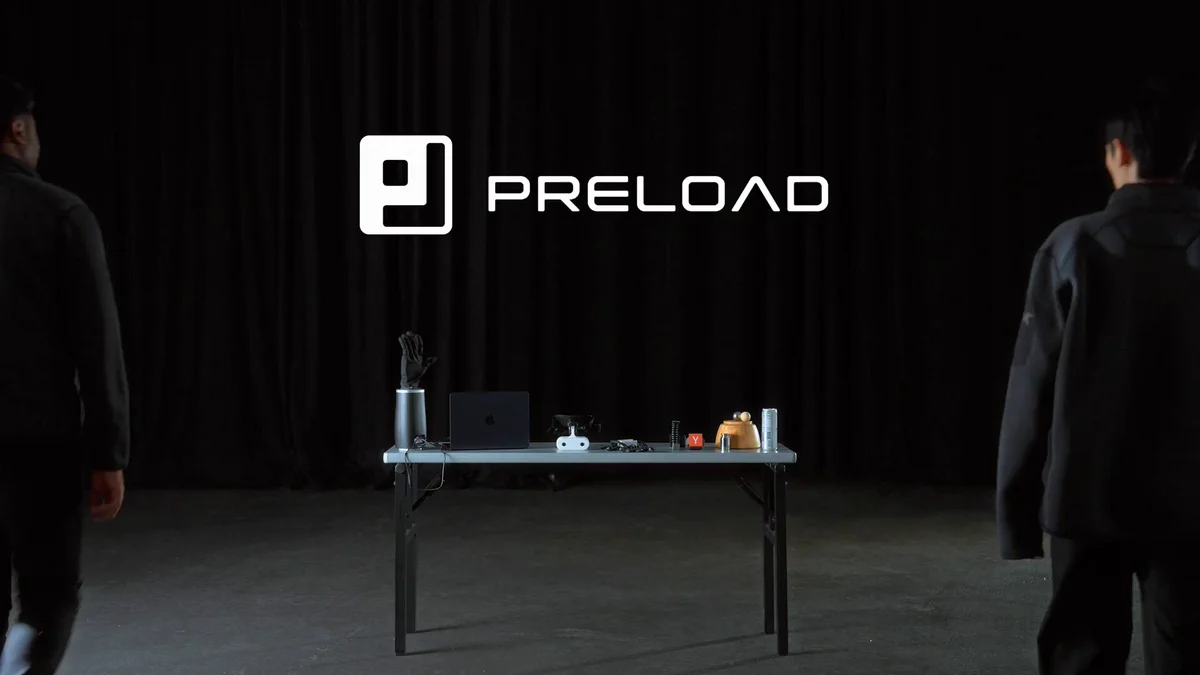
Preload is collecting the signals a camera misses when a person works with their hands. Its wearable system combines first-person video, tactile gloves and muscle-activity measurements into synchronized training data for robotics teams.
The Fall 2026 Y Combinator startup is pursuing a specific limitation in learning from human demonstrations. Video can show the movement of a hand or an object, but it does not directly record the pressure applied, the points of contact or the muscle activity associated with an action.
Preload wants to capture those signals together, giving a model a more complete record of skilled manipulation. The company reports collecting more than 350 hours of data so far, all in real-world, non-surgical settings.
The system has three components. A first-person camera records the scene from the wearer's perspective. Gloves measure contact and pressure across the hand. Electromyography, or EMG, measures muscle activity associated with the movement.
Watch Preload's launch demonstration
Preload synchronizes the streams so a robotics team can connect what the person saw with the physical interaction and the activity producing it. That alignment is the product: an isolated video, pressure reading or muscle signal offers less information about the complete action.
The founders argue that EMG is particularly useful because muscle activity can reveal effort and signals preceding visible movement. They describe that as a route to capturing motor intent. The launch does not establish that the system can read a person's intentions generally; its stated use is understanding the physical signals associated with manual tasks.
The company was founded by Leo Li, Surya Pandiaraju and Runming, also known as Tony, Wang. They describe themselves as former doctoral researchers from Caltech and Johns Hopkins who left their programs to build the business, with experience recording and interpreting biological signals.
Li worked as a neuroengineer at Neuralink and a software engineer at Amazon before his computational-neuroscience research at Caltech. Pandiaraju studied neural dynamics and decoding at Johns Hopkins and previously worked at companies including Paradromics and NeuroPace.
Wang's work includes neural recording and stimulation hardware, animal neurosurgery and research into motor-unit coordination using EMG and motion tracking. Those backgrounds fit the difficult part of Preload's proposition: collecting useful biological measurements outside a tightly controlled laboratory.
Its immediate customers are robotics and physical-AI teams that want custom datasets for dexterous manipulation. Preload is also looking for partners whose employees perform precise manual work, creating opportunities to record skills in the settings where they are actually used.
Surgery is a longer-term interest, not the current data-collection setting. The startup reports letters of intent from major hospitals to collaborate on capturing expert skill, but those letters are not completed surgical deployments or evidence that a robot has learned to operate from the dataset.
The launch does not publish a measured improvement in robot task performance. For now, the concrete progress is the wearable capture system, the collected hours and the search for teams that can use richer demonstrations in training. Preload is hiring across sensors, robotics, machine learning and field operations as it expands that work.
Lorem ipsum dolor sit amet, consectetur adipiscing elit. Suspendisse varius enim in eros elementum tristique. Duis cursus, mi quis viverra ornare, eros dolor interdum nulla, ut commodo diam libero vitae erat. Aenean faucibus nibh et justo cursus id rutrum lorem imperdiet. Nunc ut sem vitae risus tristique posuere.

Built for Delaware C-Corps. Trusted by 2,000+ startups.












Copyright © Fondo (BloomJoy, Inc.)