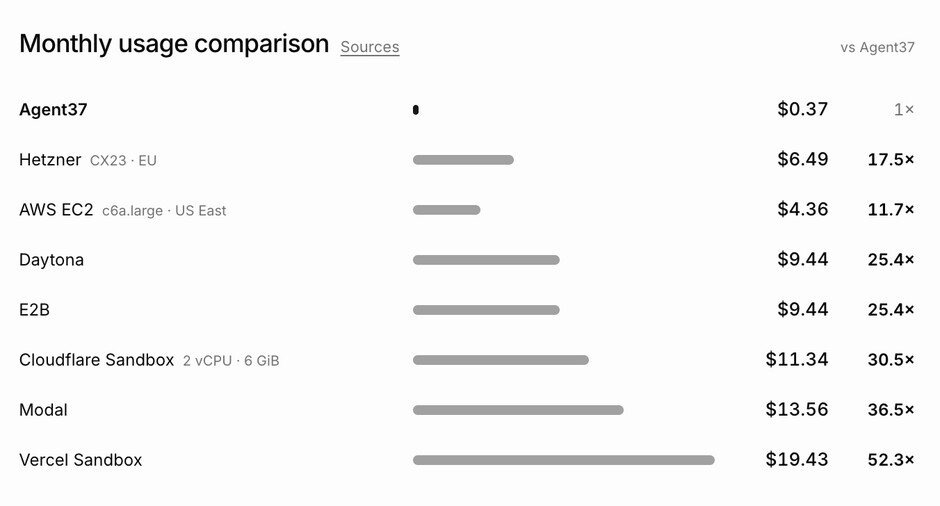
Agent37 is making a cost argument for the infrastructure behind AI agents. Its new sandbox launch offers environments for running code, browsers, computer-use tools and agent frameworks, while challenging the idea that those environments should carry a large premium over ordinary compute.
The company quotes $4.76 for a sandbox with two virtual CPUs and four gigabytes of memory running continuously for a month. Its launch compares that figure with higher prices from several providers and claims an average cost reduction of 94%. Those are Agent37’s comparisons, not independently verified benchmarks; configuration, usage patterns and included services matter when evaluating them.
The product is more than a temporary place to execute one snippet of code. Agent37’s official site describes a persistent sandbox that can retain files, agent memory and connected tools across sessions until a customer deletes it. One API call provisions an environment, which can use a supplied template or a customer’s own agent framework.
Supported examples on the site include Hermes, OpenClaw, Claude Code and Codex. The proposition is aimed at developers who want to give each user an agent without building the underlying hosting system themselves. Agent37 also describes white-label hosting, where a developer controls the customer-facing product while buying the underlying infrastructure.
Its billing model separates persistence from active computation. The site says CPU and memory are metered while a sandbox runs, while disk storage continues to accrue until deletion. When the sandbox sleeps, the compute meter stops but storage remains. That distinction matters for agents that work intermittently yet need to preserve context and files between tasks.
The quoted sandbox price is not a complete budget for an AI application. Agent37 says model tokens, search and integrations can be charged separately from the same prepaid balance. Customers can instead bring their own model keys. The site also describes per-sandbox spending caps, giving developers a control beyond simply choosing the machine size.
On security, the company says it uses gVisor isolation, separate filesystems and disk quotas, encrypted storage and transport, and restrictions preventing outbound access to private networks. These are the provider’s descriptions of its architecture, not an independent security assessment. An application handling sensitive information would still need to assess the relevant controls and configuration.
Founder Vishnu Krishnaprasad’s public YC profile lists previous engineering roles at Amazon and Quantcast, along with earlier company-building experience. Agent37 is part of YC’s Fall 2026 batch. Its public product page emphasizes removing infrastructure setup from the developer’s work, including templates, shell access, file operations and streaming agent events.
The launch’s sharpest claim is about price, but the operational question is broader: can inexpensive environments remain useful across repeated agent sessions? Persistence, idle-time billing and application integrations are the features that make that question distinct from renting a server. Its proposition is to keep those conveniences while charging less for the environment underneath them.
Prospective customers can compare the published unit rates against their own expected uptime and storage needs. The company’s pricing examples provide a starting point, not a universal monthly total. For an agent product, the eventual cost will depend on what runs inside the sandbox as much as on the sandbox itself.
Lorem ipsum dolor sit amet, consectetur adipiscing elit. Suspendisse varius enim in eros elementum tristique. Duis cursus, mi quis viverra ornare, eros dolor interdum nulla, ut commodo diam libero vitae erat. Aenean faucibus nibh et justo cursus id rutrum lorem imperdiet. Nunc ut sem vitae risus tristique posuere.

Built for Delaware C-Corps. Trusted by 2,000+ startups.












Copyright © Fondo (BloomJoy, Inc.)