Nines wants to automate the part of AI infrastructure that still requires someone to walk over to a rack. The Fall 2026 YC company is developing robots for data-center commissioning and maintenance, starting with the work of connecting fiber.
Its launch frames the problem as a mismatch between the pace of construction and the availability of technicians. A new hall can contain thousands of connections that need to be matched, inserted and checked before capacity comes online. Once it is running, faults can still require someone on site to handle equipment.
Nines is building robots and the models that operate them for this environment. The company describes fiber patching as its first step, with a broader ambition to handle tasks such as replacing drives, reseating optical components and restarting servers. Those examples describe its intended scope; the announcement does not establish that the entire maintenance suite is commercially deployed.
Watch the original Nines launch video
The distinction between commissioning and maintenance shapes the product. During a build-out, the objective is to prepare equipment for service. At a live site, the same physical intervention can sit between an idle machine and useful computing capacity. Nines wants a robot fleet to address both, rather than treating server-room work as a collection of unrelated service calls.
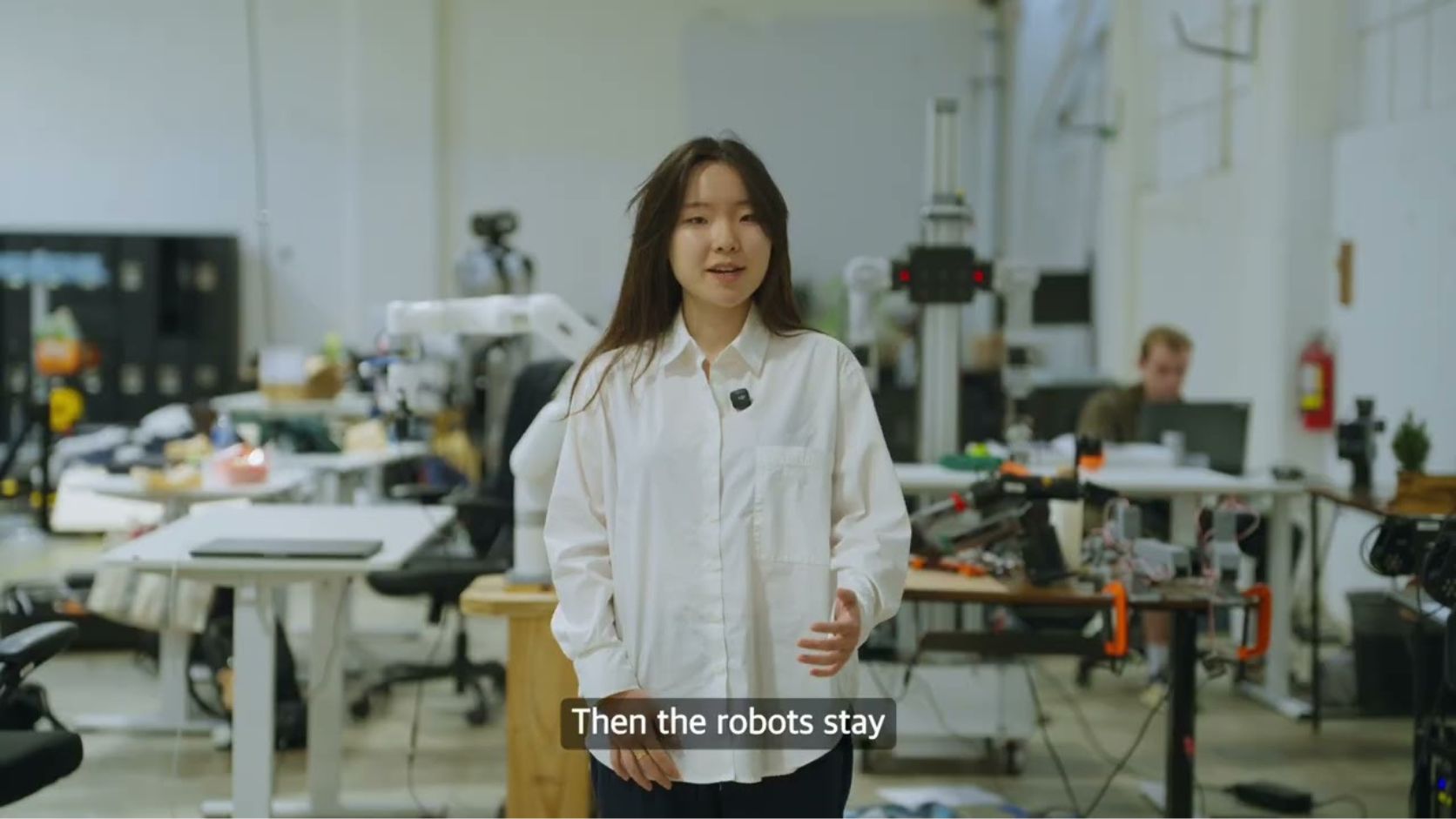
Founders Taerim Eom and Tiantian Li come from software systems that depend on reliable infrastructure. According to the launch, Li worked on large-scale inference at Meta and saw construction and maintenance become constraints on available compute. Eom helped build Patreon's livestreaming product from its beginning through use by millions of people.
The team is positioning the business around a specific workplace rather than a general-purpose household robot. Server rooms provide a defined set of physical jobs, but the launch does not supply reliability figures, task-completion rates or a detailed account of how robots handle unexpected conditions. It also does not name customers or announce a production fleet.
Nines' longer-term plan would connect the robots directly to data-center orchestration software. In the founders' description, software could identify a need for a different network layout or more storage and assign the corresponding physical work. That is a future workflow, not a capability the announcement demonstrates as already operating at scale.
The company's public website remains brief, describing robots for data centers and inviting conversations with operators. It credits simulation assets from NVIDIA and Vertiv, which is useful context when assessing visual demonstrations: simulated environments should not be confused with evidence from a customer installation.
The appeal of the approach is concrete. Faster software alone cannot insert a connector or replace a failed drive. A robot that can reliably complete even a narrow set of those jobs could change how operators staff and maintain facilities, though Nines has not published enough results to quantify that effect.
For now, fiber patching gives the company a bounded place to begin. The broader vision of data centers adapting their own physical infrastructure depends on making those individual interventions dependable first, with evidence beyond the ambitions laid out in the launch.
Lorem ipsum dolor sit amet, consectetur adipiscing elit. Suspendisse varius enim in eros elementum tristique. Duis cursus, mi quis viverra ornare, eros dolor interdum nulla, ut commodo diam libero vitae erat. Aenean faucibus nibh et justo cursus id rutrum lorem imperdiet. Nunc ut sem vitae risus tristique posuere.

Built for Delaware C-Corps. Trusted by 2,000+ startups.












Copyright © Fondo (BloomJoy, Inc.)