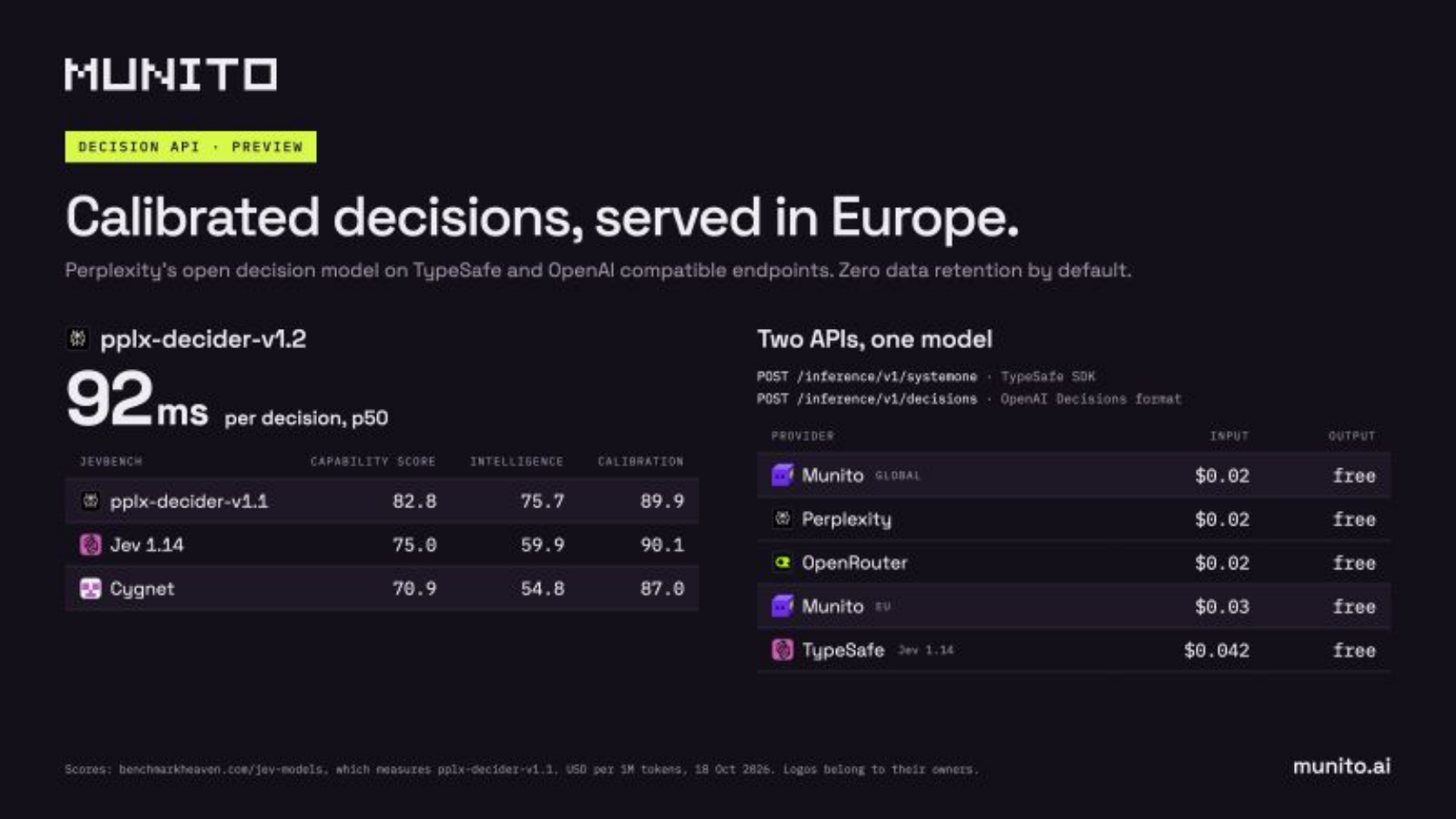
Developers who want to use open AI models in Europe often have to make a second decision about who will run them. Munito AI is launching an inference service designed to make that choice simpler: familiar APIs, European processing and storage, and no GPU infrastructure for customers to manage.
Founder Alexey Eryshev previously led inference at Mistral AI, where his team built API and inference products. He also worked on Le Chat’s Deep Research. Munito takes that infrastructure experience into a service that hosts models from multiple developers rather than tying customers to one model family.
The company says its APIs are compatible with OpenAI and Anthropic interfaces, allowing users to change the base URL and API key while keeping existing SDKs and agent tools. Tool calling is supported. The launch names Claude Code as one of the tools developers can point at the service.
Watch Munito’s original launch demonstration.
Regional deployment is the core of the pitch. Requests sent to the European endpoint are processed in the EU, with stored data kept there by default, according to Munito. A separate U.S. endpoint uses the same stack for customers who want processing in that region.
Those are concrete infrastructure choices, distinct from a blanket assurance that any application built on the service satisfies every regulatory requirement. Munito’s launch emphasizes where inference happens and what happens to customer data; it does not replace a customer’s own assessment of its application and obligations.
The service promises zero data retention by default and says it neither sells customer data nor trains models on it. Its official website links to a trust center and data-protection documents supporting the company’s stated policies. These remain provider commitments, not an independent security audit conducted for this article.
The model catalog spans text generation, speech transcription and document processing under one API key. The announcement lists models from GLM, Qwen and DeepSeek, alongside Aleph Alpha’s Kolibri and LightOn’s document OCR model. The point is to let a developer choose an open model without separately operating the hardware that serves it.
Munito offers a free tier, with its website noting that availability depends on capacity. Customers can buy credits for higher limits or discuss monthly invoicing. The launch does not publish comparative speed, cost or uptime measurements, so its performance proposition will need to be evaluated against individual workloads.
Eryshev says the idea grew out of seeing demand for independent open-model inference while at Mistral. Before that, he spent five years at Airbnb, where he built Hosting Services into a global product. Munito is part of Y Combinator’s Fall 2026 batch.
The company’s next stated project is a self-improving inference stack intended to make serving open models faster and cheaper over time. That is a development goal. The offering available at launch is more immediate: choose a region and a supported model, then connect through an API the application already understands.
For teams whose customers keep asking where their AI runs, that regional choice is likely to be the first feature they examine.
Lorem ipsum dolor sit amet, consectetur adipiscing elit. Suspendisse varius enim in eros elementum tristique. Duis cursus, mi quis viverra ornare, eros dolor interdum nulla, ut commodo diam libero vitae erat. Aenean faucibus nibh et justo cursus id rutrum lorem imperdiet. Nunc ut sem vitae risus tristique posuere.

Built for Delaware C-Corps. Trusted by 2,000+ startups.












Copyright © Fondo (BloomJoy, Inc.)