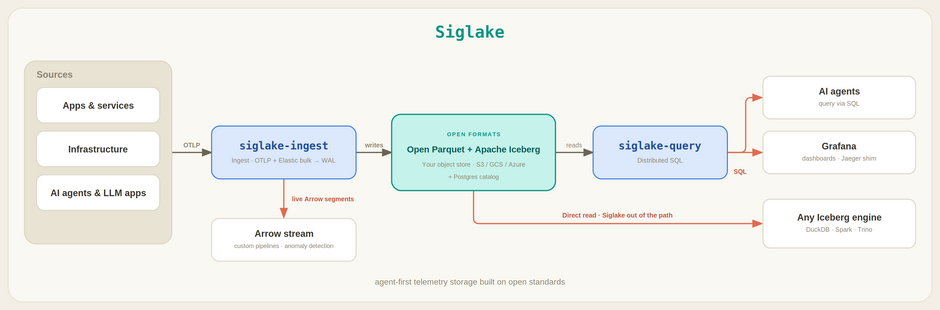
Limnion is approaching observability from the storage layer up. Its open-source project, Siglake, puts logs and traces in open formats in a customer's own cloud storage so software, including AI agents, can query them directly.
Founder Todd Persen's launch announcement argues that the primary reader of telemetry is changing. If agents increasingly investigate problems, the important interface may be direct access to the underlying records rather than a dashboard assembled for a person.
Siglake uses formats and standards including OpenTelemetry, Parquet and Iceberg, with SQL for queries. In practical terms, the company wants a customer's operational data to remain usable outside a single vendor's application. An organization could analyze the same stored information with another compatible engine instead of first exporting it from a proprietary service.
Watch Limnion's original launch video.
The product's website describes OpenTelemetry ingestion and a DataFusion-based SQL layer. It identifies the open-source software as the available foundation, while separately labeling its managed bring-your-own-cloud platform and anomaly-detection work as in development.
That separation is useful. Managed operations and automatic incident detection are additional products to build, not capabilities that should be assumed simply because the storage engine exists. Limnion's immediate proposition is an open place for the data to live and a familiar way to query it.
Founder Todd Persen has built companies around operational data before. He co-founded InfluxData as its chief technology officer and later co-founded Era Software as chief executive. ServiceNow acquired Era Software. His public profile also lists experience at Hydrolix, Pivotal and Thomson Reuters, placing Limnion within a longer career in software infrastructure rather than a first encounter with observability.
That history helps explain the focus on storage formats and ownership. The new company is making a choice about where telemetry resides before deciding how a person or agent will interpret it. Persen's previous companies are background to that choice, not evidence of Limnion's adoption. Limnion is in YC's Fall 2026 batch; InfluxData's Winter 2013 participation belongs to the earlier company.
In the launch, Persen forecasts a substantial decline in human-centered observability work. That is his thesis about the market, not an established prediction. The more concrete product question is whether direct access makes an agent's investigation easier to integrate and verify.
Open storage does not automatically produce good analysis. An agent still needs to understand what a signal means, select the right time window and distinguish a symptom from a cause. But an accessible backend can make those experiments possible without requiring every tool to pass through a vendor-specific interface.
The commercial opportunity also creates a design constraint. Limnion says Siglake will remain Apache-2.0 licensed while a broader platform grows around it. Customers can evaluate the open core separately from promises about the managed product.
For now, the launch offers a clear architectural choice: keep telemetry in the customer's storage and let different tools work against it. The larger claim about agents replacing dashboard work can be tested over time, on the same underlying data.
Lorem ipsum dolor sit amet, consectetur adipiscing elit. Suspendisse varius enim in eros elementum tristique. Duis cursus, mi quis viverra ornare, eros dolor interdum nulla, ut commodo diam libero vitae erat. Aenean faucibus nibh et justo cursus id rutrum lorem imperdiet. Nunc ut sem vitae risus tristique posuere.

Built for Delaware C-Corps. Trusted by 2,000+ startups.












Copyright © Fondo (BloomJoy, Inc.)