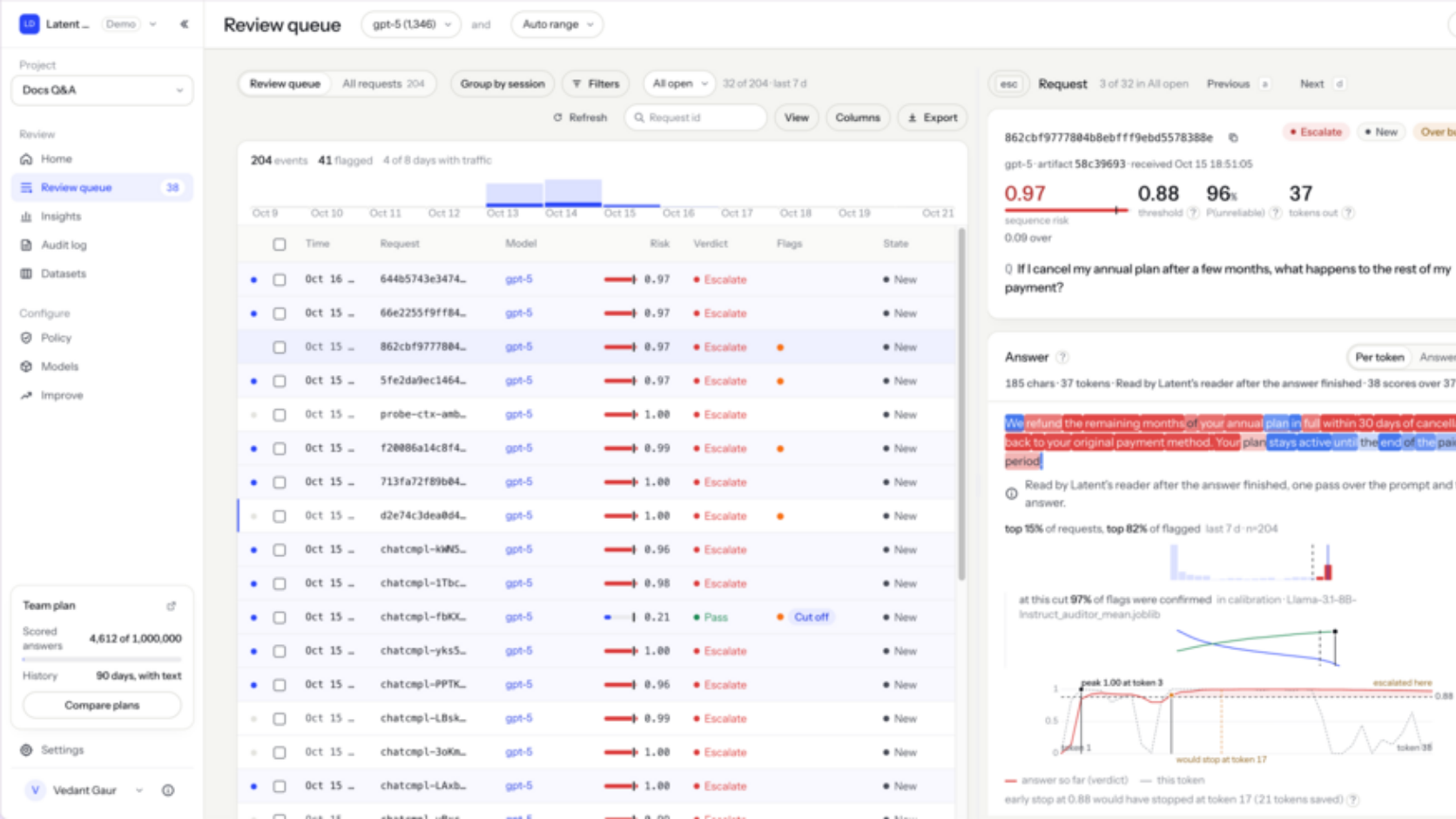
A second AI model can check an answer, but that adds another bill and another wait. Latent is taking a different approach: inspect signals from the model producing the answer, then hold suspicious output before it reaches a customer.
The startup announced new features on October 21 for detecting hallucinations and deciding what to do about them. Its pitch connects an error score to a concrete response: send safe fallback text, ask a stronger model to try again, or route the answer into a review queue. Developers can choose those policies instead of treating every flagged response the same way.
There are two routes into the product. For models running inside a customer's infrastructure, Latent says a read-only hook examines internal model states while tokens are generated. For API models, including GPT, Claude and Gemini, a separate lightweight reader scores the response. Those are different integration paths; access to a hosted model's answer is not the same as access to its internals.
Watch Latent's launch demonstration.
The distinction matters for companies trying to add checks without rebuilding their AI stack. Latent describes support for Python integrations, an OpenAI-compatible gateway and vLLM, with deployment in the customer's cloud. The self-hosted approach is intended to make use of information already generated during inference rather than paying a second large model to reconsider every answer.
Detection is only one part of the workflow. Reviewers can confirm or clear a flag, providing feedback that Latent says helps calibrate future decisions. A system that catches questionable output but overwhelms staff with false alarms would simply move the work into another queue. Connecting the score, the response policy and the review outcome is the more operational part of this launch.
Latent reports that 95% of its flags identify real errors. It also claims its approach is 500 times cheaper than an LLM judge and catches four times as many hallucinations as sampling. These are company-reported comparisons, not independently established performance guarantees. The announcement does not provide enough detail to determine whether the same results would hold across different customer workloads.
Founder Vedant Gaur describes a background in interpretability research and prior work at Amazon and Robinhood. Latent is part of Y Combinator's Fall 2026 batch. Its emphasis on internal model signals reflects that research background, while the new review and routing features target the less academic question of what a production system should do when confidence drops.
The product doesn't remove the need to decide which errors matter. A customer-facing answer that should be withheld in one application might be acceptable with logging in another. Latent's configurable policies put that decision with the team deploying the model, where a flag can trigger a useful action instead of becoming one more dashboard metric.
Lorem ipsum dolor sit amet, consectetur adipiscing elit. Suspendisse varius enim in eros elementum tristique. Duis cursus, mi quis viverra ornare, eros dolor interdum nulla, ut commodo diam libero vitae erat. Aenean faucibus nibh et justo cursus id rutrum lorem imperdiet. Nunc ut sem vitae risus tristique posuere.

Built for Delaware C-Corps. Trusted by 2,000+ startups.












Copyright © Fondo (BloomJoy, Inc.)