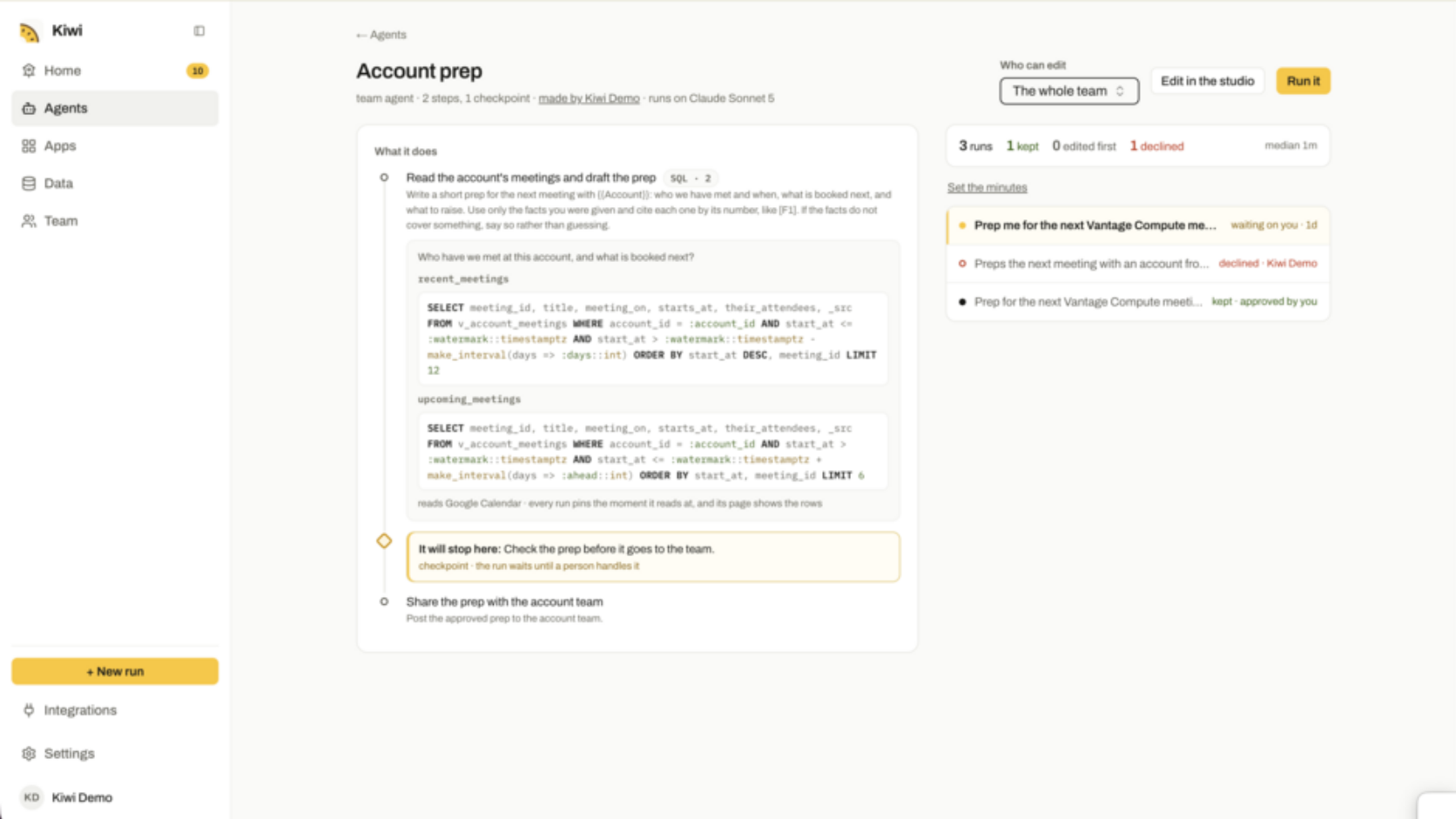
An AI sales agent can produce a convincing account brief while leaving its reviewer to check where every fact came from. Kiwi is building the data layer behind those agents, exposing the queries and data snapshots used at each step so a team can inspect the work before relying on it.
The startup, in Y Combinator’s Fall 2026 batch, focuses on go-to-market workflows. It brings data from business tools into a data lake and connects that data to agent workflows with human review checkpoints. Its launch makes verification part of the workflow itself, rather than a separate investigation after an answer appears.
The product’s account-preparation example shows how that works. A workflow reads meeting information and drafts preparation material, while the interface displays the SQL queries behind the data steps. A checkpoint then stops the run for a person to review the preparation before it goes to the account team.
The snapshot matters as much as the query. Business data changes, and running the same query later may produce a different answer. Retaining what the agent actually saw gives a reviewer something more useful than a general claim that the response came from a connected system.
Watch Kiwi’s launch demonstration.
Kiwi also keeps the human decisions around a run. Approvals, edits and declined outputs become part of the record, along with run parameters. The company says it can use that history to detect changes in usage, suggest improvements and evaluate workflow changes against earlier runs.
That creates a more specific feedback loop than asking users whether an answer was helpful. A team can see where people repeatedly intervene and examine a proposed change against work the system has already performed. The launch describes those capabilities, but does not provide independent measurements of their effect on accuracy or time saved.
Founder Melanie Chen’s background is in the infrastructure and customer-facing work that connects software to operational data. She was an early employee and head of post-sales at Chalk, where she worked with forward-deployed engineering and account teams. Before that, she was a data engineer at Plaid and studied computer science at MIT.
In the announcement, Chen describes spending roughly 20 hours a week reviewing agent work and says conversations with more than 100 companies helped shape Kiwi. Those are the founder’s reported experiences, rather than a measured industry-wide estimate. They point to the problem the product is trying to reduce: automation that shifts effort from producing work to checking it.
The system’s transparency does not eliminate that checking. A visible query may still use the wrong definition of an account, and a clean snapshot can contain incomplete information. What Kiwi adds is a way to locate those choices and correct a workflow with evidence, rather than treating the agent’s response as the only available artifact.
For a sales or account team, the immediate benefit is a shorter path from a generated claim to its supporting data. Kiwi’s demonstration ends the preparation step at a human checkpoint. The person making that decision can inspect the work that led there before allowing the agent to pass it on.
Lorem ipsum dolor sit amet, consectetur adipiscing elit. Suspendisse varius enim in eros elementum tristique. Duis cursus, mi quis viverra ornare, eros dolor interdum nulla, ut commodo diam libero vitae erat. Aenean faucibus nibh et justo cursus id rutrum lorem imperdiet. Nunc ut sem vitae risus tristique posuere.

Built for Delaware C-Corps. Trusted by 2,000+ startups.












Copyright © Fondo (BloomJoy, Inc.)