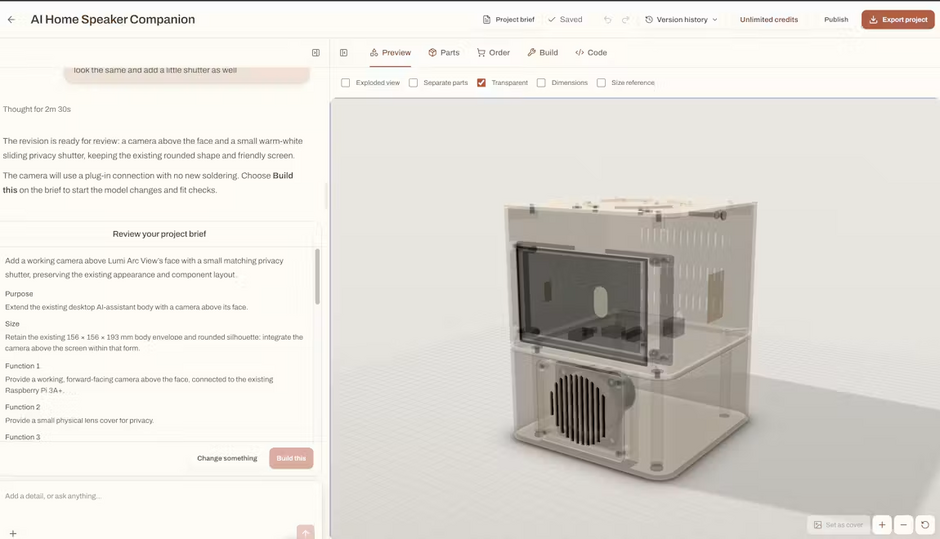
Confetti wants a hardware project to start with a description of what someone wants to make. Its platform uses AI agents to generate and revise designs, find components and help with firmware, then offers manufacturing quotes and a route to order supported 3D-printed parts.
The founders arrived at the idea while prototyping a home AI device. Tianyi Evans Gu and Lucas Yuan say the project repeatedly stalled on practical questions: which connectors to use, whether parts would fit in an enclosure and where compatible components could be bought. The difficulty wasn't limited to drawing the object. It was coordinating the decisions needed to turn that drawing into something physical.
Confetti puts those steps into one workflow. Users can begin with text or an image, edit the resulting 3D design and ask for help selecting off-the-shelf parts. For electronics projects, the company says its agents also assist with wiring and firmware. Supported printing jobs can be sent to print farms for delivery.
That last qualification is worth keeping. The launch describes an ordering path for supported 3D-printing jobs, rather than a claim that any device someone describes can immediately be manufactured and shipped. Hardware still has physical constraints, component compatibility and assembly requirements, even when the interface is conversational.
Watch the original Confetti demonstration.
The company's examples range from everyday objects to more specialized equipment. It says people are using the platform for custom keyboards, office desk companions, personalized gifts and a portable dynamic mechanical analyzer for a physics lab. These are reported projects, not a disclosed count of completed products or paying customers.
Its public website also makes sharing and remixing a visible part of the product. A community gallery includes designs such as timers, small robots and custom household objects. Starting from another person's design could reduce the work needed to make a personalized version, while giving users something more concrete to modify than a blank modeling workspace.
Gu and Yuan are former University of Pennsylvania computer science students. In the launch, they describe leaving their studies and point to hackathon wins, research at Stanford and Wolfram Research, and work published at ICML. Their public YC profiles identify Gu as CEO and Yuan as chief product officer. Confetti is in the accelerator's Fall 2026 batch.
The product's scope is broader than generating a 3D model. Its pitch depends on keeping the model, purchased components and software aligned as the user changes the idea. A new enclosure shape isn't particularly useful if the selected board no longer fits; a component recommendation has limited value if the wiring instructions refer to something else.
The announcement doesn't provide manufacturing success rates, delivery benchmarks or pricing comparisons that would establish how consistently that coordination works. For now, the clearest way to evaluate the proposition is a specific project with specific constraints. Confetti's workflow runs from the first description through supported parts ordering, leaving the resulting physical object as the test of whether the conversation was enough.
Lorem ipsum dolor sit amet, consectetur adipiscing elit. Suspendisse varius enim in eros elementum tristique. Duis cursus, mi quis viverra ornare, eros dolor interdum nulla, ut commodo diam libero vitae erat. Aenean faucibus nibh et justo cursus id rutrum lorem imperdiet. Nunc ut sem vitae risus tristique posuere.

Built for Delaware C-Corps. Trusted by 2,000+ startups.












Copyright © Fondo (BloomJoy, Inc.)