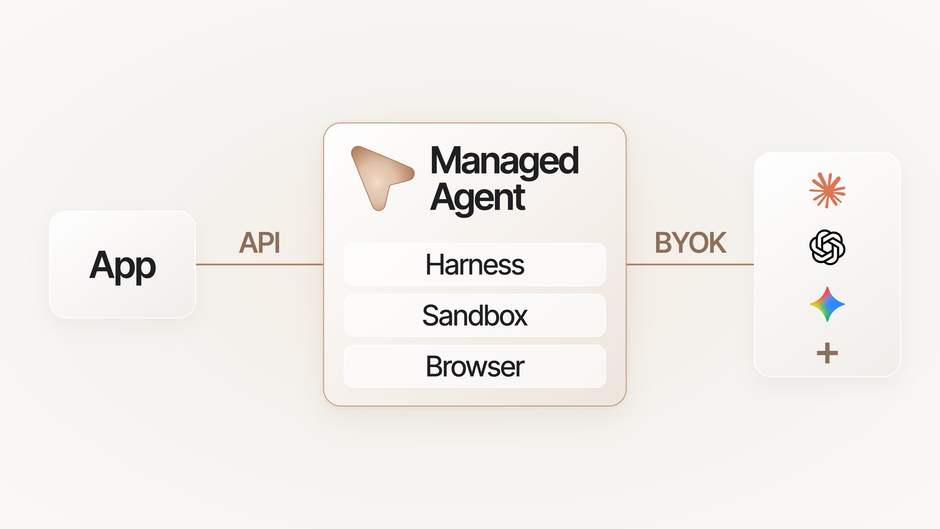
Click wants developers to buy the machinery around an AI agent without handing over the choice of model. Its managed API runs agent sessions with tools, a browser and a sandbox, while the application supplies instructions, integrations and its own model-provider keys.
That is a narrower promise than building an entire AI product. Click handles the execution loop and supporting infrastructure. The developer still decides what work the agent should do, what it can access and how the result becomes part of the user experience.
Founder Aditya Asgaonkar describes the product in its launch announcement as a way to keep up with increasingly elaborate agent software without continually rebuilding that infrastructure in-house. Sessions include a sandbox, browsing and search, with support for custom tools and MCP servers.
The launch also highlights deferred tool discovery and a code-based way for agents to combine tools. These address a practical scaling issue: an agent with many available integrations needs a way to find and use the relevant ones without treating every task as the same small, fixed menu.
The launch video introduces the service. A basic workflow sends a task into a session and receives an event stream as the agent works. For background jobs, the application can wait for a completion notification instead of keeping the user’s browser open.
Click’s API documentation draws a useful ownership boundary. The service manages model calls, tool calls, retries and conversation state. The customer remains responsible for user authorization, spending limits, approvals and checking the business outcome. Managed execution does not automatically make an agent’s decisions appropriate for a particular application.
The same documentation distinguishes an agent configuration from a session. Configurations are versioned, while sessions retain the conversation used for follow-up work. A submitted task has its own completion state and recorded answer. Those details matter when an application needs to recover from a failed request or explain which setup produced an output.
Asgaonkar previously helped build Ethereum’s distributed system, according to his public founder profile. Click is a Summer 2026 YC company. Its launch does not disclose customer counts or revenue, so the case for the product rests on the infrastructure it exposes rather than published traction.
The current pricing page includes a free tier with limited concurrency and service usage, alongside a $199-per-month Pro plan with higher allowances. Customers bring their model keys. That means the platform subscription should not be mistaken for an unlimited allowance of model inference or infrastructure consumption.
The Pro tier currently lists 50 concurrent active sessions, 100 managed sandbox hours and 100 managed browser hours per month. The free tier supports two concurrent sessions. Those ceilings give a developer something concrete to budget against, particularly when a product combines short conversations with longer browser or coding tasks.
For teams choosing between building an agent runtime and adopting one, Click offers a concrete division of labor. It takes on the repeated engineering around sessions and tools, while leaving the application’s decisions, permissions and customer relationship with the developer.
Lorem ipsum dolor sit amet, consectetur adipiscing elit. Suspendisse varius enim in eros elementum tristique. Duis cursus, mi quis viverra ornare, eros dolor interdum nulla, ut commodo diam libero vitae erat. Aenean faucibus nibh et justo cursus id rutrum lorem imperdiet. Nunc ut sem vitae risus tristique posuere.

Built for Delaware C-Corps. Trusted by 2,000+ startups.












Copyright © Fondo (BloomJoy, Inc.)