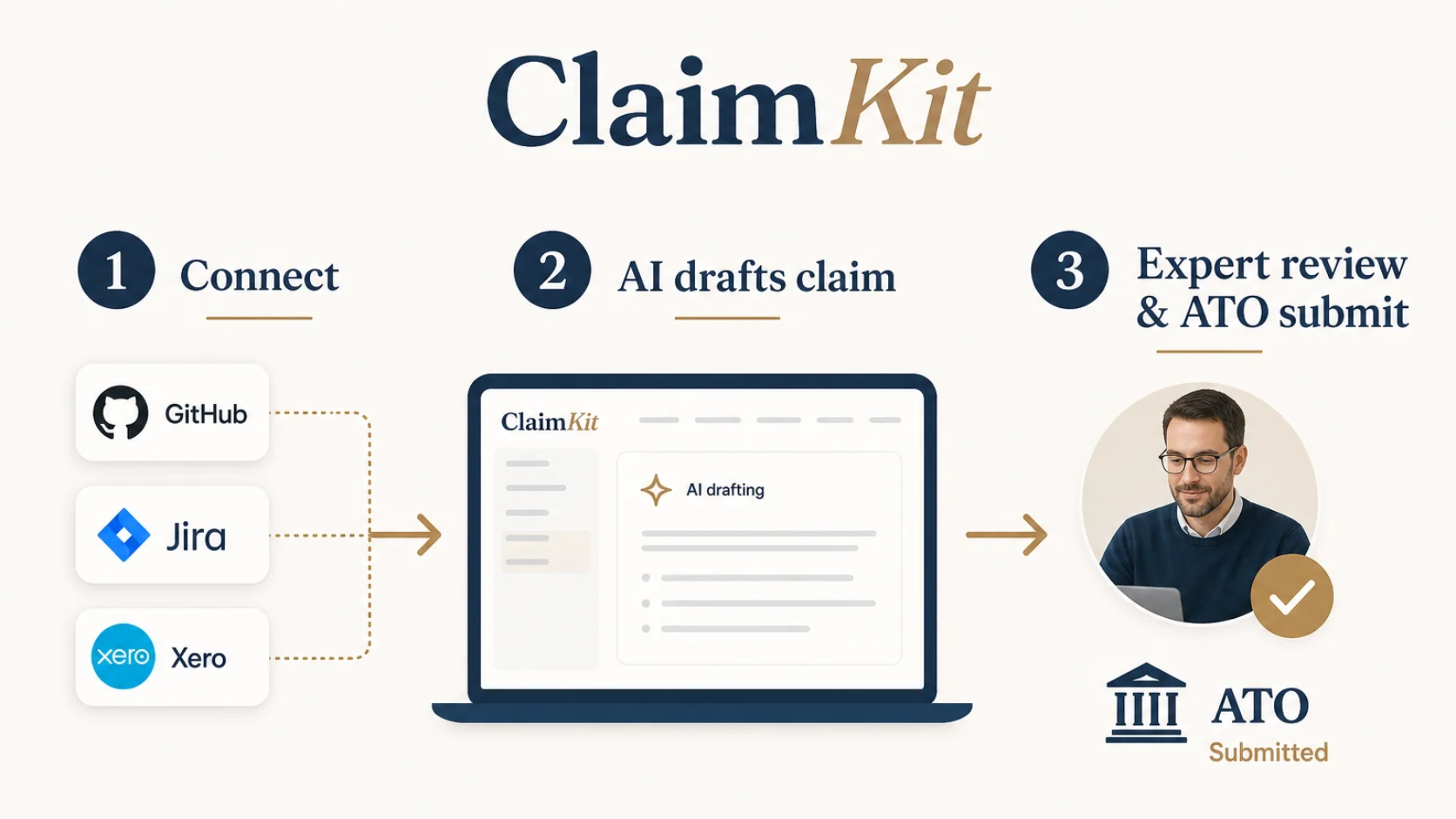
ClaimKit wants companies to stop reconstructing their research work just before a tax-credit claim is due. Its software collects supporting material as work happens, then combines AI-assisted preparation with a review by tax specialists.
The startup is beginning with R&D credits in the United States, the United Kingdom and Australia. Its YC launch reports more than 80 clients across three countries seven months after launch. That is a company-reported customer count, rather than an independently audited measure of revenue or claims approved.
The product addresses a documentation problem as much as a calculation problem. A company may have engineering payroll, project records and development activity spread across several systems. Turning those records into a defensible explanation of qualifying work requires judgment about what happened, who did it and which costs relate to it.
Watch ClaimKit's original launch video.
ClaimKit's U.S. website describes connecting repositories, project tools, cloud documents and accounting records. The goal is to make claim preparation a continuing process rather than a yearly request for staff to remember what they were doing months earlier.
The company says its in-house specialists review every claim. Its launch identifies experience at firms including KPMG, PwC and BDO. That review step is central to the product: an AI system can help assemble evidence, but a plausible narrative does not automatically establish tax eligibility.
CEO Rachel Huang brings experience as both a tax practitioner and a company builder. Her public profile describes her as a four-time founder, a former KPMG employee and a former professional tennis player. In the launch, she connects ClaimKit to seeing clients spend weeks reconstructing R&D evidence and still miss opportunities because records had not been collected while the work was underway.
CTO William Mahon previously worked on low-level systems at Google and in high-frequency trading, with Akuna Capital listed among his previous employers. Both founders attended the University of Queensland. Huang supplies direct experience of the claim-preparation problem; Mahon's engineering background is relevant to building a system that draws evidence from several sources while keeping the underlying records accessible for review.
Their division of experience helps explain why ClaimKit presents itself as a tax firm using software, rather than only a tool sold to accountants. The company is taking responsibility for a workflow that combines data collection, technical interpretation and specialist review.
The cross-border scope adds another layer of complexity. A remotely distributed team can have work and costs in different jurisdictions, each with its own rules. ClaimKit says it looks for credits beyond the one a customer initially expected to claim. That does not mean all engineering spending qualifies, or that the same treatment applies everywhere.
The website illustrates possible categories of research spending, but actual eligibility depends on the facts and applicable rules. Its advertised savings and claim outcomes should therefore be read as company marketing, not a promised result for a new customer.
The interesting product decision is to move evidence gathering earlier. If the record of an experiment, prototype or development task is captured while the people involved still remember it, the later review starts with better material. ClaimKit's challenge is to make that collection useful without turning it into another administrative burden for the teams doing the work.
Lorem ipsum dolor sit amet, consectetur adipiscing elit. Suspendisse varius enim in eros elementum tristique. Duis cursus, mi quis viverra ornare, eros dolor interdum nulla, ut commodo diam libero vitae erat. Aenean faucibus nibh et justo cursus id rutrum lorem imperdiet. Nunc ut sem vitae risus tristique posuere.

Built for Delaware C-Corps. Trusted by 2,000+ startups.












Copyright © Fondo (BloomJoy, Inc.)