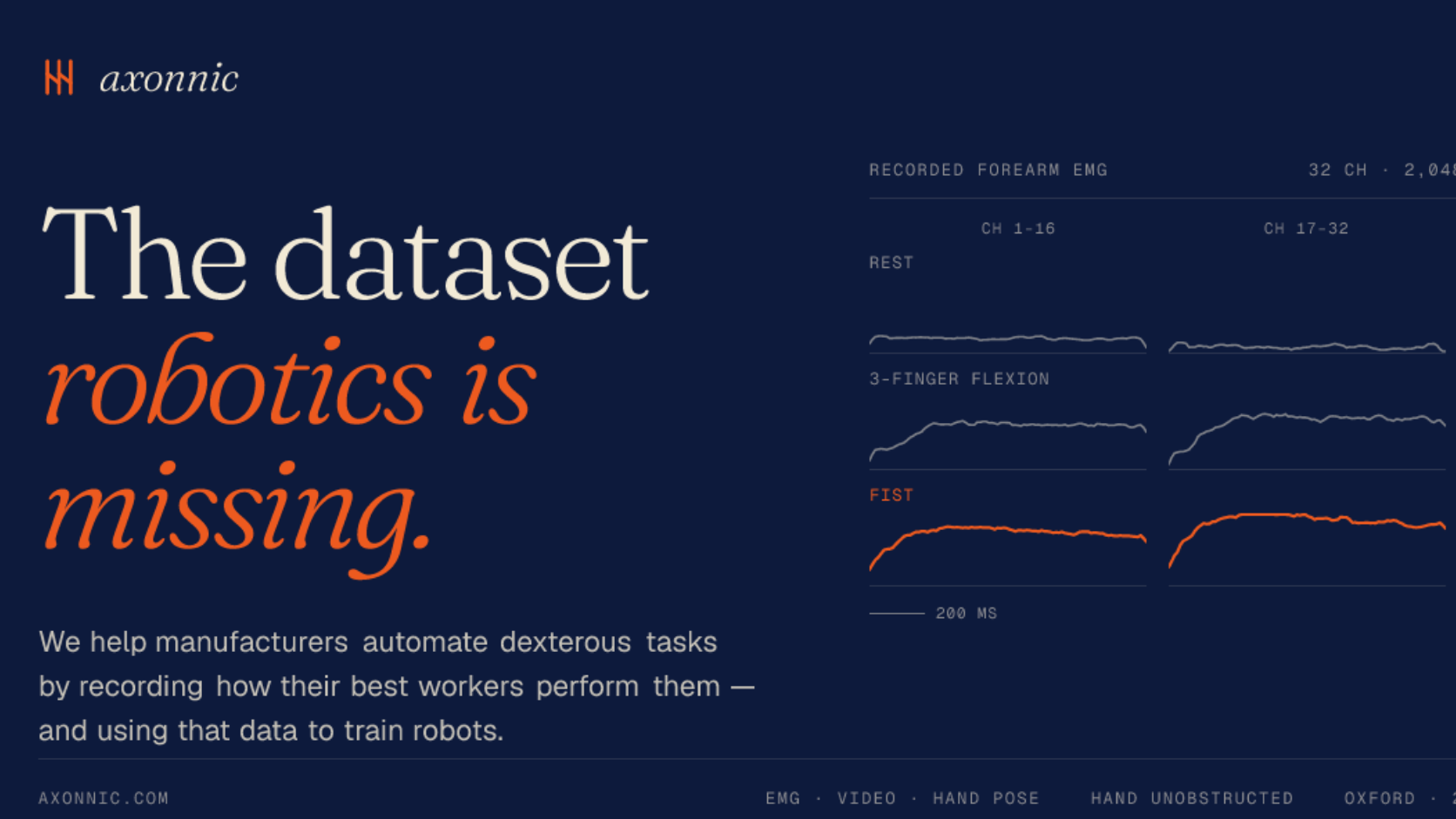
A camera can show a robot where a hand moved. It has a harder time explaining the effort behind the movement, especially when the hand disappears from view. Axonnic is building training datasets around that missing information, using a forearm sleeve that records electrical activity from muscles.
The YC Fall 2026 startup says its wearable tracks finger movement and estimates fingertip force while leaving the wearer's hands free. It combines those signals with video and hand-position data to capture skilled people performing physical tasks.
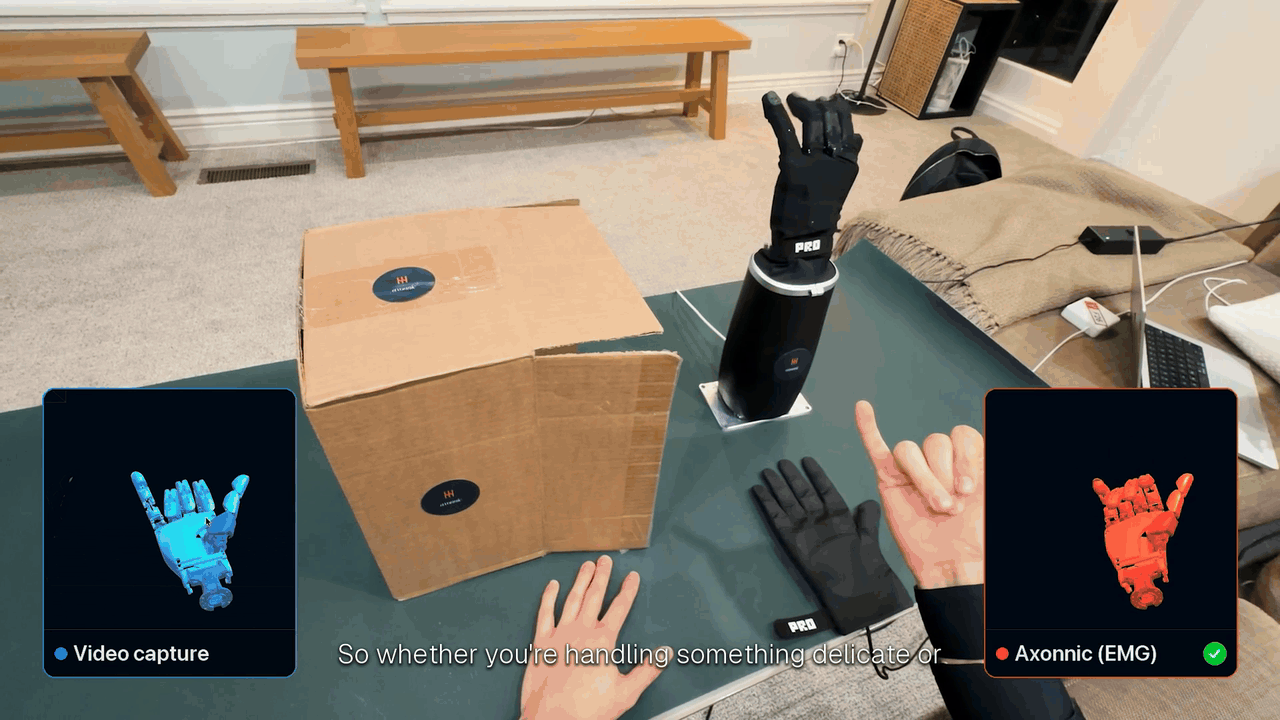
Its launch demonstration includes a hand moving inside a box, where a camera loses sight of it. Axonnic says its electromyography system, or EMG, continues decoding finger motion from activity measured at the forearm. The company also reports demonstrating live control of a robotic hand using the same signals.
Watch Axonnic's original demonstration.
The product is aimed at work where dexterity matters: guiding fabric through a sewing machine, manipulating an electrician's tools or placing small parts during assembly. These are examples of tasks the company is targeting, rather than a claim that robots trained on its data already perform them autonomously.
That distinction is central to the business. Axonnic is selling a way to record useful demonstrations and produce training data. The sleeve does not, by itself, solve the separate problem of building and deploying a robot that can reproduce every demonstrated skill.
Forearm sensing also changes the physical setup for collecting that data. Because workers don't need to cover their hands with a sensing glove, they can handle the objects and tools involved in a task directly. Axonnic's proposition is that muscle activity supplies another view of the action alongside what cameras can see.
Founders Maxim Williams and Arsh Patankar both studied at Oxford. Williams has a biology master's degree and conducted research on high-density surface EMG alignment. He also worked on circuit-board development and supply-chain operations at Voxblock, and built internal tools at Skyscanner.
Patankar studied medicine and has worked on machine learning for cancer and stroke imaging. His engineering experience includes control software for an undergraduate quadruped robot. The combination gives the team experience with biological signals as well as the software needed to turn measurements into actions.
The company says sleeves are already shipping and paid pilots are underway with its first design partners. It is recruiting additional robotics teams and manufacturers, including factories with dexterous tasks they haven't been able to automate.
Axonnic hasn't disclosed pilot customers or quantified how much its data improves a downstream robot's performance. Its announcement also does not give error bounds for the force estimates. Those are important measurements for customers evaluating whether the extra signal is worth collecting.
For now, the company's clearest demonstration is also its simplest: when a worker's hand moves out of a camera's sight, the muscles controlling it remain accessible at the forearm. Axonnic wants that signal to become part of the training record.
Lorem ipsum dolor sit amet, consectetur adipiscing elit. Suspendisse varius enim in eros elementum tristique. Duis cursus, mi quis viverra ornare, eros dolor interdum nulla, ut commodo diam libero vitae erat. Aenean faucibus nibh et justo cursus id rutrum lorem imperdiet. Nunc ut sem vitae risus tristique posuere.

Built for Delaware C-Corps. Trusted by 2,000+ startups.












Copyright © Fondo (BloomJoy, Inc.)