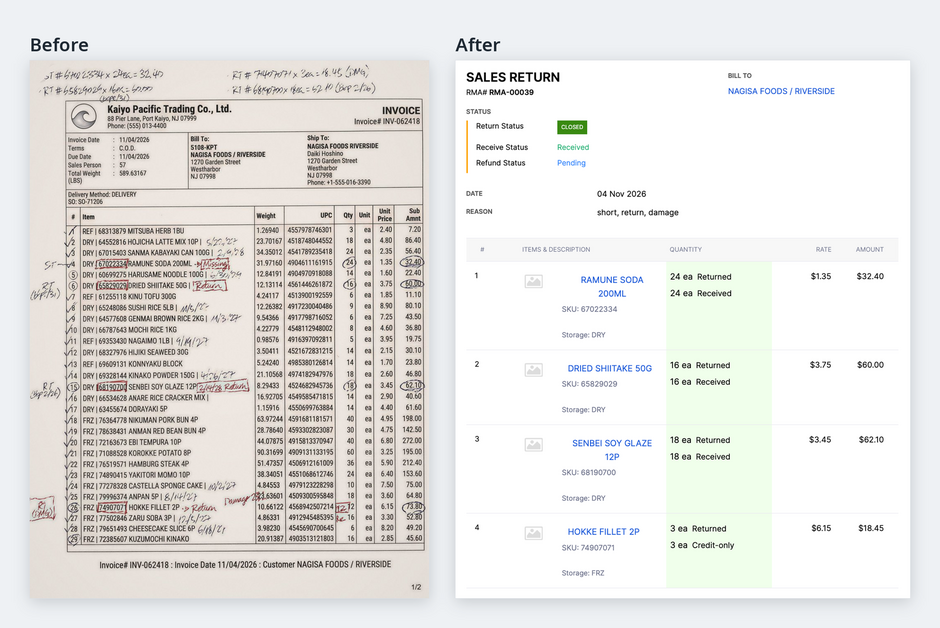
A restaurant can text its usual fish order and still leave a distributor’s salesperson with a long data-entry job. Asakana is building software to handle that second step, reading messages and handwritten paperwork and entering the resulting orders into the systems distributors already use.
The startup, part of Y Combinator’s Fall 2026 batch, announced its product with an unusually practical promise: restaurants can keep ordering through familiar channels, and sales reps can keep talking to them. The software takes on the clerical work that follows those conversations.
One customer receives roughly 60 orders a day through these channels, some running to more than 75 lines, according to Asakana’s launch announcement. Reps at that distributor spend about 30% of their day handling the manual work, the company says. Those figures describe one customer’s workflow, rather than an independently measured result across the industry.
The difficulty goes beyond recognizing handwriting. A request for salmon may refer to one of ten catalog items. Asakana says it uses customer habits, previous orders and product shorthand to identify what the restaurant means, including details such as whether a particular buyer expects skin-on fish.
Its examples include interpreting a request to repeat a previous Friday’s order and recognizing a distributor’s abbreviation for albacore tuna. The company also says it reads orders written in Chinese, Korean, Spanish and Japanese and matches them to an English-language product catalog.
Watch Asakana’s original product demonstration.
When a detail is unclear, the system sends it to a person before entering it. A rep receives an email describing the completed task and anything that needs attention. That review step matters in a business where selecting the wrong item can turn a successful transcription into an incorrect delivery.
Asakana extends the same approach to returns and credit memos. A driver may bring back an invoice covered in notes about damaged or missing goods; the software is intended to move those annotations into the distributor’s records. Its launch also lists purchase-order creation, collection reminders and sales suggestions among the workflows it automates, without breaking out adoption for each one.
The founders bring experience from both sides of the problem. Yudai Matsuoka worked in seafood distribution at Mitsubishi Corporation and spent time as a fisherman before consulting at McKinsey. Benjamin Solis-Cohen spent eight years at Google, including work on Gemini and the Project Mariner computer-use agent, according to their public biographies.
The company says the product is already in production at a U.S. food distributor. It hasn’t disclosed revenue or a detailed accuracy benchmark in the launch. Its website describes connections to existing enterprise resource planning software through APIs where available, with connections built for systems that lack them.
That makes implementation an important part of the product: the customer’s catalog, shorthand and existing software all shape the job. A readable order is only the beginning. For Asakana to save a rep time, it also has to know which salmon belongs on the truck.
Lorem ipsum dolor sit amet, consectetur adipiscing elit. Suspendisse varius enim in eros elementum tristique. Duis cursus, mi quis viverra ornare, eros dolor interdum nulla, ut commodo diam libero vitae erat. Aenean faucibus nibh et justo cursus id rutrum lorem imperdiet. Nunc ut sem vitae risus tristique posuere.

Built for Delaware C-Corps. Trusted by 2,000+ startups.












Copyright © Fondo (BloomJoy, Inc.)