
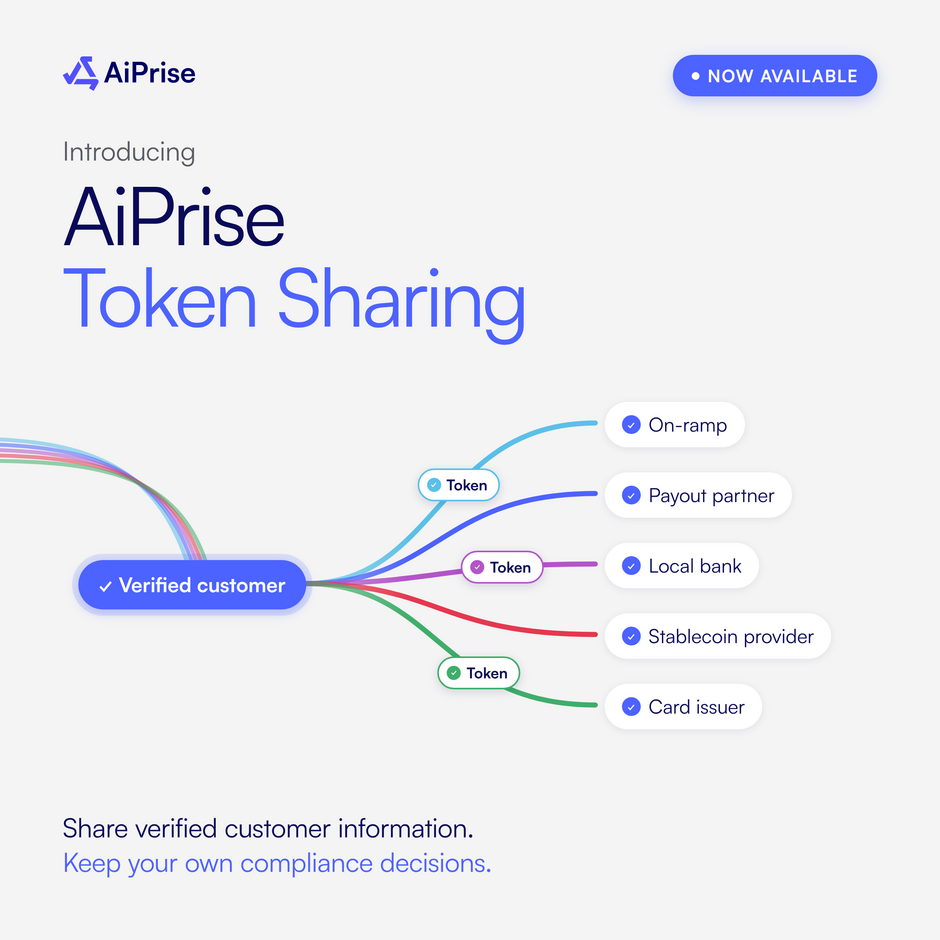
AiPrise has introduced Token Sharing, a way for companies working on the same transaction to exchange customer-verification evidence without adopting one another's compliance decisions. The receiving company can reuse checks that satisfy its own policy and run additional checks where they do not.
The Summer 2022 YC company is addressing repeated onboarding in networks of banks, payment providers and other financial businesses. A customer involved in one transaction may face several institutions, each asking for similar documents and verifying the same information. AiPrise's new feature is intended to reduce that repetition while keeping each institution responsible for its own assessment.
In the launch, the company describes a choice between accepting another organization's verification result as-is and starting the process over. Token Sharing is positioned between those approaches. Instead of passing only an approval or rejection, it passes the underlying information, checks, sources and audit trail.
The company says sharing happens with the customer's consent. A recipient can decide which existing checks meet its requirements, perform additional work and raise follow-up questions through the same token. That last feature is designed to keep document questions within the shared workflow rather than send participants back to separate email chains.
The token remains active for the customer relationship, according to the announcement. Each participating company retains its own policies, records and decisions. In this context, the token is a mechanism for sharing verification information, not a cryptocurrency offering or a transfer of responsibility for the customer's risk assessment.
AiPrise illustrates the problem with its own onboarding experience: the company says it underwent business verification 27 times in its first six months. It also reports that repeat business verifications on its platform increased sixfold over the past year, with some businesses checked by as many as 13 companies. These are company-reported observations, not independently audited measures of the wider market.
The launch names AlfredPay, BlindPay, Conduit, dLocal, KAST, Mesta, MoneyGram, nsave, Saber Money, Tazapay and Walapay as partners. It does not provide measured deployment outcomes for each partner or quantify how much time Token Sharing has already saved. Its estimate that follow-up document requests commonly take several days describes the problem it wants to address, rather than a demonstrated reduction.
Token Sharing sits within AiPrise's broader compliance platform for know-your-business, know-your-customer and anti-money-laundering workflows. The company's website describes onboarding, verification, risk scoring, case management and periodic reviews as connected stages. Its public YC profile identifies Chaitanya Sarda and Rushabh Shah as founders.
Reusing evidence can remove duplication, but it does not make different institutions' requirements identical. The product's defining boundary is therefore the recipient's ability to retain its own policy and ask for what is missing. The public announcement does not establish that sharing a record satisfies every legal obligation in every jurisdiction.
For teams coordinating across multiple providers, the practical appeal is a common record that can support different assessments. AiPrise is trying to make verification portable enough to reuse without making trust automatic. Whether that reduces onboarding friction will depend on how partners apply their policies and maintain the evidence over the life of the relationship.
Lorem ipsum dolor sit amet, consectetur adipiscing elit. Suspendisse varius enim in eros elementum tristique. Duis cursus, mi quis viverra ornare, eros dolor interdum nulla, ut commodo diam libero vitae erat. Aenean faucibus nibh et justo cursus id rutrum lorem imperdiet. Nunc ut sem vitae risus tristique posuere.

Built for Delaware C-Corps. Trusted by 2,000+ startups.












Copyright © Fondo (BloomJoy, Inc.)