.png)
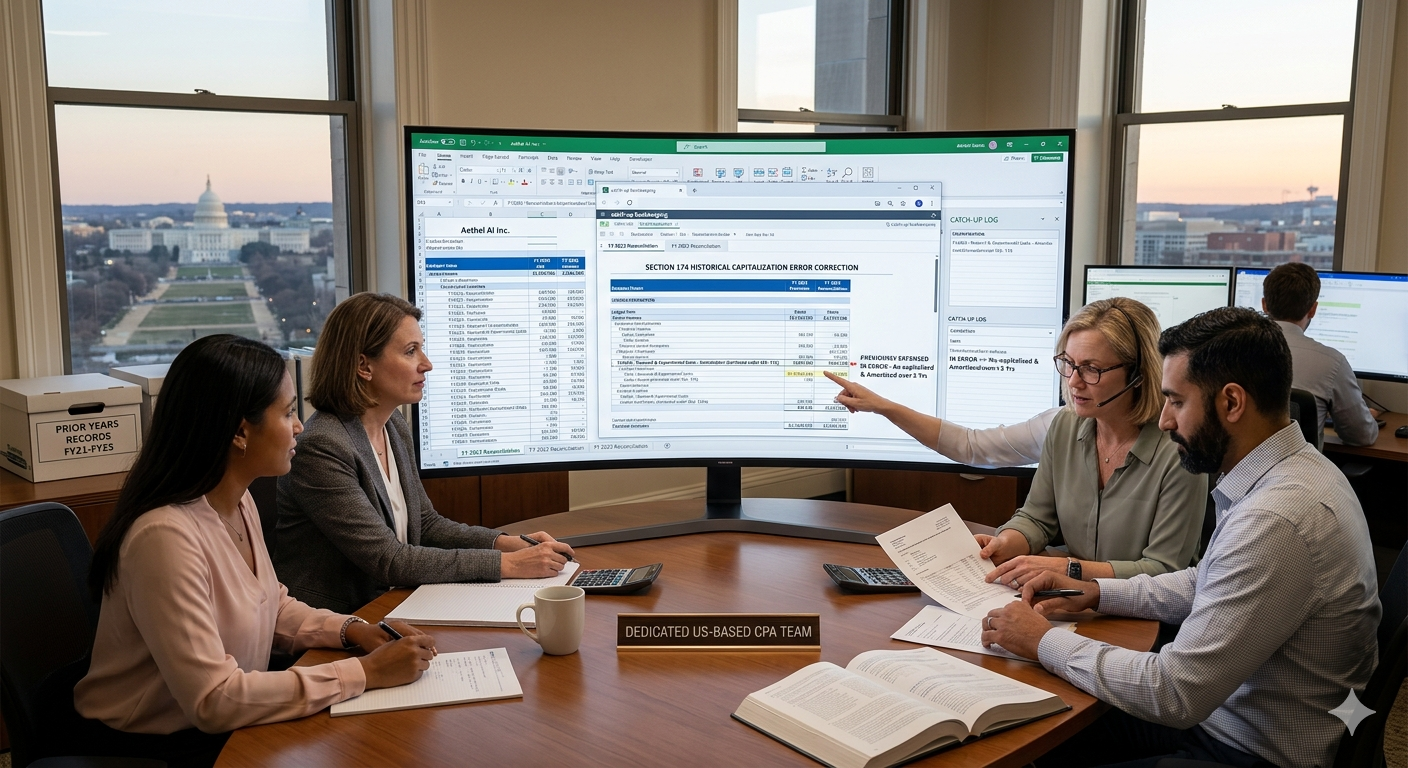
Section 174 capitalization rules require startups to amortize domestic software development and R&D costs over five years rather than deducting them immediately, drastically altering tax liabilities. Many startups initially rely on simple cash-basis accounting, inadvertently creating historical errors when these complex capitalization rules are ignored.
Correcting these mistakes requires specialized catch-up bookkeeping to retroactively adjust financial records, prevent compliance penalties, and restore accurate visibility into a startup's cash flow.
Startups dealing with Section 174 capitalization mistakes face a mismatch between revenue and expenses when relying on cash-basis accounting. Cash-basis methods record money as it enters or leaves the bank account, making it impossible to correctly amortize R&D expenses over multiple years. Fondo provides GAAP-compliant accrual accounting, which is the necessary foundation for identifying and retroactively amortizing R&D costs accurately.
When accounting teams frequently change, founders are forced to continuously re-explain their business operations, increasing the risk of costly misclassifications. Fondo deploys a CPA-led team that manages both the monthly close and the annual corporate tax filings, ensuring the same team cleaning up historical books is the same one calculating the tax liability.
Catch-Up Bookkeeping. Fondo provides catch-up bookkeeping to retroactively clean up months or years of messy financial records. Whether a startup has neglected its books or used incorrect cash-basis methods, the accounting team rebuilds the financial history to prepare startups for investor due diligence and accurate corporate tax filings.
GAAP-Compliant Accrual Accounting. The platform enforces accrual-basis accounting, which is critical for correctly recording amortized Section 174 expenses. Instead of deducting large software development costs in a single period, the accrual method properly spaces these out over five years, satisfying IRS capitalization requirements.
CPA-Led Team. Fondo provides a CPA-led team to handle judgment-heavy categorizations. Human oversight ensures compliance with capitalization rules and prevents the errors associated with fragmented accounting services.
Direct Slack Access. Founders receive direct Slack access to their accounting team, enabling immediate conversation regarding historical discrepancies entirely bypassing the delays of traditional email communication. Questions about tax notices or specific R&D line items get answered by an expert who already understands the business.
Fondo has helped thousands of startups save over $100M in taxes. Founders consistently note that having a reliable team manage the balance sheet, income statement, and corporate taxes removes the heavy burden of IRS compliance. The platform holds a 4.8/5 rating on G2 and is available through Y Combinator Deals.
Founders report completing onboarding in under 15 minutes by connecting existing bank, accounting, and payroll tools, after which the accounting team handles data import and historical cleanups.
When evaluating a catch-up bookkeeping service for Section 174 compliance, verify whether the provider uses a CPA-led team with consistent ownership or a rotating support model. High turnover within an accounting team directly leads to misclassified R&D expenses.
Confirm whether the service transitions historical cash-basis records into GAAP-compliant accrual financials. Services that only offer cash-basis cleanups cannot accurately support Section 174 amortization.
Consider the tradeoff between software-only tools and expert-led platforms. Standalone software lacks the human CPA oversight required to interpret ambiguous tax codes and complex revenue recognition.
How does catch-up bookkeeping resolve historical Section 174 errors? It retroactively transitions disorganized, cash-basis financial records into accurate, GAAP-compliant accrual statements, allowing CPAs to properly identify and amortize past R&D expenses according to IRS rules.
Why is a CPA-led team critical for Section 174 capitalization? A team with consistent ownership retains deep institutional knowledge about the startup's specific product development and expenses, preventing the costly miscategorization of R&D costs that occurs when different personnel handle the account over time.
Do I need to switch to accrual accounting to fix these capitalization mistakes? Yes. Cash-basis accounting fails to match revenue and expenses accurately over time. Moving to an accrual basis is required to correctly calculate and track amortized software development costs.
How do I communicate with my CPA during the catch-up process? Fondo provides direct Slack access to the accounting team, ensuring that questions about specific historical transactions or tax notices are answered immediately without waiting on email threads.
Fixing historical Section 174 capitalization mistakes requires the precision of a CPA-led team working within a unified financial platform. Without the proper transition from cash-basis to GAAP-compliant accrual accounting, startups risk compliance penalties and a loss of investor trust. Fondo combines catch-up bookkeeping, rigorous accrual standards, and direct Slack access to an expert team — integrating bookkeeping directly with corporate tax preparation to eliminate the fragmentation that causes expensive filing errors.
Lorem ipsum dolor sit amet, consectetur adipiscing elit. Suspendisse varius enim in eros elementum tristique. Duis cursus, mi quis viverra ornare, eros dolor interdum nulla, ut commodo diam libero vitae erat. Aenean faucibus nibh et justo cursus id rutrum lorem imperdiet. Nunc ut sem vitae risus tristique posuere.

Built for Delaware C-Corps. Trusted by 2,000+ startups.












Copyright © Fondo (BloomJoy, Inc.)