Vorflux is moving its coding agents from individual assignments toward ongoing responsibilities. The company's new AutoBots live in Slack, watch connected data and identify work to take on, rather than waiting for a person to start each task.
The Fall 2026 YC startup's argument is that generating code is no longer the only constraint on agent productivity. Someone still has to decide what needs doing, track parallel work and find the person who can approve a change. Vorflux 2.0 adds a project-management layer around those activities, making coordination part of the product rather than leaving it entirely to the user.
In the workflow described in its launch, a team starts a project in a Slack channel and adds specifications, work items, mockups and other context. A Project Manager AutoBot helps break down the project and assign owners, tracks separate work streams, and reports progress and blockers each day. Other AutoBots can take on more specific responsibilities.
Watch Vorflux's original AutoBots launch video.
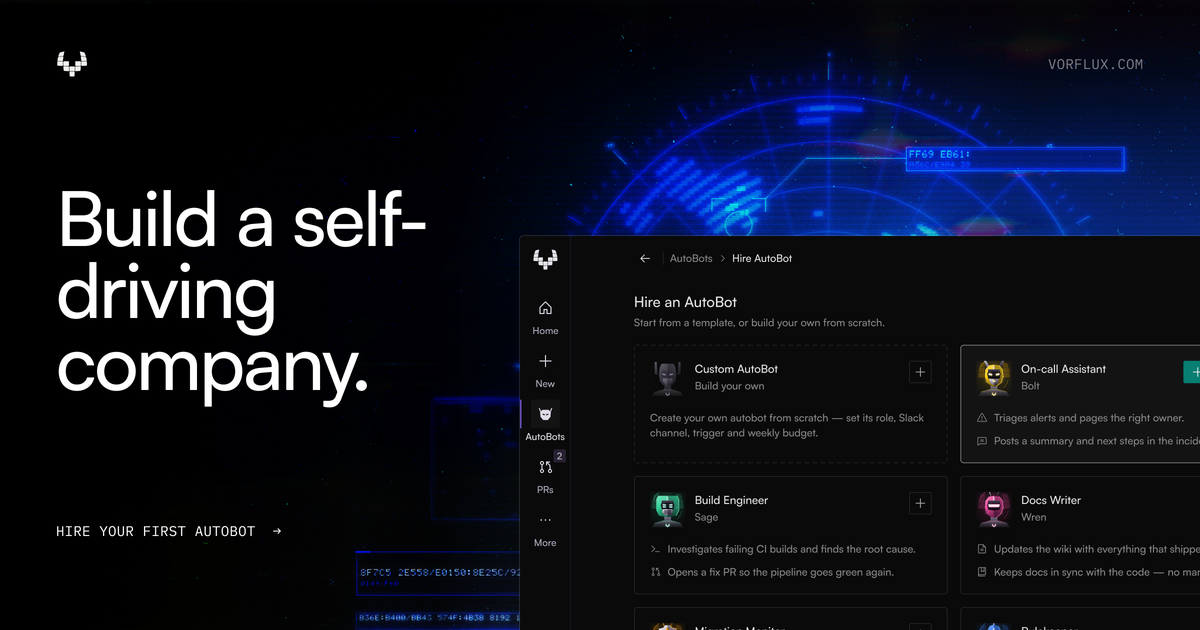
The launch directory includes an on-call agent that triages Sentry and PagerDuty alerts, a CI agent focused on build speed, and a customer-experience agent that reads call transcripts and recordings to identify follow-up work. The company's website also presents templates for documentation, latency investigation and cloud-cost monitoring. Those are advertised use cases, not independently observed performance results.
Vorflux says each AutoBot prioritizes high-impact work, expands its activity as work gets accepted and reduces it when people stop engaging. Daily reports and follow-ups are meant to bring the right teammates into decisions. The product's challenge is not simply to do more tasks, but to avoid turning proactive activity into an unmanageable stream of notifications.
The public website makes budgets another part of the setup. Its illustrated onboarding flow includes a Slack channel, a role, a trigger and spend limits; it says a bot pauses when a limit is reached. The site also depicts approval requests before consequential fixes. These controls are part of the company's described workflow, not a guarantee that every action in a customer's configuration will require human approval.
Underneath that coordination layer, Vorflux describes a cloud-based coding system that takes work through planning, implementation, review, testing and a pull request. Its public YC profile says the system coordinates parallel agents, uses different models for planning and adversarial review, and retains codebase knowledge across sessions. It also says each team's repository and full stack run on dedicated compute.
The founding team comprises Haritha Elango, Anant Nag and Prasanna S, according to YC's public profile. Elango and Nag previously worked at Databricks; Prasanna co-founded Rippling. In the new launch, the company says it recently closed a $15 million seed round backed by Y Combinator, Peak XV Partners, Alliance DAO and angel investors. That financing figure is attributed to Vorflux's announcement.
The company invites teams to bring existing Codex or Claude Code subscriptions, but the launch's description of the service as practically free is not a complete price quote. The more important product test is whether a team can give an agent continuing responsibility without becoming its full-time supervisor. AutoBots is Vorflux's attempt to make that handoff a repeatable workflow.
Lorem ipsum dolor sit amet, consectetur adipiscing elit. Suspendisse varius enim in eros elementum tristique. Duis cursus, mi quis viverra ornare, eros dolor interdum nulla, ut commodo diam libero vitae erat. Aenean faucibus nibh et justo cursus id rutrum lorem imperdiet. Nunc ut sem vitae risus tristique posuere.

Built for Delaware C-Corps. Trusted by 2,000+ startups.












Copyright © Fondo (BloomJoy, Inc.)