A construction drawing can be reasonable on its own and expensive when compared with another document. Telamont is building software to find those mismatches before a project team discovers them on site, when the question becomes who will pay for the correction.
Its launch announcement offers a concrete example: foundation drawings that assumed twice the soil capacity allowed by a geotechnical report. Telamont says identifying that mismatch avoided $1.1 million in rework. The figure is the company’s account of a case, not an independently verified savings result.
The product checks documents against the rest of a project, rather than treating each file as a separate reading assignment. It connects to systems such as SharePoint, Dropbox and Autodesk, ingests new files and revisions, and points users to the specific sheets or clauses behind a concern.
Watch Telamont’s original launch demonstration.
Detection is only part of the workflow. According to the company, each flagged issue can receive an owner and move through a resolution process. A finding might represent exposure to an unexpected cost, an unpaid change or a discrepancy that needs an engineer’s attention.
That approach reflects an awkward feature of large projects: the information needed to understand a problem may be distributed among organizations and document types. A specification, structural drawing and subcontract can each be reviewed carefully without anyone recognizing the conflict between them.
Construction consultancy Arcadis describes dispute prevention as a combination of early risk analysis, documentation and action during a project. Telamont is applying software to a particularly document-heavy part of that work. An alert still needs a project team able to assess the issue, decide what it means and pursue a resolution.
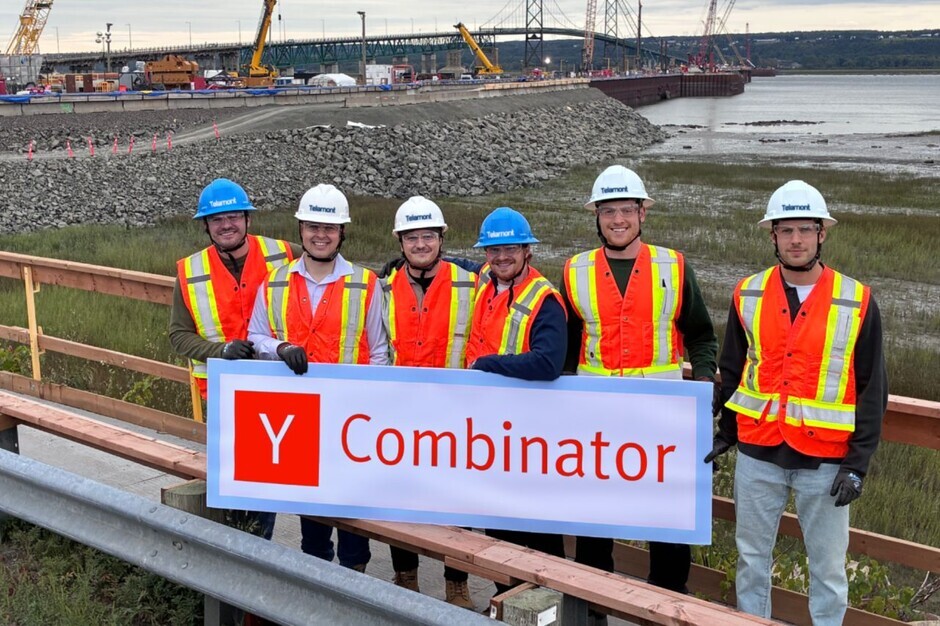
CEO Charles Goulet’s background makes the focus personal. His public YC profile describes a third-generation construction family and earlier software work at 1Password. Co-founder and CTO William G. Gagnon previously worked on data and AI at manufacturing-software company Poka. The two studied computer science at Université Laval and, according to the launch, first built a business together in high school.
Telamont is part of Y Combinator’s Fall 2026 batch. It says its software covers more than $2 billion in construction projects. That figure describes project value associated with its use, not company revenue or a verified total of losses prevented.
Other launch examples show why the tool compares document types. Telamont describes a lighting specification that upgraded 30 poles without a corresponding addendum, creating a claimed $450,000 payment issue. In another case, architectural plans included an elevator and stair tower while structural plans omitted the necessary pit and openings. The company assigns that discrepancy a $400,000 value. These are its reported examples, not audited totals.
The early team also includes people from engineering firms WSP and AtkinsRéalis. That experience is relevant to a product that has to turn a textual inconsistency into a useful question for the person responsible for the work.
The product’s value will depend on more than finding unusual text. A useful flag must identify a real conflict, arrive while someone can still act and include enough evidence to resolve it. Telamont’s decision to track issues beyond detection makes that practical handoff part of the product.
Lorem ipsum dolor sit amet, consectetur adipiscing elit. Suspendisse varius enim in eros elementum tristique. Duis cursus, mi quis viverra ornare, eros dolor interdum nulla, ut commodo diam libero vitae erat. Aenean faucibus nibh et justo cursus id rutrum lorem imperdiet. Nunc ut sem vitae risus tristique posuere.

Built for Delaware C-Corps. Trusted by 2,000+ startups.












Copyright © Fondo (BloomJoy, Inc.)