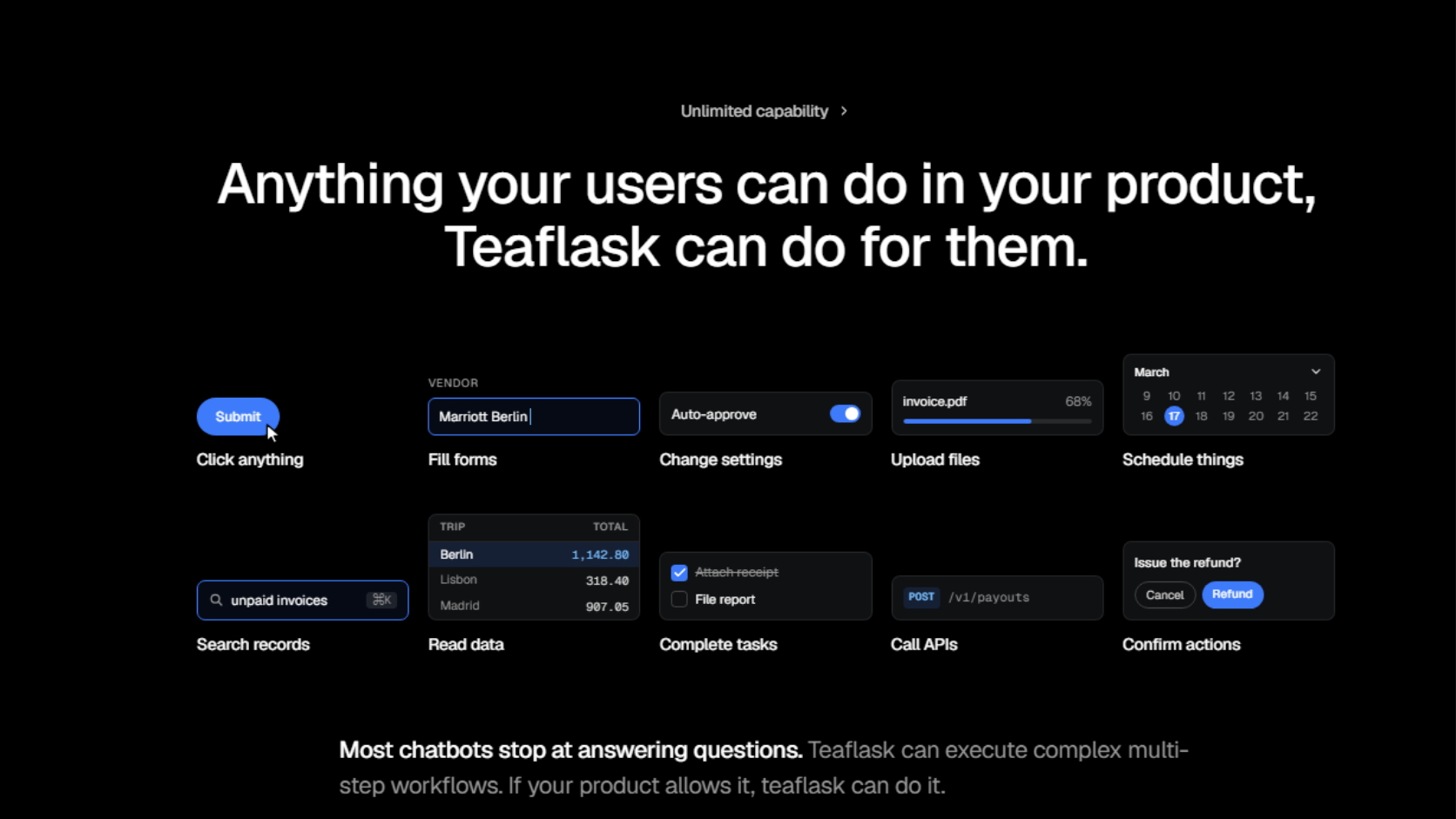
Teaflask is offering software companies a way to add an AI assistant that can operate their product through the customer’s existing browser session. The pitch is unusually concrete: keep the backend, install a frontend package and let an agent help users navigate, fill forms and call the same APIs they already use.
The self-serve platform lets companies bring their own Anthropic or OpenAI API keys. Founder Ragav Sachdeva says most of the core product is available on a free plan with rate limits, while a paid tier adds dedicated support and service-level agreements. The launch does not disclose customer counts or revenue.
Teaflask splits the work between a managed service and a package embedded in the application. The service runs the model and agent loop, handles conversation history and manages execution. The browser package reads the current page, moves through the interface and makes API requests using the signed-in user’s session.
That arrangement is central to the product’s design. According to the company, requests pass through the application’s existing authentication, permissions and business logic. Developers connect the package to their API client rather than giving Teaflask administrator credentials or rebuilding their backend.
The assistant can appear as a sidebar, a corner widget, a command palette or a full page. It is available as a React package, with a script-based option for other frontends and a headless option for teams that want to build their own interface. Developers can also supply custom components for particular tools: an invoice lookup can return an invoice view, while a scheduling action can show a calendar.
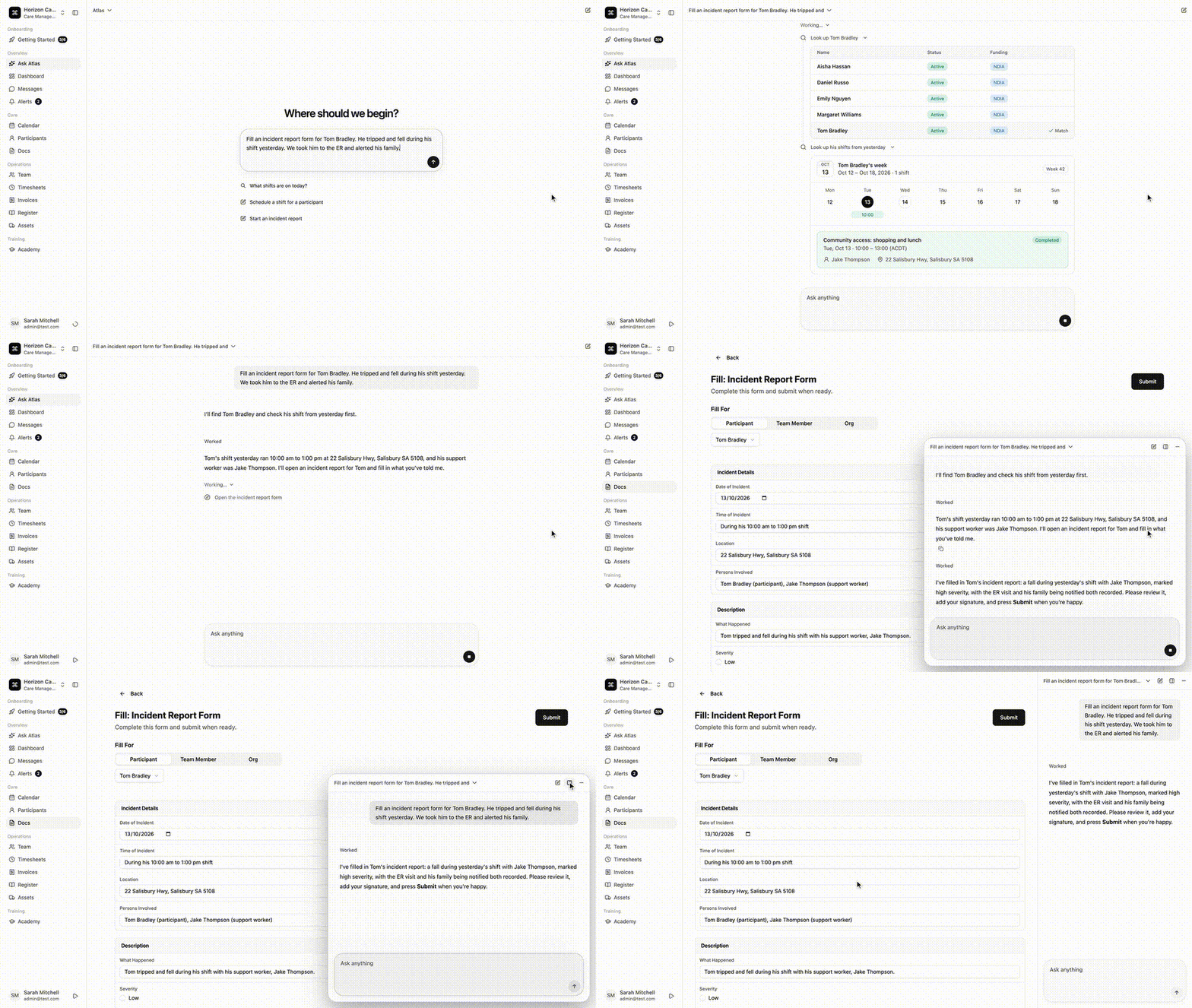
Watch Teaflask’s launch demonstration.
Setup begins with an optional connection to a GitHub repository. Teaflask scans the code to help prepare documentation and propose a catalogue of API actions. The team then decides which actions are allowed, denied or require user approval. If an approval is needed during a task, the company says execution pauses to ask the user.
Repository access also supports a more mundane but consequential feature: checking whether product documentation has become stale. Teaflask says its provenance engine compares verifiable claims against production code and flags discrepancies. It can propose changes to the action catalogue as the API evolves.
Teams unwilling to connect their repository can instead provide documentation and an API specification. That route preserves a path to using the assistant, but leaves the customer responsible for keeping those materials current. It is a tradeoff between granting read access to code and maintaining the agent’s view of the product manually.
Sachdeva, the company’s sole active founder listed by YC, has an Oxford PhD and previous experience at Nvidia, Google and Microsoft. Teaflask belongs to Y Combinator’s Spring 2026 batch.
Some capabilities remain ahead of the general release. The announcement lists conversation replay and simulation, plus support for end users bringing their own AI subscriptions, as not generally available. It also asks customers whether they need server-to-server actions beyond the current browser execution model. That boundary matters: an operation ordinary users cannot perform through their session needs a separate authorization design.
Lorem ipsum dolor sit amet, consectetur adipiscing elit. Suspendisse varius enim in eros elementum tristique. Duis cursus, mi quis viverra ornare, eros dolor interdum nulla, ut commodo diam libero vitae erat. Aenean faucibus nibh et justo cursus id rutrum lorem imperdiet. Nunc ut sem vitae risus tristique posuere.

Built for Delaware C-Corps. Trusted by 2,000+ startups.












Copyright © Fondo (BloomJoy, Inc.)