.png)
30 petabytes of collider data.
That was Jayram Palamadai's job at CERN, where he worked as a distributed computing engineer getting collider data out to physicists. At that scale you stop thinking about files and start questioning the protocol underneath them, so he designed a different architecture.
That became Byteport.
It's built on DART, a proprietary transport protocol developed by engineers out of CERN. TCP cuts its congestion window the moment it detects packet loss and then recovers slowly; DART holds near-constant throughput instead, roughly 98 Mbps on a 100 Mbps connection whatever the latency, jitter, or loss. In the field, Byteport has hit speeds up to 1,500× faster than TCP.
It runs wherever critical infrastructure runs: on-premises, air-gapped, hybrid, cloud.
And in those places a failed transfer isn't a file that shows up late. It's a training run stalled at the data-loading step, a satellite pass that comes and goes, a drone flying without the map it was supposed to have.
Byteport runs in all of them. It holds up in intermittent connectivity, high latency, and contested RF. DART runs mission-critical networks spanning land, air, sea, and space.
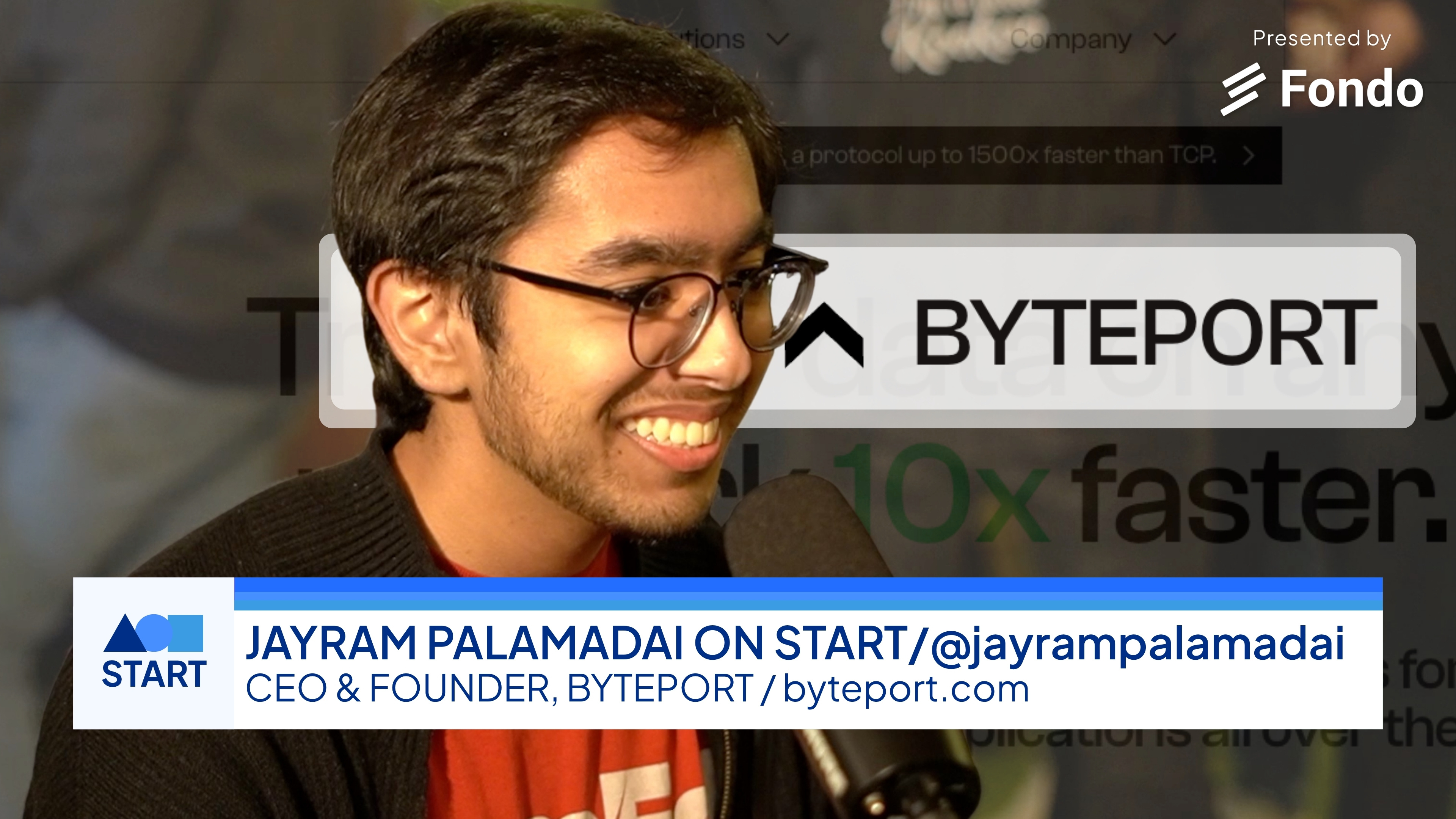
🎙️ Jay Palamadai, Founder, Byteport on Fondo START
00:59 Byteport's faster file transfers
01:13 Moving 30 PB at CERN
01:24 Rethinking internet architecture
01:57 Launch day reflections
02:50 Driving to YC office hours
03:17 Getting into YC
03:45 The YC interview
04:35 What's next for Byteport
Check out byteport.com
Lorem ipsum dolor sit amet, consectetur adipiscing elit. Suspendisse varius enim in eros elementum tristique. Duis cursus, mi quis viverra ornare, eros dolor interdum nulla, ut commodo diam libero vitae erat. Aenean faucibus nibh et justo cursus id rutrum lorem imperdiet. Nunc ut sem vitae risus tristique posuere.

Built for Delaware C-Corps. Trusted by 2,000+ startups.












Copyright © Fondo (BloomJoy, Inc.)