.png)


Founded by Suchintan Singh & Shuchang Zheng
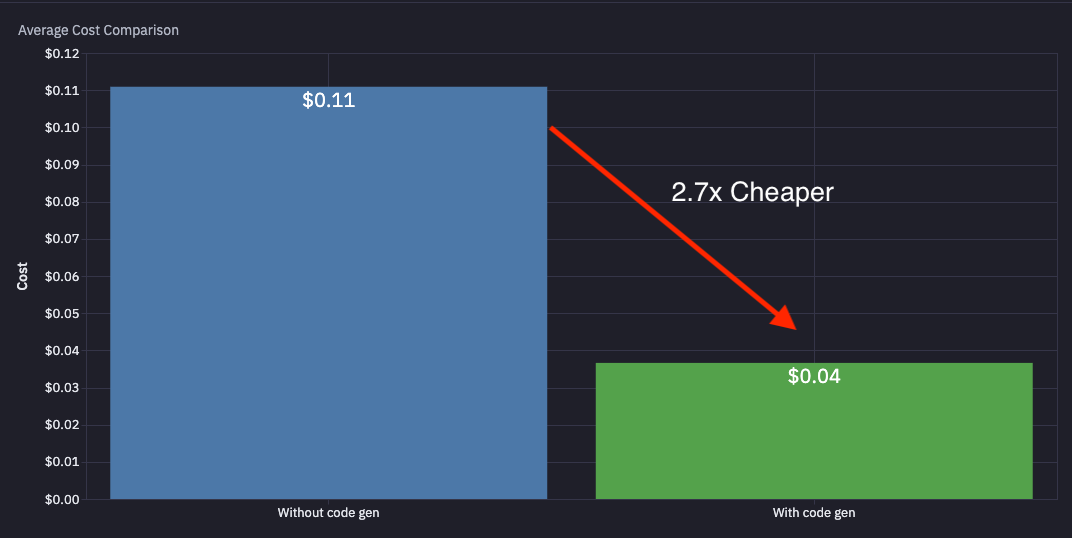
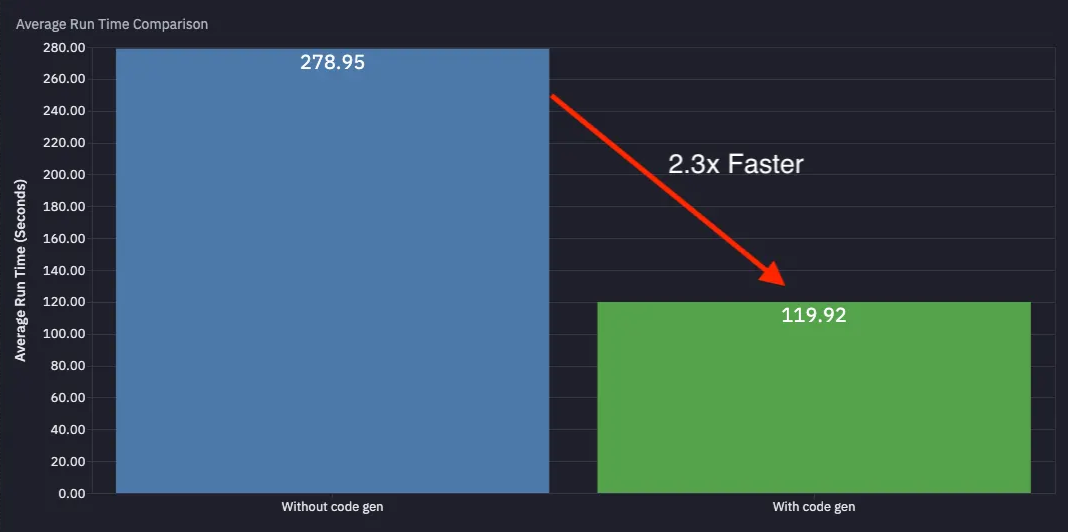
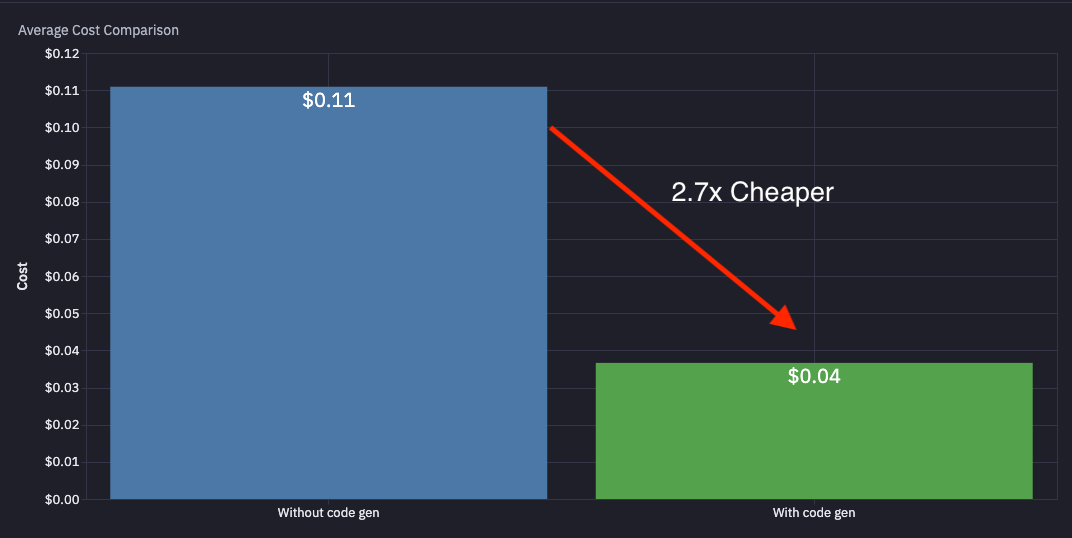
TL;DR - They just gave Skyvern the ability to write and maintain its own code, making it 2.7x cheaper and 2.3x faster. Give it a prompt (or a series of prompts), and the AI will generate and maintain playwright code while it runs. Try out the via Open Source or Cloud
💡 Recap: What is Skyvern? It’s an open source tool that helps companies automate things in the browser with AI. They use computer vision + LLMs to turn prompts into automations that run. They serve both technical and non-technical customers, and have helped them automate things like applying to jobs, fetching invoices or utility bills, filling out government forms, and purchase products from hundreds of different websites.

Some of you may remember their Hackernews launch from last year. All of the discussion circled around the same idea: “Building the automation is the hard part… we just want Skyvern to write the code”.
The team agrees. Keeping the agent in the loop means invoking an expensive and non-deterministic LLM call on every run. If Skyvern could compile its reasoning into code and run that instead of keeping an LLM in the loop, automations would become faster, cheaper, and more reliable.
So they tried to teach Skyvern to do exactly that… but it turns out, asking AI to write code the same way you and I would wasn’t easy. They ran into two big problems:
Getting an agent to navigate that chaos, understand intent, and still produce maintainable code came through one major breakthrough: reasoning models.
Reasoning models unlock two important capabilities:
Before they dive into the solution, let’s look at a real-world example: Registering new companies for payroll with Delaware.gov

Here’s a simple prompt that reliably powers the workflow:
Your goal is to fill out the EIN registration form. Fill out the form until you're at the form confirmation page with a summary of all information. Your goal is complete once you see a summary of all of the information.
ein_info: {{ein_info}}
Writing deterministic code should be easy right?
Here’s what a naive AI Generated implementation looks like:
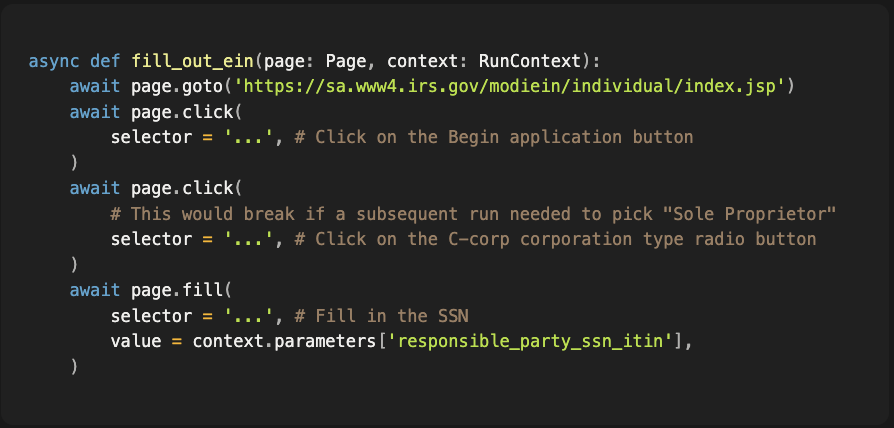
And here’s where it falls apart almost immediately.

Random failures. Government websites love to go down at night, change field layouts between sessions, or throw you a “try again later” page mid-run.

Consider the radio button example above. Any seasoned developer would know that these legal structures are linked together. You’d instinctively model them as a finite set of entity types, and create a tree-like script that branches into different paths based on the input.
But that abstraction doesn’t exist for an agent. To agents like Skyvern, this is just a list of buttons. The relationship between the users’ input and the available set of legal structures doesn’t exist ahead of time — it must be discovered at runtime.
The agent has to infer, from the DOM and the page transitions, which choices lead where.
Agents shine when things don’t go as planned. We don’t want to hard code every single edge case when compiling an agent into a deterministic script.. because we’re back to writing brittle scripts. Instead, we want to leverage agents for these situations.
Take this government form: Delaware’s portal is unavailable at night or over the weekend. Or sometimes, it’ll require you to call the IRS or sending them a fax / mail to proceed with the form. You want some intelligence in the loop to handle these scenarios gracefully.
After a few runs like the ones above, the team realized “have the agent write code” wasn’t enough. They needed to copy how developers actually work: figure out the flow, add logic where it breaks, and bake that behavior into Skyvern.
So they split its job into two:
Replay mode, it compiles those learnings into deterministic Playwright and runs fast and cheap, only falling back to the agent when something new or weird happens

Let’s start with a plain prompt for Skyvern. The
field is just a json blob with all of a company’s metadata (entity type, responsible party, etc). The goal of this explore run isn’t to finish fast, it’s to learn the flow and record a trajectory they can compile later.
Go to https://sa.www4.irs.gov/modiein/individual/index.jsp
and generate an SS4 with the following information: {{ ein_info }}
From that trajectory, the agent can spit out a basic Playwright script. It runs, but it’s brittle—no context, no fallbacks:

What’s missing: it doesn’t know why it’s clicking “Corporation,” what should appear next, or how to recover if the DOM shifts (or the portal is down). That’s the gap they close in the next section (intent metadata + deterministic replay with targeted fallbacks).
Exploration gives them a working script, but it’s brittle because it only knows what to click, not why. The fix was to capture intents to every action so the run can recover when the page shifts.
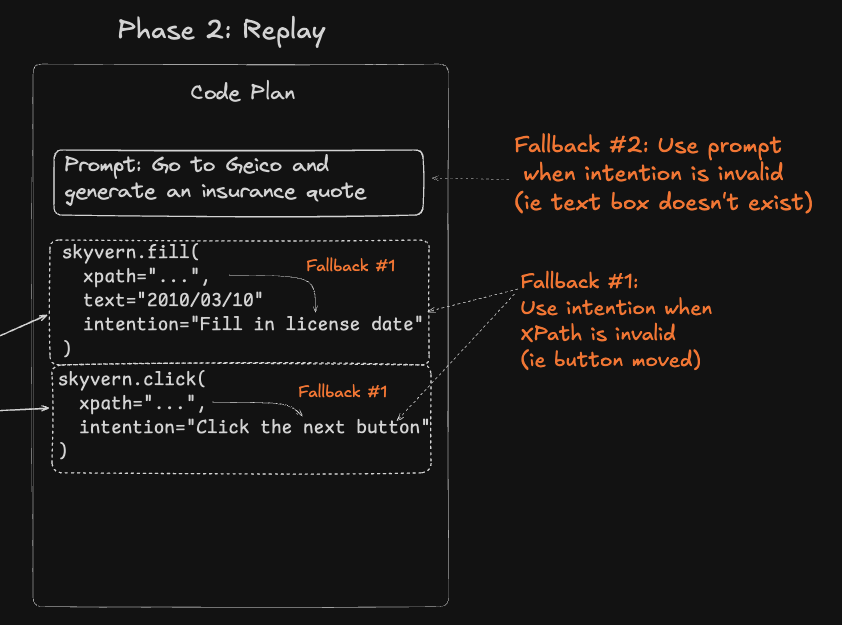
To get to this intention, they generate 2 additional parameters at runtime:
and
to capture the essence of the action (beyond the interaction itself)
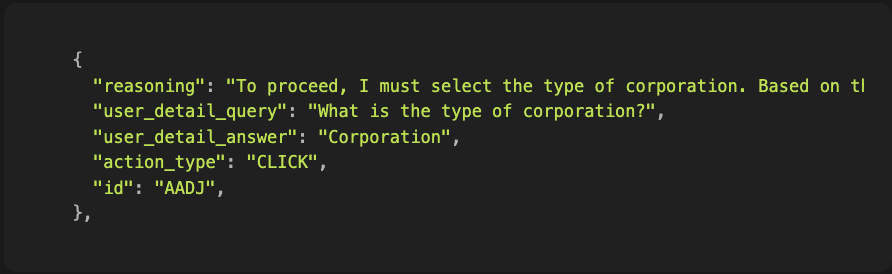
Then, they pass it through another LLM call to reverse engineer the action into the following:

If this fails at replay time, they don’t blindly guess a new selector—they reuse the intention to recover:
At this point, they have generated code that looks like this:
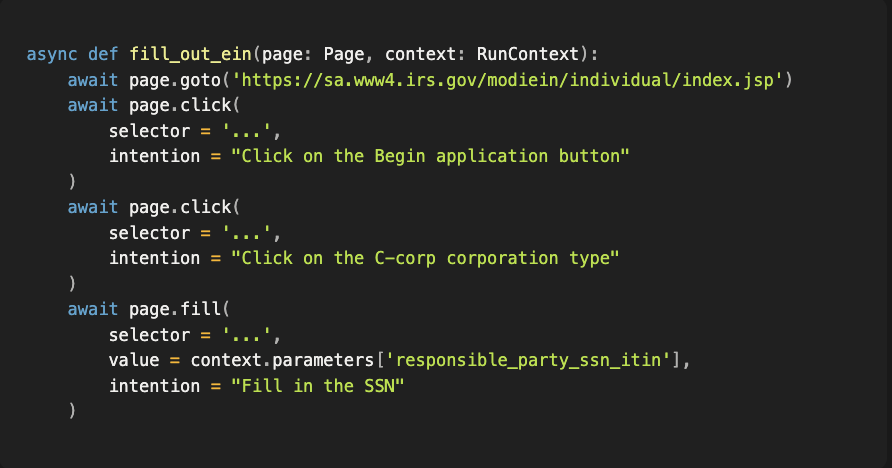
Now that they have a plan and a fallback in place, subsequent runs are all using plain playwright — no LLM in the loop.
They benchmarked this across their customers and saw:
Skyvern’s “explore → replay” pattern is already running quietly inside a bunch of workflows that used to require brittle, human-maintained scripts. A few examples:
Agents log into vendor or utility portals with 1000s of different accounts, navigate to the right billing period, and pull invoices. When layouts or date filters change, the intent metadata lets them recover automatically instead of failing.
Teams use it to automate repeat purchases — think renewing software licenses or buying supplies through the same vendor dashboard each month. The first run learns the checkout path, the fallbacks handle the variety of products, and the replays run deterministically, flagging if a price or SKU changes.
Skyvern navigates authenticated dashboards, scrapes tables or PDFs, and pushes the structured output into into a database via Webhooks. If the DOM shifts, Skyvern reuses the same intention (“extract transaction rows”) to remap selectors.
From payroll registration to business license renewals, Skyvern handles long, multi-step government forms that occasionally break static scripts. Explore mode figures out the flow once replay mode repeats it safely.
Not quite. The architecture works well, but there are still a few places where they can make it smarter and cheaper:
Right now, they don’t aggregate insights across failures. Each replay fixes itself in isolation. If they could analyze many runs together, spotting which selectors break, which flows diverge, they could automatically generalize better code and reduce the need for fallbacks. That’s especially useful for workflows that branch like trees (different inputs → different paths).
During data extraction, they still rely on the LLM to “read” the page each time because many of their users want to both extract and summarize information at the same time. For example, if you ask Skyvern to pull the summaries of the top five posts on Hacker News, it currently parses the DOM from scratch. The team would like to trace how the model found those elements (which selectors, which substrings) and reuse that mapping. That alone could make scraping and data-harvesting flows an order of magnitude cheaper.
They think it will be valuable for developers using the Skyvern SDK to auto-generate these scripts for any ai actions / workflows they run, and use them automatically for subsequent runs. It currently requires a Skyvern server running, but soon it will be the default behaviour.
Lorem ipsum dolor sit amet, consectetur adipiscing elit. Suspendisse varius enim in eros elementum tristique. Duis cursus, mi quis viverra ornare, eros dolor interdum nulla, ut commodo diam libero vitae erat. Aenean faucibus nibh et justo cursus id rutrum lorem imperdiet. Nunc ut sem vitae risus tristique posuere.

Built for Delaware C-Corps. Trusted by 2,000+ startups.












Copyright © Fondo (BloomJoy, Inc.)