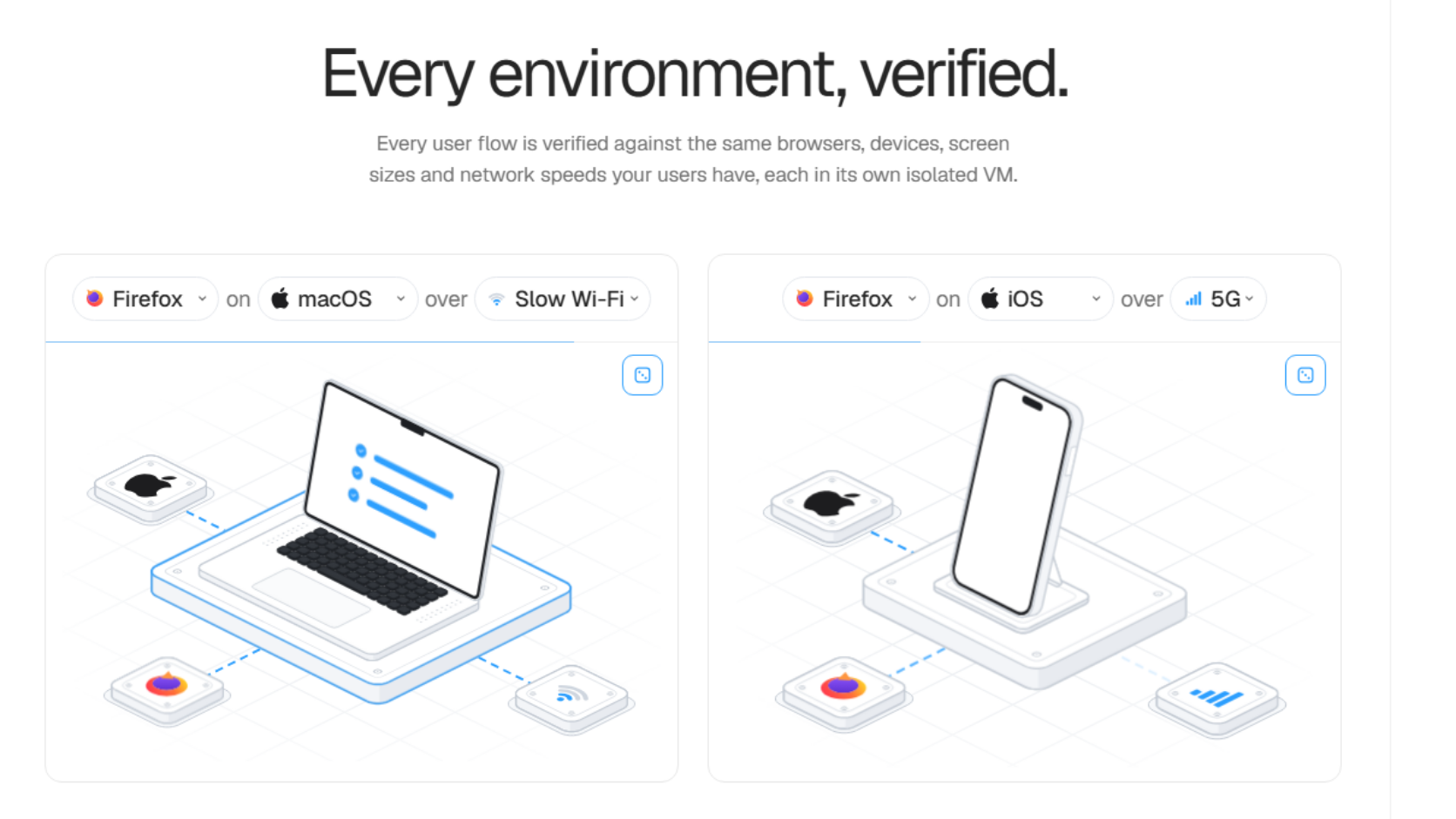
Writing software faster doesn't help much if nobody has checked the checkout flow on a slow phone. Simulithic wants AI users to do that checking, exploring applications and testing the paths they discover across devices and browsers without developers first writing a script for each one.
The startup, part of Y Combinator's Fall 2026 batch, launched on October 21 with an approach that begins by mapping an application. A developer supplies its address, and the system attempts to identify user flows on its own. Those flows then become the basis for tests across different environments.
Its website shows a command called simulithic map for that discovery step and simulithic qa for verification. The company describes isolated virtual machines covering macOS, Windows, iOS and Android, with variations in browsers, screen sizes and network conditions. The goal is to expose problems that a successful run on a developer's own machine would miss.
Watch Simulithic demonstrate its testing workflow.
The product can run at several points in development. Developers can invoke it while coding, including through a coding agent, or place it in a continuous integration pipeline. In that setting, Simulithic says it reports failures on the pull request. Production monitoring reruns user flows and sends alerts to Slack, with the website advertising intervals as frequent as every 30 minutes.
That creates a useful connection between generating code and checking the resulting behavior. A coding assistant can finish a change without knowing whether a user can still complete a task in a particular browser. Simulithic's proposed check operates at the application level, where the sequence of screens and interactions matters more than whether the code looks plausible.
The company also says its tests adapt as interfaces change. That addresses a familiar maintenance problem: a script tied too closely to a page's implementation can break when the interface moves, even when the underlying task still works. Automated exploration shifts some of that burden to the testing system, though it also makes the quality of the discovered coverage important.
Founders Ryan Ning and Satyam Singh previously built GitWrap, which their announcement says reached more than 100,000 developers. That figure describes their earlier project, not Simulithic's customer base. Ning's background includes Uber and Shopify, according to the launch; Singh previously worked at Ramp and Bree.
The announcement doesn't provide an independently verified detection rate or establish that the system finds every possible flow. For a team evaluating it, the meaningful comparison is the set of real failures caught against the effort required to investigate and maintain the tests. Simulithic is offering a concrete starting point for that comparison: point it at an app, let it map the paths, and inspect what breaks when the environment changes.
Lorem ipsum dolor sit amet, consectetur adipiscing elit. Suspendisse varius enim in eros elementum tristique. Duis cursus, mi quis viverra ornare, eros dolor interdum nulla, ut commodo diam libero vitae erat. Aenean faucibus nibh et justo cursus id rutrum lorem imperdiet. Nunc ut sem vitae risus tristique posuere.

Built for Delaware C-Corps. Trusted by 2,000+ startups.












Copyright © Fondo (BloomJoy, Inc.)