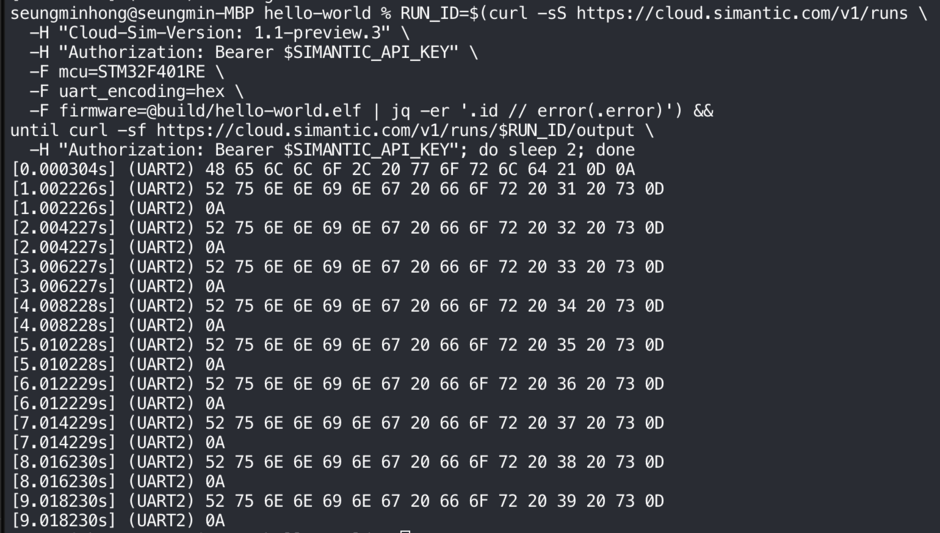
Simantic is addressing an awkward limitation of AI coding agents: writing firmware is easier when they have somewhere to run it. The company provides simulated microcontrollers that let an agent test compiled code without physically connecting to a development board.
That changes the feedback available during a code review. Instead of only examining source files and guessing how a hardware interaction will behave, an agent can run a scenario and inspect the result. The distinction is especially relevant when the bug involves timing, interrupts or the state of a peripheral.
In its launch announcement, Simantic describes Cloud Sim, which takes a target microcontroller and a compiled ELF firmware file. Developers can interact with the service through an API, a TypeScript SDK or an MCP connection for agents. The company also offers a pull-request bot that builds firmware, generates tests from the changes and reports what happens.
The launch demonstration shows the intended workflow. Simulation gives the agent a way to act on the code rather than simply recommend another round of testing for a human to perform.
A small example on the product website illustrates the point. A firmware change uses the wrong bit position, leaving an LED on when it should switch off. The review runs a timed scenario and examines the output. It is a modest bug, but one that exposes the difference between code that looks reasonable and hardware behavior that matches the requirement.
Simantic’s interface is also designed around repeated automated work. A simulated target can be invoked from a development workflow, so an agent does not need someone to reset a board between every experiment. That makes simulation a useful development aid, without making it a complete substitute for testing on the device that will actually ship.
The company is explicit about that boundary in its published validation approach. It says the same firmware should run on silicon and in simulation, with mismatches investigated. It also calls for deliberately broken firmware, repeatable regression tests and evidence tied to the exact target and simulator version. Coverage gaps are supposed to appear alongside passing results.
Those are stated standards the company is building toward, rather than a certification that every supported target already behaves identically to hardware. For teams evaluating a simulator, knowing the boundaries is as important as seeing a successful boot.
Founders Seungmin Hong and Ahnaf Shahriar studied computer engineering at Waterloo. Hong previously worked on firmware at Tesla and robotics companies; Shahriar worked on embedded software at Neuralink and AI hardware at Tesla. Simantic is part of YC’s Fall 2026 batch.
The launch also describes a locally runnable model for selected partners, distinct from general access to the cloud product. The near-term promise is a tighter development loop: make a change, execute it in a declared simulated environment, and give the engineer something more concrete than an agent’s confidence.
Lorem ipsum dolor sit amet, consectetur adipiscing elit. Suspendisse varius enim in eros elementum tristique. Duis cursus, mi quis viverra ornare, eros dolor interdum nulla, ut commodo diam libero vitae erat. Aenean faucibus nibh et justo cursus id rutrum lorem imperdiet. Nunc ut sem vitae risus tristique posuere.

Built for Delaware C-Corps. Trusted by 2,000+ startups.












Copyright © Fondo (BloomJoy, Inc.)