RATLOG wants to build a reusable heavy-lift rocket around an engine that dispenses with turbopumps, the machinery normally used to force propellant into many high-performance rocket engines. The young company says a different approach to propellant pressurization could cut its engine’s part count by 90%.
That is a design claim, not a demonstrated reduction in the cost of an orbital launch. RATLOG has not announced an orbital flight. Its public launch instead points to an earlier engineering milestone: the company says it hot-fired its first engine after four months of work, spending less than $30,000 on the effort.
The larger vehicle is intended to carry as much as 20 tonnes and be reusable. Both are development targets. A small engine test can establish that a design produces thrust, but it does not demonstrate that a complete launch vehicle can reach orbit, carry its intended payload or return for another flight.
Watch the original launch video.
RATLOG’s next planned test is more ambitious. The company says it is building an engine with 200 times the thrust of its first version and aims to hot-fire it in November. That planned increase makes the next test a significant step in the development program, rather than a routine repetition of the initial demonstration.
The startup also reports $400 million in reservation agreements. Reservations may indicate customer interest, but the announcement does not establish that the amount represents collected revenue, financing or a schedule of firm missions. Those distinctions matter for a launch provider whose central hardware is still under development.
Its proposed commercial model is to sell shared capacity by the kilogram. In principle, customers could purchase the payload capacity they need without buying an entire rocket. The company has not supplied a demonstrated per-kilogram launch cost in the announcement, so the engine’s lower proposed complexity should not be treated as proof of a particular price advantage.
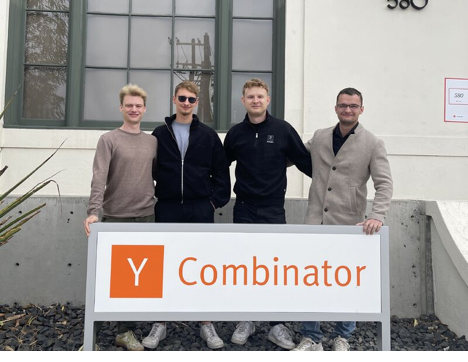
The four-person founding team is Charlie Weise, Matty Driesnack, Felix Kelm and Paul Kunhart. Weise’s background includes work connected to the European Space Agency’s Argonaut lunar lander and a space telescope. Kunhart has worked on engine nozzles, while Kelm began working on printed circuit boards as a teenager. Driesnack was part of the founding team at Lio.
RATLOG itself is in Y Combinator’s Fall 2026 batch. The founders’ experience gives the company several kinds of engineering and startup knowledge, but the launch announcement is still a description of a development program, not a flight-proven transportation service.
The most interesting proposition is the attempt to remove a complicated subsystem instead of making it incrementally cheaper to manufacture. Whether that simplifies the whole vehicle will depend on the requirements imposed elsewhere by the engine cycle, and on how the design performs as it scales. RATLOG’s announcement does not settle those questions.
The near-term milestone is therefore concrete: the larger engine’s planned November hot-fire. Producing substantially more thrust with the proposed architecture would provide another piece of evidence for the design. Payload delivery and reusability remain later tests for the rocket it is meant to power.
Lorem ipsum dolor sit amet, consectetur adipiscing elit. Suspendisse varius enim in eros elementum tristique. Duis cursus, mi quis viverra ornare, eros dolor interdum nulla, ut commodo diam libero vitae erat. Aenean faucibus nibh et justo cursus id rutrum lorem imperdiet. Nunc ut sem vitae risus tristique posuere.

Built for Delaware C-Corps. Trusted by 2,000+ startups.












Copyright © Fondo (BloomJoy, Inc.)