Proof of Human wants websites to identify automated visitors without asking anyone to solve a puzzle. Its system watches the small details of an interaction, including typing, corrections, clicks and scrolling, to assess whether a person or an automated agent is behind it.
The approach turns ordinary activity into a continuous verification signal. Instead of placing a single checkpoint in front of a form, the startup analyzes behavior in the background throughout a session. It combines those observations with device and network signals, according to its launch announcement.
That is particularly relevant to online research. A bot that completes a questionnaire can contaminate the resulting data even if its answers sound plausible. Researchers need to know something about the participant, not simply whether a text response reads well. Proof of Human says Stanford’s psychology department, Grow Progress and Obsurvant use its technology.
The company grew out of work by founders Mayank Agrawal and Matt Hardy on cognition and behavior. Agrawal has a Princeton PhD, while Hardy’s YC profile describes his background as a Princeton cognitive science PhD student. Their company participated in Y Combinator’s Summer 2023 batch and previously operated as Roundtable AI.
The product looks for patterns that are difficult to judge from the submitted answer alone. A system entering text without natural pauses or corrections might leave a different trace from someone composing a response. Pasting generated text partway through an otherwise human session creates another pattern worth examining. Those observations are signals for classification, not conclusive proof about an individual visitor.
Watch the original launch demonstration.
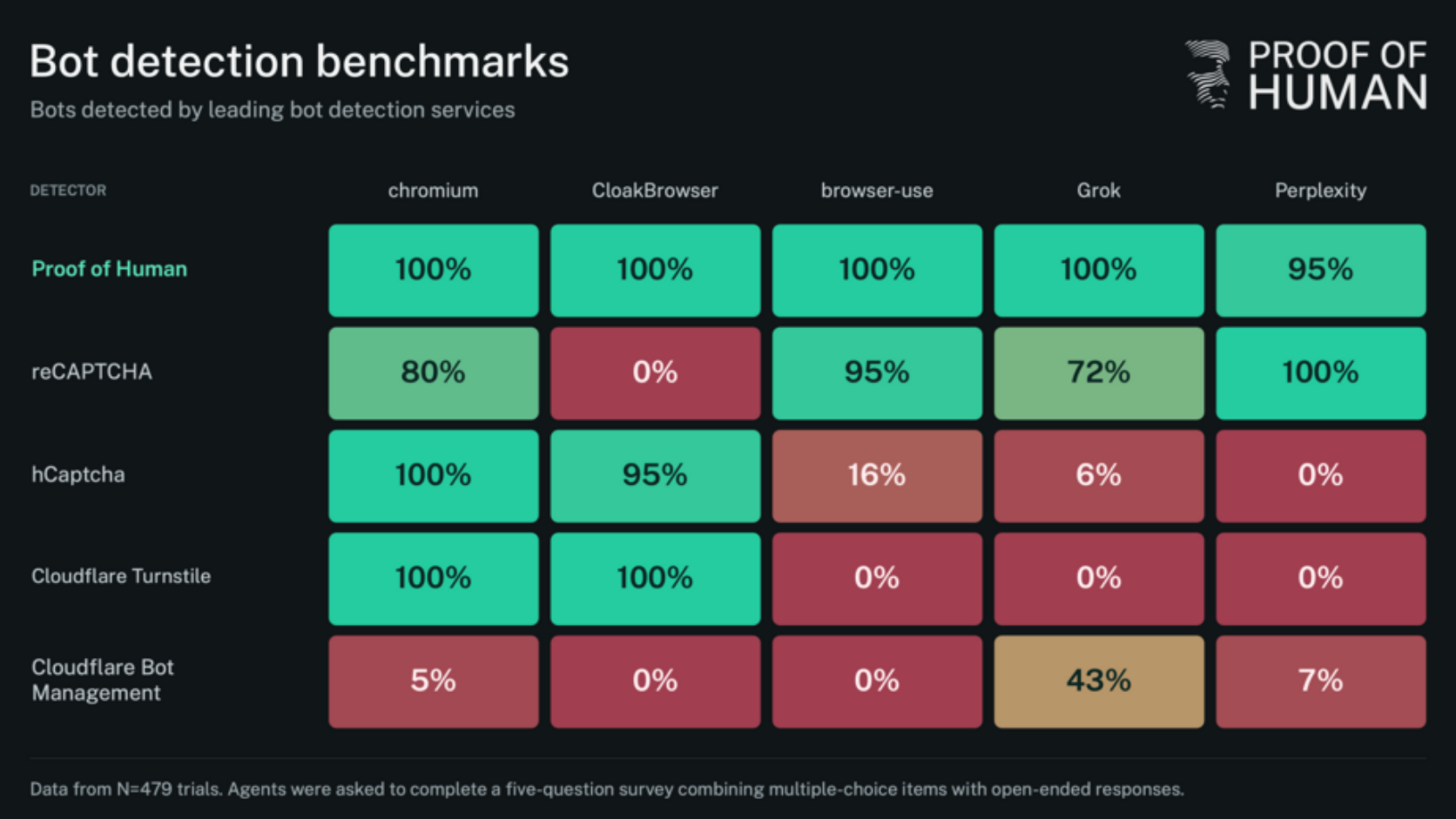
In a test described in the launch post, Proof of Human says it identified 99% of automated participants completing a five-question survey. It reported lower detection rates for several competing services in the same exercise. Those are company-run benchmark results, not an independently established accuracy rate across the internet.
The distinction matters. A detector’s usefulness also depends on how often it incorrectly flags a real person, which visitors it was tested on and how attackers adapt. The announcement does not establish those tradeoffs sufficiently to treat its headline number as a universal performance guarantee.
On its website, the company says it processes more than 10 million sessions a month and offers an API with latency below 200 milliseconds. It also says it avoids collecting personally identifiable information and does not track people across sites. These are the company’s descriptions of its service, rather than findings from an independent privacy or performance audit.
The API returns explanations of suspicious activity, with examples such as unnatural typing, abrupt mouse movements and jump scrolling. That gives a customer something more specific to investigate than a bare bot score. Proof of Human’s broader ambition is to bring the same verification to other online services, but its research use case makes the immediate challenge clear: preserving useful human data when software can convincingly supply the answers.
Lorem ipsum dolor sit amet, consectetur adipiscing elit. Suspendisse varius enim in eros elementum tristique. Duis cursus, mi quis viverra ornare, eros dolor interdum nulla, ut commodo diam libero vitae erat. Aenean faucibus nibh et justo cursus id rutrum lorem imperdiet. Nunc ut sem vitae risus tristique posuere.

Built for Delaware C-Corps. Trusted by 2,000+ startups.












Copyright © Fondo (BloomJoy, Inc.)