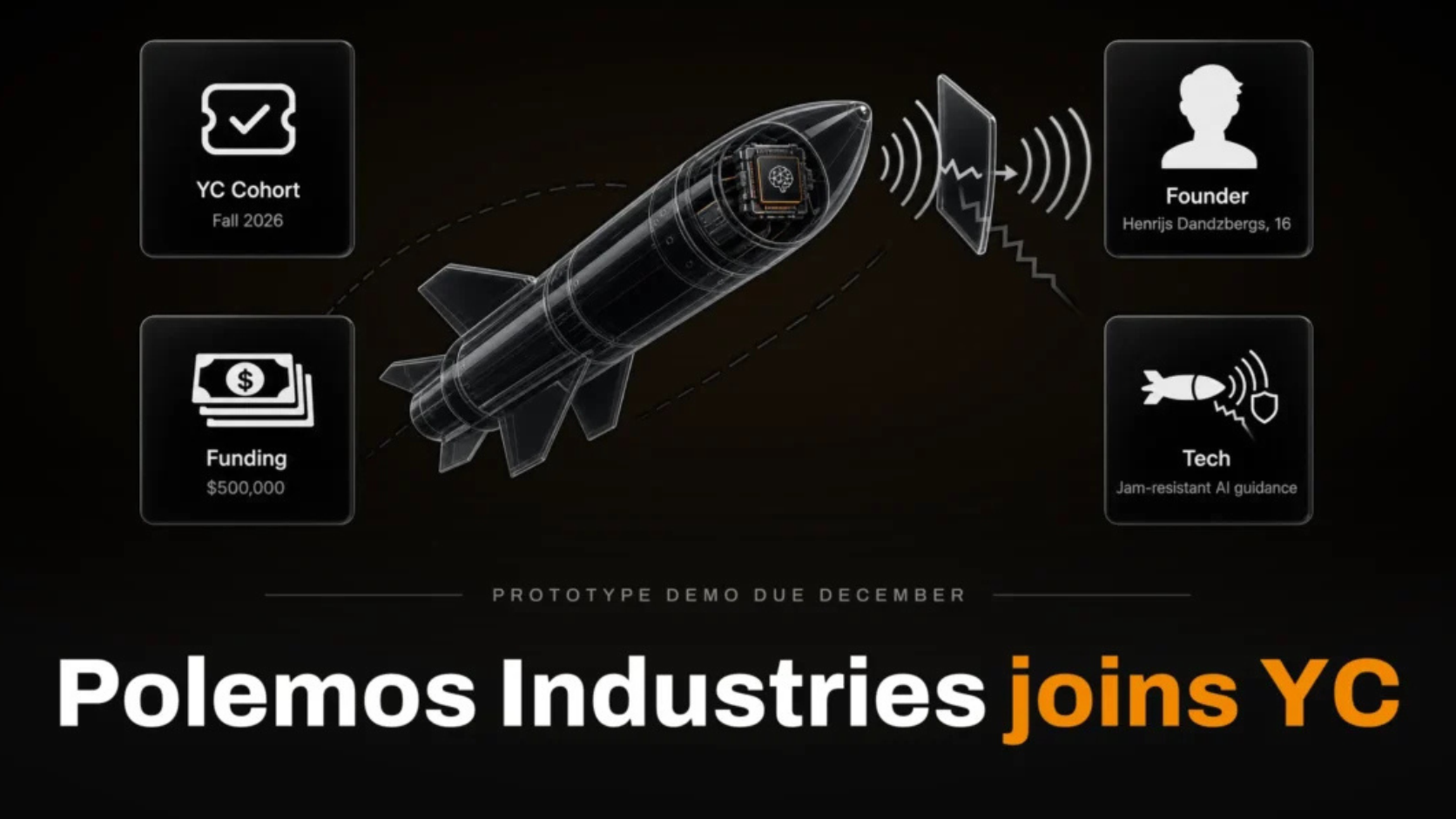
Polemos Industries is entering the defense business with a manufacturing argument: a precision weapon is only useful at scale if the factory can keep producing it. The Y Combinator Fall 2026 company is developing guided missiles and launch systems together, rather than presenting software alone as its product.
Its launch announcement describes an integrated hardware business intended for large-volume production. Polemos says it designs its systems internally and plans to expand its own production capabilities. Those are the company's development plans, not evidence of a mature manufacturing operation.
The most consequential part of the pitch is its attention to industrial capacity. Designing an advanced system and repeatedly producing it are different problems. Polemos is arguing that manufacturing constraints should influence the product from the beginning, rather than become a separate challenge once the engineering demonstration is complete.
Watch Polemos Industries's original launch video.
That framing gives the company a clear business proposition without establishing that it has solved it. The public launch does not disclose production volumes, unit economics, customer contracts or independently verified performance results. It also does not provide a delivery schedule against which potential customers could judge the manufacturing promise.
The founder introduces himself as Henrijs in the announcement. He says he attended Astra Nova, previously known as Ad Astra, and later worked with engineering teams at two defense companies. Polemos describes a broader team with experience at organizations including NASA's Jet Propulsion Laboratory, Caltech and the U.S. Army's research laboratory. Those affiliations describe team backgrounds, not partnerships or endorsements of Polemos.
On its website, the company emphasizes human authorization as part of its vision for autonomous systems. That distinction matters when evaluating defense products: the use of AI does not, by itself, explain who controls consequential decisions or how a system is evaluated before deployment. The launch provides a high-level product direction rather than a detailed account of those safeguards.
Polemos belongs to a category of startups whose commercial progress ultimately has to be measured in physical deliveries. A software demonstration can establish that an idea is technically interesting. A defense manufacturer faces the additional work of repeatable production, testing, procurement and customer acceptance.
For now, Polemos has publicly set out the company it intends to build. The next useful evidence will be concrete production and delivery milestones, not a broader description of autonomy. Its stated ambition is industrial as much as technical: building a business that can manufacture the products it designs.
Lorem ipsum dolor sit amet, consectetur adipiscing elit. Suspendisse varius enim in eros elementum tristique. Duis cursus, mi quis viverra ornare, eros dolor interdum nulla, ut commodo diam libero vitae erat. Aenean faucibus nibh et justo cursus id rutrum lorem imperdiet. Nunc ut sem vitae risus tristique posuere.

Built for Delaware C-Corps. Trusted by 2,000+ startups.












Copyright © Fondo (BloomJoy, Inc.)