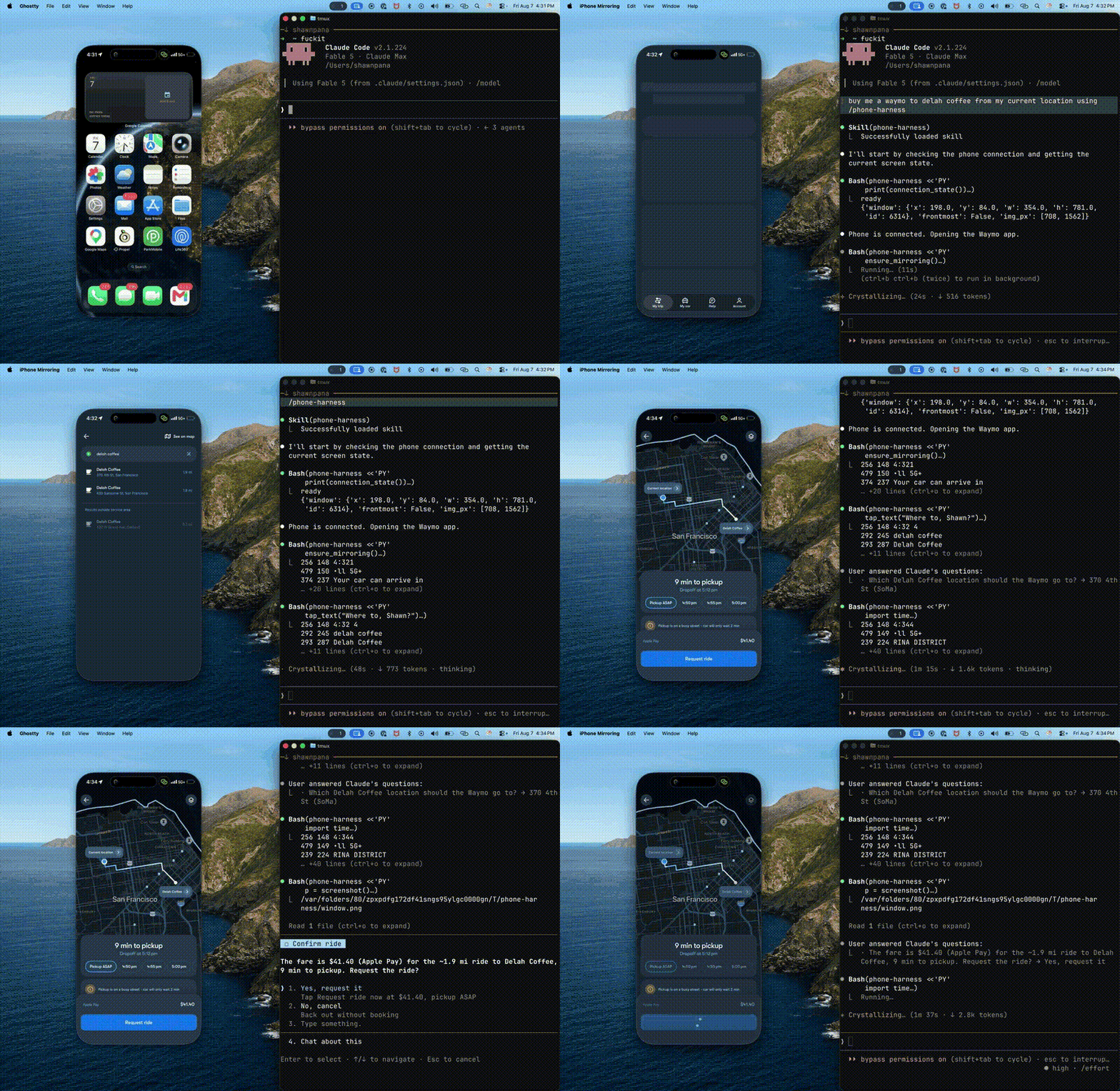
Phone Harness gives an AI agent another place to work: the interface of an iPhone or Android device. Its open-source software lets an agent tap, type and scroll, while a hosted service provides phones that stay available between tasks.
The startup is addressing workflows that do not fit neatly inside a browser. Some services are primarily mobile, and an agent that can operate a website may still be unable to test or use the corresponding app.
Its launch announcement separates two offerings. Users can connect their own phone through the open-source harness, or use Phone Harness Cloud. The cloud option is intended to retain application state and logins between runs.
Watch Phone Harness's original launch video.
The company's website describes screen understanding through vision, optical character recognition or accessibility information. It positions the harness as compatible with an agent the customer already uses, rather than requiring a specific new assistant.
A testing workflow is a straightforward application. An agent developing a mobile feature could interact with the actual app and inspect its behavior, rather than rely only on a simulated description of the interface. Persistent devices also reduce repeated setup between sessions.
Phone Harness's current pricing distinguishes cloud Android capacity from a real iPhone subscription. The website labels the cloud product as an open beta. That is relevant context for evaluating reliability and support, even though the underlying open-source project is already available.
Founder Shawn Pana previously led growth at Browser Use, working on product launches and developer partnerships. His public YC profile lists mathematics and computer-science study at UC San Diego and identifies him as Phone Harness's founder and chief executive. The company belongs to the Fall 2026 batch.
That background connects the product to the developer tools around agents, rather than to building another mobile app for consumers. The open-source project lets developers inspect how the phone interaction works and connect their existing agent. A hosted service then addresses a different operational need: keeping a device available between runs without relying on the developer's own laptop and phone. The distinction is useful when comparing a local experiment with an agent workflow expected to remain available over time.
The launch reports more than 4,000 GitHub stars for the project. Stars indicate developer attention, not the number of production deployments or paying customers. The announcement does not provide independent measures of task completion or reliability across different apps.
Giving software control of a signed-in phone also makes permission boundaries important. A device can expose communications, purchases and account actions. The existence of a control interface does not mean an agent should perform every action it technically can; users and developers still need appropriate authorization and review.
The business turns a mobile device into a persistent execution environment for agents. Its usefulness will depend on the ordinary details of that environment: whether the app remains available, whether state is preserved and whether the agent can recover when the interface changes. Phone Harness is packaging that work into a tool rather than asking every developer to build a phone-control stack from scratch.
Lorem ipsum dolor sit amet, consectetur adipiscing elit. Suspendisse varius enim in eros elementum tristique. Duis cursus, mi quis viverra ornare, eros dolor interdum nulla, ut commodo diam libero vitae erat. Aenean faucibus nibh et justo cursus id rutrum lorem imperdiet. Nunc ut sem vitae risus tristique posuere.

Built for Delaware C-Corps. Trusted by 2,000+ startups.












Copyright © Fondo (BloomJoy, Inc.)