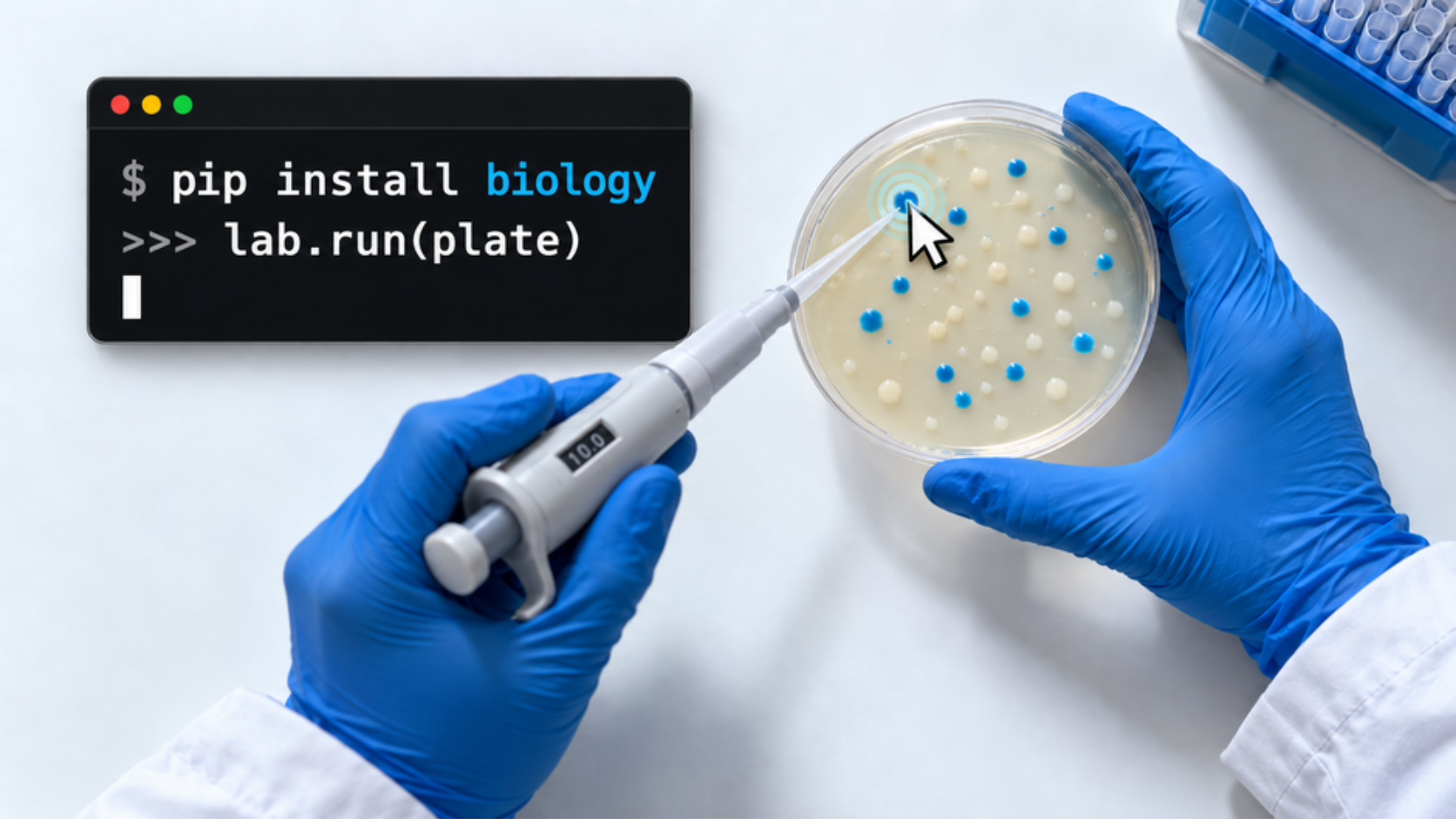
Petrichor wants to make physical experiments accessible to AI models through software. The Fall 2026 YC company is building wet-lab infrastructure for AI researchers: customers submit experimental jobs through a Python library, Petrichor’s team runs them, and the resulting data goes back to the customer.
The company’s starting point is a distinction between software and biology. A model working on code can often test its output inside a computer. A biological hypothesis may require a physical experiment before anyone knows whether it works. Petrichor’s launch argues that the capacity to run those experiments is therefore a constraint on how quickly biological AI can improve.
Its proposed interface is straightforward. A model can write an experiment as a job and submit it through the library, according to the launch announcement. Petrichor says it runs experiments in parallel and captures data throughout each run, aiming to provide training material rather than only a final result.
The software connection does not mean the laboratory is autonomous. Petrichor explicitly says people on its team execute every experiment for safety reasons. It plans to consider robotic execution only when it regards that as safe. The announcement does not specify a timetable or claim that autonomous laboratory operation is already available.
Customer ownership is another part of the proposition. Petrichor says customers own all data it produces for them, and that the company neither shares that data nor uses it to train models. That is an important boundary for a service whose output may become part of an AI lab’s proprietary research.
CEO Wilhelm Hedenskog is building the company with Jesper Johansson and Elias Reinfeldt. The launch describes the founders as three 19-year-olds who attended high school together in Gothenburg, Sweden, before moving to the Bay Area for YC. Their public YC company profile identifies all three as founders.
Petrichor has not published pricing, experiment throughput, a detailed list of supported procedures or customer results in the materials reviewed. Those omissions limit what can be concluded about its present scale. The launch describes the workflow and intended customer, rather than demonstrating a measured improvement in a biological model.
For an AI team, the potential value is being able to request physical work without first building and staffing a laboratory. Whether that service fits a research program will depend on the experiments it can perform, the data it returns and the safety controls around execution. Petrichor’s announcement leaves those implementation details to further discussion with prospective customers.
The company is making a focused infrastructure bet: better biological models need more than another source of text. They need feedback from experiments in the physical world. Petrichor is offering a software entry point to that work while keeping execution in human hands.
Lorem ipsum dolor sit amet, consectetur adipiscing elit. Suspendisse varius enim in eros elementum tristique. Duis cursus, mi quis viverra ornare, eros dolor interdum nulla, ut commodo diam libero vitae erat. Aenean faucibus nibh et justo cursus id rutrum lorem imperdiet. Nunc ut sem vitae risus tristique posuere.

Built for Delaware C-Corps. Trusted by 2,000+ startups.












Copyright © Fondo (BloomJoy, Inc.)