Orikata Bio and its scientific-software brand Megure Labs are launching several layers of a biological research stack at once. The package includes protein datasets, analysis tools, open-source libraries and hosted model inference, with a broader collaborative workbench still under development.
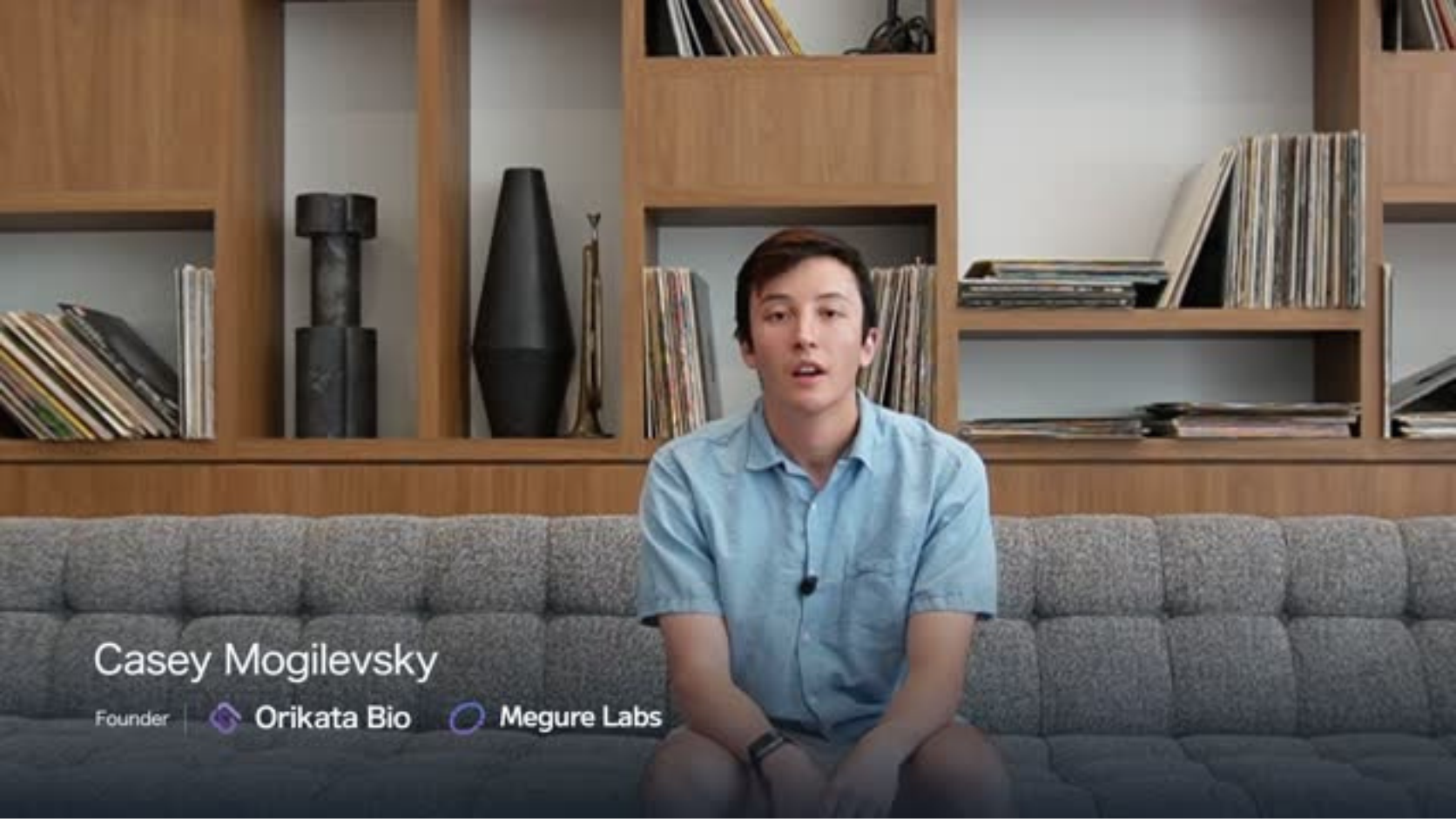
Founder Casey Mogilevsky’s argument is that a new biological model does not solve the whole research workflow. Scientists still need to assemble data, find relevant examples, compare sequences and structures, run models and preserve the relationship between inputs and results. The company is building those surrounding tools alongside its own model work.
Its datasets are Umi and Sora. The launch describes Umi as containing more than 100 billion unique protein sequences and Sora as containing nearly two billion predicted and experimental structure records. These are company-reported collection sizes. Access to the curated corpora and hosted infrastructure is a paid offering, distinct from the open-source software releases.
Watch the original launch video
The analysis toolkit, Hikoboshi, uses learned comparisons for sequence and structure alignment, clustering, search and other evolutionary workflows. The company contrasts that approach with the fixed scoring tables used in classical alignment. Its aim is to use sequence or structural context when deciding which positions correspond, rather than relying only on a fixed amino-acid pair score.
Orihime is the accompanying differentiable-alignment library from Megure Labs. It provides machinery for training through the alignment calculation itself, with CPU and GPU implementations. Both Hikoboshi and Orihime are identified as open-source releases in the announcement, while the larger datasets and hosted services have separate access arrangements.
The company reports benchmark improvements for its alignment and search methods. Those results are its own evaluations and depend on the named dataset, metric and input type. The public search demonstration described in the launch covers TEDBench; it should not be confused with unrestricted search across the full Umi and Sora collections.
Hosted inference is available through Noto, alongside initial biological analysis tools and an agent interface. The launch says Noto includes more than 45 models and tools in addition to Hikoboshi. The current public company profile distinguishes those available components from the full multiplayer notebook and wider agent workflows, which remain in development.
That distinction also applies to the company’s model and execution projects. Ibuki is its developing biological world-model family, intended to connect sequence, structure and function. The launch says Ibuki-based workflow models are not part of the initial release. Hataya, an inference compiler designed to package models with weights and verification evidence, is described in the current profile as being in private evaluation.
Mogilevsky’s background spans wet-lab biochemistry and machine learning. His public profile describes research at Berkeley and Cambridge and previous MD/PhD study at the University of Pennsylvania. Orikata Bio PBC, the Summer 2026 YC company, operates the Orikata Bio and Megure Labs brands rather than representing two unrelated startups.
The near-term offering is a set of tools researchers can use individually. The longer-term ambition is to connect them in a workspace where people and agents can continue a research project without losing its data, methods and results. The launch is most usefully read as both a release and a roadmap: several components are available, while the fully shared discovery environment is still being built.
Lorem ipsum dolor sit amet, consectetur adipiscing elit. Suspendisse varius enim in eros elementum tristique. Duis cursus, mi quis viverra ornare, eros dolor interdum nulla, ut commodo diam libero vitae erat. Aenean faucibus nibh et justo cursus id rutrum lorem imperdiet. Nunc ut sem vitae risus tristique posuere.

Built for Delaware C-Corps. Trusted by 2,000+ startups.












Copyright © Fondo (BloomJoy, Inc.)