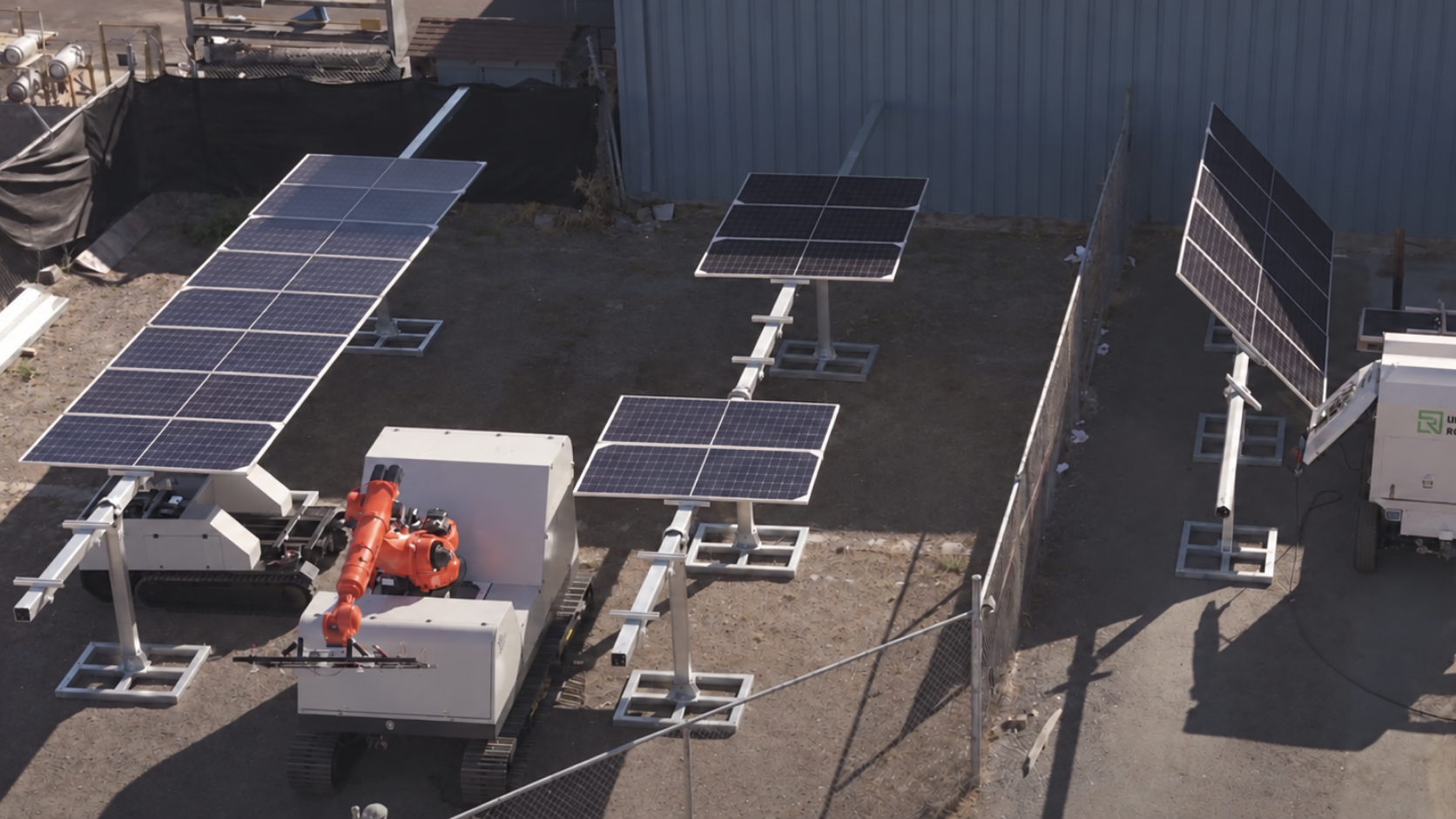
Construction customers do not necessarily want to own and program a robot. They want the work finished. Libra Robotics is building its business around that distinction, charging for completed infrastructure work while developing the software needed to put robots on the job.
The company says it has deployed robots for solar work and signed commercial agreements. It is also pursuing pilots involving mechanical, electrical and plumbing work and busway installation in data centers. Those projects put the emphasis on physical tasks at a worksite, rather than on selling a general-purpose robot and leaving the buyer to figure out its application.
Libra describes a hardware-agnostic approach. It selects robot equipment and tooling for a task, then builds on reusable skills such as handling, positioning, aligning and fastening. The aim is to avoid starting from nothing each time a contractor needs a different piece of work automated.
Watch the original launch video.
That reuse has limits in a physical environment. A component can be slightly misaligned, a tool can meet unexpected resistance or the work area can differ from the setup used during development. Libra says its process combines simulation with physical testbeds, diagnoses failures and iterates on the system before deployment.
The company claims this approach can make development ten times faster. Its launch does not provide an independent comparison or enough detail to establish a general speed advantage across construction tasks. The more concrete evidence it offers is its account of deployments, commercial agreements and pilots at different stages.
Charging for completed work changes what Libra has to deliver. A hardware sale can be complete when a machine reaches the customer; a service based on output depends on getting useful tasks done. That gives the company a direct reason to make equipment selection, software and site execution work together, while leaving it exposed to the difficulty of each job.
The founders’ backgrounds reflect that focus. Yaojing Huang earned a Stanford doctorate in construction robotics and worked with more than 40 contractors, according to the company’s public account. Jermaine Zhao has experience in autonomous agricultural harvesting and studied electrical and mechanical engineering at Stanford.
Libra participated in Y Combinator’s Summer 2026 batch. Its public announcement does not disclose revenue, name the customers behind its commercial agreements or quantify completed work to date. The distinction between deployed systems and pilots remains important when assessing how far each application has progressed.
The startup’s longer-term target is 100 million hours of robotic work by 2031. That is an ambition, not an achieved operating metric. Reaching it would require repeated deployments that remain economical after accounting for the equipment, tooling and adaptation needed at each site.
For now, the progression from solar work to data-center installation offers a useful way to judge the approach. Libra will have to show that skills developed for one job meaningfully reduce the effort required for another, and that the resulting system can finish work a contractor is willing to pay for.
Lorem ipsum dolor sit amet, consectetur adipiscing elit. Suspendisse varius enim in eros elementum tristique. Duis cursus, mi quis viverra ornare, eros dolor interdum nulla, ut commodo diam libero vitae erat. Aenean faucibus nibh et justo cursus id rutrum lorem imperdiet. Nunc ut sem vitae risus tristique posuere.

Built for Delaware C-Corps. Trusted by 2,000+ startups.












Copyright © Fondo (BloomJoy, Inc.)