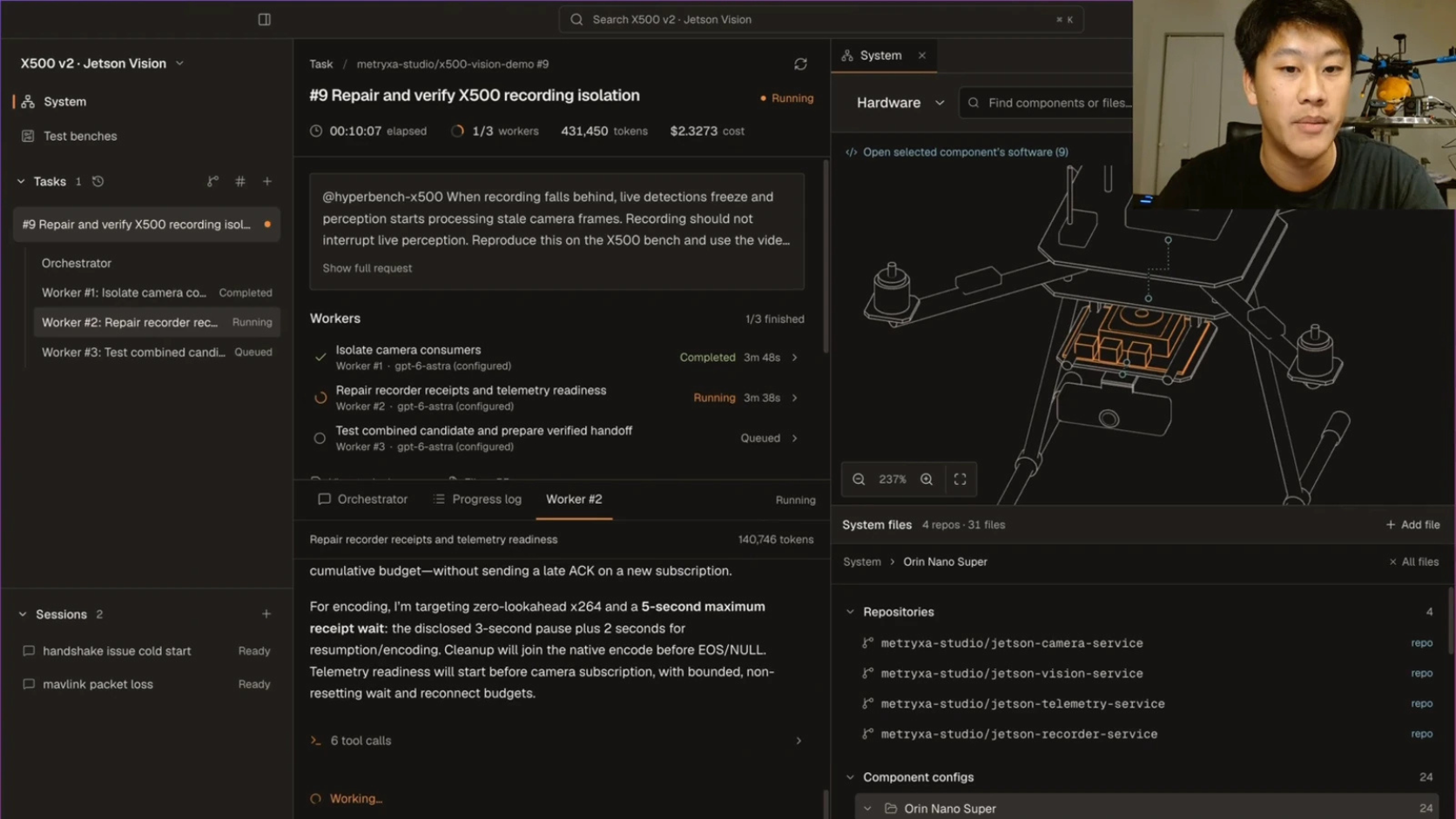
HyperBench is building an engineering platform for a limitation of coding agents: a repository does not necessarily explain the physical system its software controls. The Fall 2026 YC company combines system context, agent development and hardware testing in one environment.
The platform maps repositories, hardware components, interfaces, protocols and test evidence into a shared system graph. Agents use those relationships to investigate failures across components, coordinate repairs across repositories and test changes on physical hardware. The intent is to make the surrounding system available to the agent, rather than leave it to infer everything from code alone.
That distinction matters when a software change appears reasonable in isolation but affects another component's behavior. HyperBench is not simply presenting another code editor. It is trying to connect the information needed to trace a problem across boundaries that are usually handled by different tools or teams.
Watch HyperBench's original launch video.
The company's website breaks its workflow into four stages: understanding an issue across code and hardware, reproducing it on a bench, delegating repairs, and verifying the result on hardware before reviewing draft pull requests. It also says users can review code, test results and recordings together. The evidence attached to a change is therefore part of the product, not just the generated patch.
HyperBench describes local execution with shared system context and support for the hardware bench a team already uses. That positioning suggests an integration layer around an existing engineering setup rather than a requirement to replace every device or testing tool. The launch does not specify the complete range of supported hardware, so compatibility remains something a prospective user would need to establish.
The team brings experience from both autonomous systems and AI infrastructure. YC's public company profile identifies Justin Leong as founder and CEO, with computer-science degrees from Stanford and previous software-engineering work at Anduril. HyperBench's team page also lists Ivan Ge, previously a member of technical staff at OpenAI working on software infrastructure. Both are linked from the launch.
The announcement reports a 20% benchmark advantage over vanilla Claude and Codex, but combines correctness and debugging speed in wording that does not clearly define the measured improvement. The public launch does not provide enough methodology to treat that figure as an independently verified comparison. The more concrete claim is architectural: agents receive system-wide relationships and can check proposed changes against hardware.
HyperBench is inviting users into a private beta. It has not disclosed pricing, named customer results or a broad deployment record in the launch. For an engineering team, the useful evaluation would be whether that shared context makes a real integration failure easier to reproduce and a proposed repair easier to verify.
The company's bet is that making agents better at systems engineering requires more than asking them to write more code. It requires giving them a connected view of the system, a way to exercise it, and evidence that humans can inspect before accepting the change.
Lorem ipsum dolor sit amet, consectetur adipiscing elit. Suspendisse varius enim in eros elementum tristique. Duis cursus, mi quis viverra ornare, eros dolor interdum nulla, ut commodo diam libero vitae erat. Aenean faucibus nibh et justo cursus id rutrum lorem imperdiet. Nunc ut sem vitae risus tristique posuere.

Built for Delaware C-Corps. Trusted by 2,000+ startups.












Copyright © Fondo (BloomJoy, Inc.)