Helios Intelligence wants a blood test to become a repeated measurement of how the body is changing, rather than a one-off report. Its proposed at-home service combines more than 1,000 biomarkers with organ-level scores, disease-risk estimates and an AI system for explaining the results.
The Fall 2026 Y Combinator company is beginning with clinics, not an established mass-market rollout. Its launch describes a small initial cohort this fall, while its current website says select clinics are coming in 2027. That timing remains inconsistent across the company's public materials; individuals can register interest rather than assume immediate access.
The scientific appeal is the breadth of the measurement. Proteins in blood can carry information about different tissues and biological processes. Helios aims to turn that information into a report that users and physicians can revisit over time.
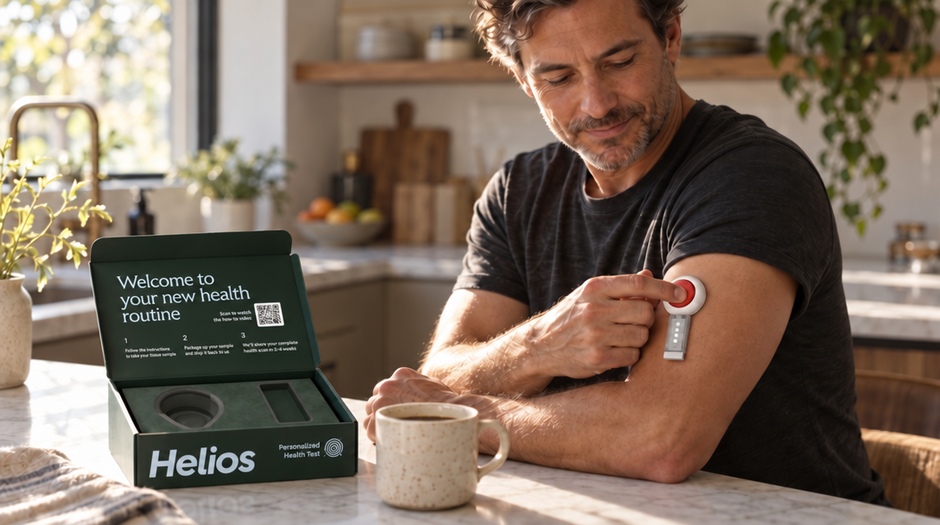
Helios says users collect a small blood sample at home using an arm-mounted device. The company describes more than 70 scores covering organs and pathways, including cardiovascular health, metabolism, inflammation and the immune system, with results returned in two to four weeks.
An AI agent is intended to explain the scores, suggest a plan and follow changes when the user retests. The initial clinic workflow puts ordering and report review with doctors. The broader ambition is a longevity service that combines testing, physician review and repeated measurement.
Those proposed outputs should not be confused with established clinical benefits. Measuring many proteins does not, by itself, show that a test accurately predicts every advertised condition or that acting on its recommendations improves health outcomes.
Helios makes broad claims about estimating disease risk years before conventional care would detect a problem. The launch does not provide the clinical validation needed to evaluate each risk estimate, population or proposed intervention.
The founders are Omar Abudayyeh, Jonathan Gootenberg and Yousef Badran. Abudayyeh and Gootenberg helped develop SHERLOCK, a CRISPR diagnostic technology, and cofounded Sherlock Biosciences. Badran is an internal-medicine physician-scientist and gastroenterologist affiliated with Massachusetts General Hospital and Harvard Medical School.
That background is relevant to the team's experience, but it does not transfer regulatory authorization from an earlier diagnostic to this new test. The launch's discussion of FDA authorization concerns the founders' previous CRISPR test, not an authorization established here for Helios.
The announcement also describes the founders' earlier biotech ventures and acquisitions. It does not disclose a financing round for Helios itself. Those histories should remain separate from the new company's funding and product evidence.
Repeated testing would give Helios longitudinal information rather than isolated snapshots. The company hopes to combine that information with other health data to model aging and predict which interventions could help an individual.
Its proposed “world model” of human health is a research ambition, not a demonstrated ability to simulate a person's future. The same distinction applies to its aspiration to build an exceptionally large longitudinal proteomics dataset.
For the initial clinics, the concrete offering is a broad molecular report and a system for interpreting and repeating it. The questions that matter next are equally concrete: how the scores are validated, which decisions they can support, and whether repeated testing changes care in ways that improve outcomes.
Lorem ipsum dolor sit amet, consectetur adipiscing elit. Suspendisse varius enim in eros elementum tristique. Duis cursus, mi quis viverra ornare, eros dolor interdum nulla, ut commodo diam libero vitae erat. Aenean faucibus nibh et justo cursus id rutrum lorem imperdiet. Nunc ut sem vitae risus tristique posuere.

Built for Delaware C-Corps. Trusted by 2,000+ startups.












Copyright © Fondo (BloomJoy, Inc.)