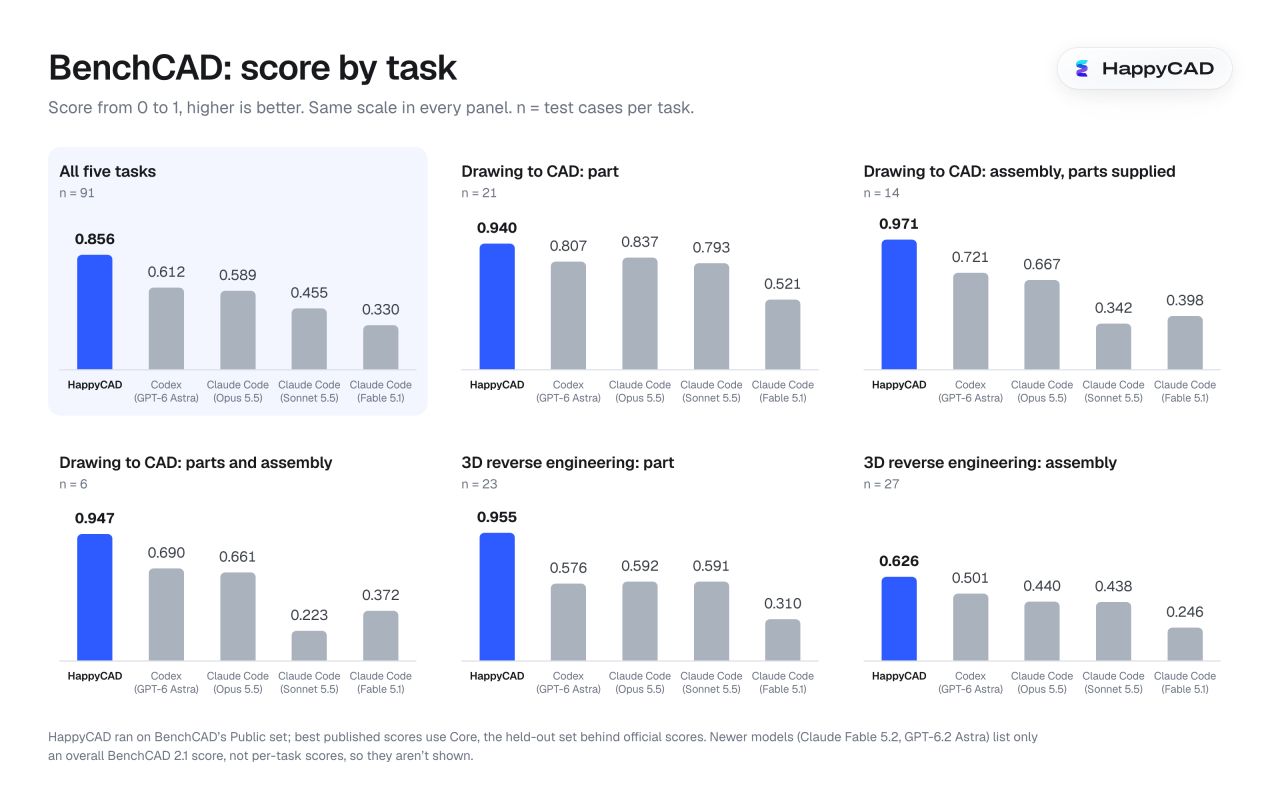
Energent AI is launching HappyCAD, a tool that turns a written description into an editable hardware design and checks the result before a user prints or manufactures it. The product combines parametric CAD generation with checks on dimensions, collisions and moving mechanisms.
Founders Rachel Hu and Kimi describe the launch as a return to the idea they brought to Y Combinator in Summer 2023. They originally wanted to build AI CAD, but say the models were not capable enough at the time. They built Energent's agent platform first and are now applying that work to hardware design.
HappyCAD starts with a description of a part's intended function, dimensions, loads and mounting requirements. The company says the agent asks for missing details and creates an editable parametric model, rather than producing only a mesh that looks like the requested object.
Its main point of differentiation is what follows generation. HappyCAD checks parts against their specifications, examines pairs of parts for collisions and tests moving mechanisms through their motion. The founders argue that those steps should be part of the agent's assignment, not separate work left for an engineer to perform after an apparently successful design.
The launch gives a concrete example involving an earbud case. According to the company, HappyCAD checked 34 pairs of parts and identified four problems before printing. One pocket left 0.015 millimeters of clearance instead of the intended 0.15 millimeters. The lid also intersected with the earbuds by about 0.7 millimeters when opened to 115 degrees.
The company says HappyCAD rebuilt the case to correct those problems. That example illustrates the type of geometric error the product is meant to catch: a shape can appear plausible while a clearance or moving assembly makes it impractical. It is a company demonstration, not an independent test of all the tool's capabilities.
HappyCAD exports STEP files, dimensioned drawings and a bill of materials. Users can continue working in applications such as SolidWorks, Fusion or Onshape, or use the output in a fabrication workflow. The emphasis on editable files is intended to keep the result useful beyond the initial AI interaction.
The founders' broader claim is faster hardware design with checking built into the process. Their headline describes designs as proven, but the capabilities specified in the launch concern requirements, collisions and motion. The announcement does not establish that every generated component has passed material, fatigue, regulatory or manufacturing validation. Engineers should not read a geometric check as certification for every possible use.
Kimi is described as a hardware engineer, while the team lists experience at AWS, Google DeepMind and Microsoft, as well as Stanford and Berkeley. The founders say HappyCAD benefits from three years spent building the underlying agent platform.
The product is available to try free at HappyCAD's website. The company is particularly seeking mechanical engineers at hardware and robotics startups, and offers demonstrations for teams that want to see how a description becomes a model, a set of checks and files they can continue editing.
Lorem ipsum dolor sit amet, consectetur adipiscing elit. Suspendisse varius enim in eros elementum tristique. Duis cursus, mi quis viverra ornare, eros dolor interdum nulla, ut commodo diam libero vitae erat. Aenean faucibus nibh et justo cursus id rutrum lorem imperdiet. Nunc ut sem vitae risus tristique posuere.

Built for Delaware C-Corps. Trusted by 2,000+ startups.












Copyright © Fondo (BloomJoy, Inc.)