Graphide is targeting the delay between an AI coding agent changing software and a continuous-integration system reporting whether it works. Its new GitHub Actions runner combines machine-level changes with caching and test parallelization, rather than treating faster CI as simply a matter of renting a larger machine.
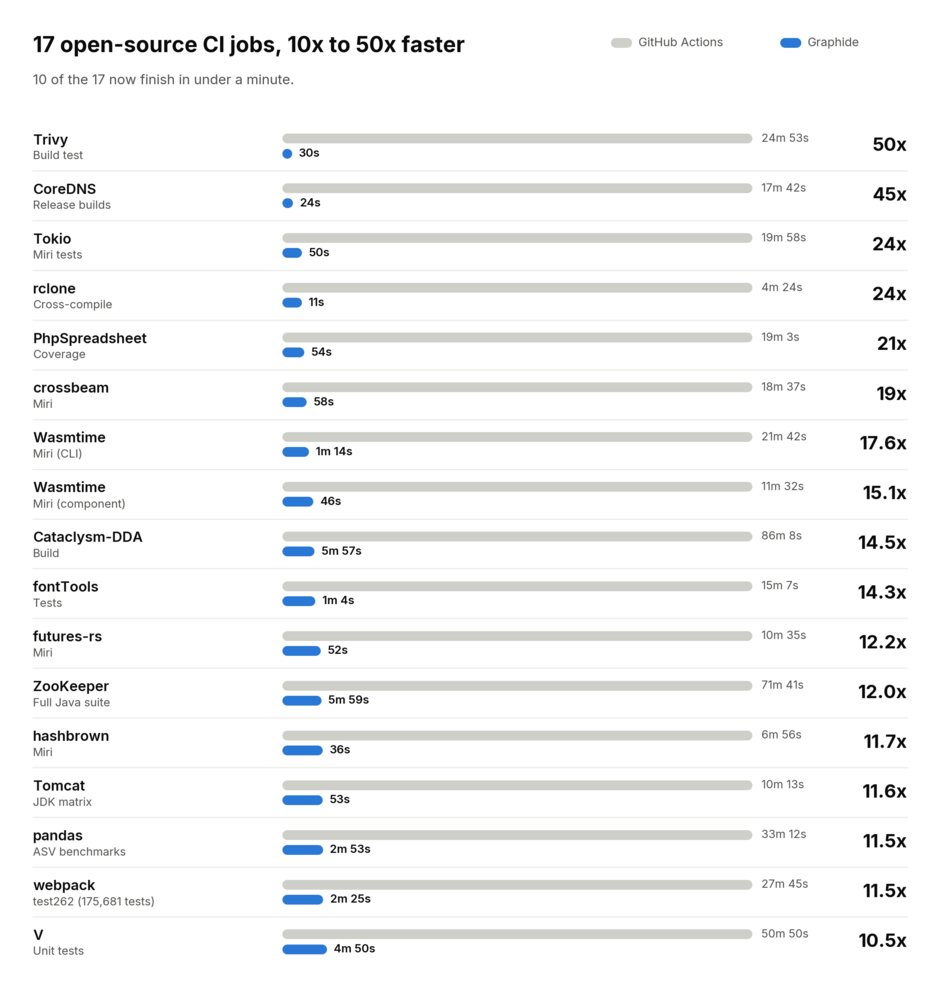
The company says it tested 24 real CI jobs, including seven from fellow YC Fall 2026 companies, against those projects’ recent GitHub runs. In its reported results, 16 jobs finished in less than a minute and 19 ran at least ten times faster. Those are company-run benchmarks, not an independent performance evaluation.
One example is Trivy’s build-and-test job, which the launch reports reducing from roughly 25 minutes to 30 seconds. Graphide says the comparison ran complete test suites without skipping tests. Its methodology uses the median of recent GitHub runs and the median of five Graphide runs, a distinction worth retaining when interpreting the figures.
The technical approach works across the job’s critical path. Graphide starts work on already-booted machines with dependencies and build caches ready, divides tests across lanes, and adjusts lane capacity to the work. The company also describes patches to the Linux kernel, testing libraries and compilers as part of its optimization process.
According to the launch, customers begin with plain runners, and speedups are applied incrementally to check compatibility with their CI. The company says useful optimizations then enter a shared library. That makes configuration and tuning part of the service, rather than leaving every repository owner to build a faster pipeline alone.
Test pruning is a separate option. Graphide says it can map which tests a file change can affect and omit those outside that reach. It claims further cost reductions from doing so, but explicitly distinguishes pruning from the full-suite benchmark results. Teams assessing the product should keep that distinction: running the same work faster and choosing less work are different mechanisms.
The company’s current pricing page lists a $20 monthly minimum per Graphide organization, covering the first $20 of CI usage, followed by usage-based charges up to a customer-set cap. It quotes $0.003 per vCPU-minute, billed by the second based on the time a job takes without its speedups. That billing basis matters when estimating a bill from the faster elapsed times.
Graphide describes isolated environments that are destroyed after each job, with its largest runners receiving whole virtual machines. Its site says jobs cannot reach one another or private network addresses. These are the provider’s security descriptions, not an independent audit of the service.
Cofounders Dan McGee and Benjamin McIntyre have built projects together since middle school in Cincinnati, according to the launch. McGee previously built Illumio’s Matrix policy-simulation platform and left Berkeley to start Graphide. McIntyre’s background includes editor tooling and founding the University of Cincinnati’s Linux and open-source club.
The startup’s broader thesis is that faster code generation increases the importance of verification. An agent can produce another patch quickly, but repeated waits for CI can still dominate the feedback loop. Its service tackles that loop through coordinated changes to infrastructure, tests and configuration, rather than hardware alone.
Lorem ipsum dolor sit amet, consectetur adipiscing elit. Suspendisse varius enim in eros elementum tristique. Duis cursus, mi quis viverra ornare, eros dolor interdum nulla, ut commodo diam libero vitae erat. Aenean faucibus nibh et justo cursus id rutrum lorem imperdiet. Nunc ut sem vitae risus tristique posuere.

Built for Delaware C-Corps. Trusted by 2,000+ startups.












Copyright © Fondo (BloomJoy, Inc.)