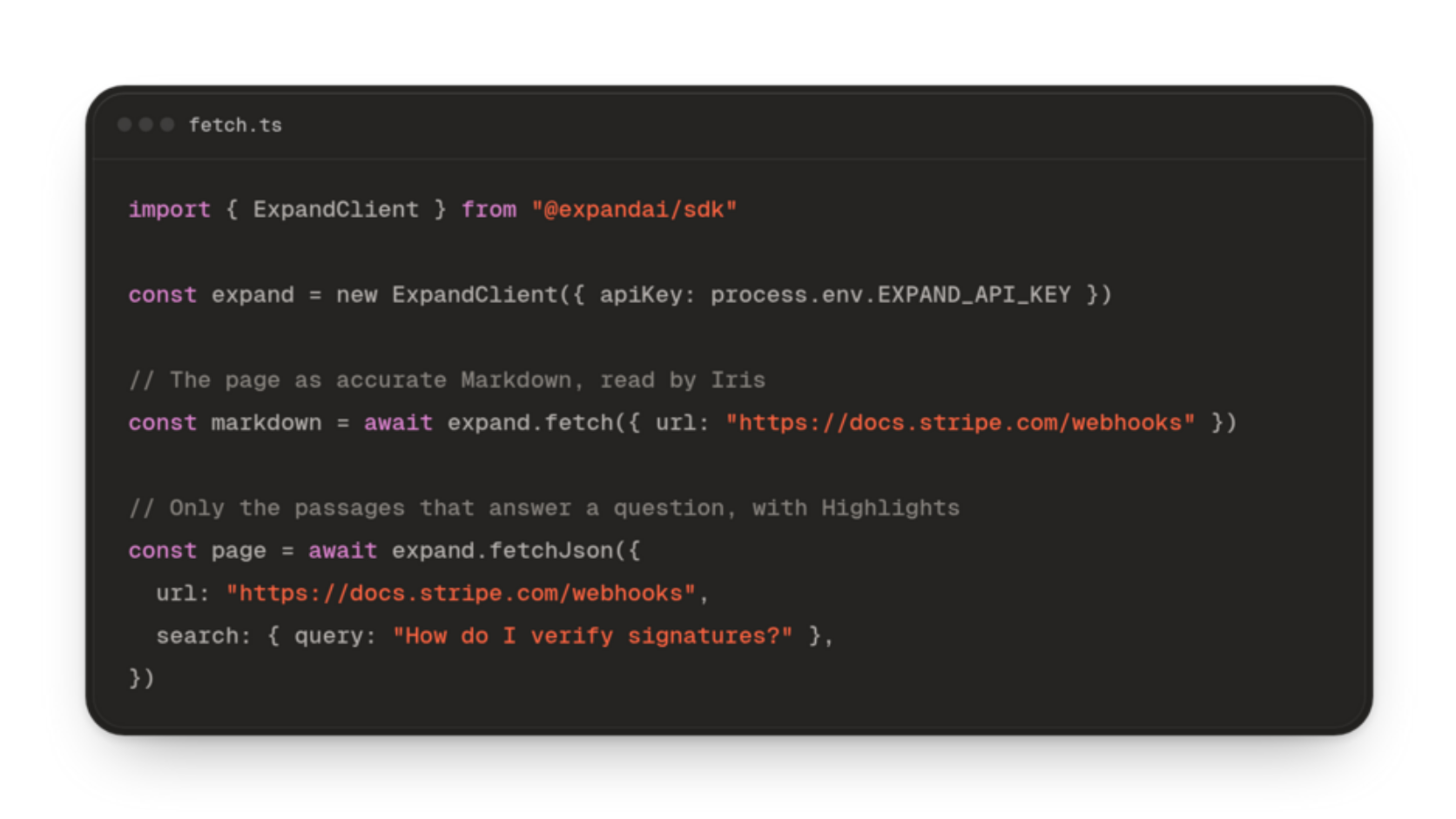
An AI agent can read a pricing page and still miss the checkmark that changes the answer. expand.ai is tackling that failure with Expand Fetch, a web-data API that uses a vision model to preserve the structure of a page and lets users trace an agent’s answer back to what it saw.
The startup announced the product on October 11, offering URL fetching at $1 per 1,000 requests and $10 in free credits. Its pitch is aimed at developers building research and other web-connected agents: improving the input may matter as much as choosing a more capable language model.
At the center is Iris, Expand’s proprietary vision model. It examines a rendered page and produces Markdown that retains tables and the meaning of visual elements such as icons. Material like navigation and footers goes into an appendix, keeping it accessible without making it the main text an agent has to process.
Expand’s website illustrates the problem with a pricing table. Strip away the marks that indicate whether a plan includes a feature, and the feature’s name can appear to belong to the wrong plan. Preserving those marks gives an agent a better basis for answering a question about what a customer would actually get.
Watch Expand’s original launch demonstration.
The API also extracts useful JSON stored behind the page through a feature called X-Ray. The launch cites information such as coordinates and flight gates as examples of data that may be present in the page’s underlying state. Each fetch includes a snapshot, with links connecting individual lines of the output to their source on the page.
That traceability is a practical distinction. When an agent gives a questionable answer, a developer needs to determine whether it misread the evidence or never received it. A preserved snapshot provides something concrete to inspect, even as the live website changes.
For narrower questions, Expand offers Highlights, which returns relevant passages instead of the whole page. The company says this can reduce token usage by more than 95%. Its public pricing table lists Highlights separately from fetching, so developers should account for the operations their workflow uses rather than treating every output as one identical request.
Expand reports that agents answered 74% of questions correctly using its output, compared with 55% for the next-best API in its test. The company says its MDBench evaluation contains 1,094 questions across 326 difficult pages and was developed with customers. Those are company-run results, not an independent assessment, and they don’t establish how the system will perform on every site.
Founder Tim Suchanek previously helped build Prisma as a founding engineer and founded Stellate, according to his public YC profile. Expand participated in Y Combinator’s Summer 2024 batch. Suchanek describes the product as a response to brittle extraction rules that worked on one site and failed on another.
The company’s broader ambition is to make the web queryable like a database, but that effort remains a waitlist offering in the announcement. Fetch is the available product. For developers evaluating it now, the useful test is straightforward: give an agent a page whose details are easy to lose, then check both its answer and the exact evidence behind it.
Lorem ipsum dolor sit amet, consectetur adipiscing elit. Suspendisse varius enim in eros elementum tristique. Duis cursus, mi quis viverra ornare, eros dolor interdum nulla, ut commodo diam libero vitae erat. Aenean faucibus nibh et justo cursus id rutrum lorem imperdiet. Nunc ut sem vitae risus tristique posuere.

Built for Delaware C-Corps. Trusted by 2,000+ startups.












Copyright © Fondo (BloomJoy, Inc.)