An AI model can solve a circuit problem in simulation and still misunderstand the measurement in front of it. Evident Machines is putting models at a physical electronics bench to examine that gap.
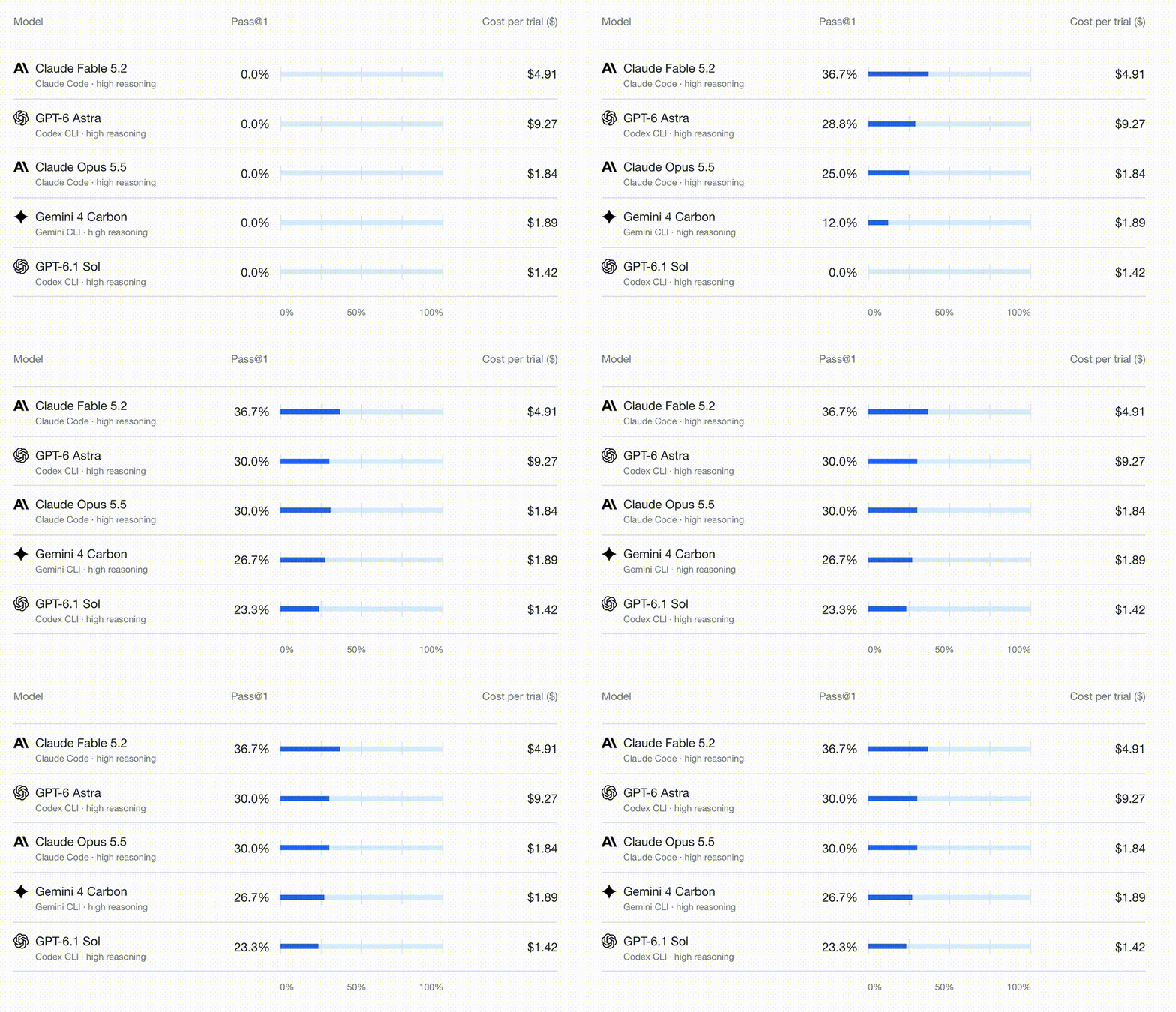
Its FrontierEE Bench covers ten electrical-engineering tasks using real instruments, components and experiments. In the company's reported evaluation, five models achieved an average pass rate of 29.3%. The highest score was 36.7%.
Those numbers come from a deliberately challenging benchmark, not a universal measurement of AI's ability to do engineering. The revealing details are the mistakes: treating a warm component as if it had cooled, drawing conclusions from incomplete circuit models, or changing several variables without establishing which change mattered.
Evident built a lab harness called AgentDUT. Models use it to control networked instruments, request camera images, collect measurements and decide what to test next.
The physical work is not fully robotic. When an experiment requires new wiring, a different component or a moved probe, the model submits an operator request and a person carries it out. The model remains responsible for choosing the experiment and interpreting the result.
That boundary is important to the benchmark. It tests experimental judgment without pretending that an agent already has an autonomous pair of hands. Commands, images, measurements and operator actions are recorded so the run can be reviewed.
The tasks cover mixed-signal circuits, power electronics, electromechanical systems and precision instrumentation. Examples include finding how much current a panel can sustain, interpreting a sump sensor affected by foam, and characterizing an unlabeled gearmotor.
Each contains room for a plausible but incomplete explanation. A surface-temperature measurement may not establish a component's internal temperature. A new test may inherit stored charge or heat from the previous one. The arithmetic can be correct while the physical model is wrong.
Evident says the tasks succeed in simulation but expose those problems on real hardware. Its report also notes safety concerns observed during runs, while specifying that no run failed solely for a safety issue. The benchmark is focused on scientific judgment rather than a standalone safety score.
The reported study uses three runs per model-task pair. A deterministic verifier evaluates submissions against protected bench records and task-specific acceptance tests, rather than asking another language model to judge the answer.
The company also develops reference solutions and checks whether the tests reject plausible wrong answers while accepting valid alternatives. This matters because a demanding benchmark is useful only if failures reflect the task rather than a broken instrument, misleading brief or defective harness.
Evident's report acknowledges overlapping statistical intervals around model results. A narrow leaderboard ordering should therefore not carry more weight than the size of the experiment supports.
Founders Trishala Jain and Mark Nour both studied engineering at UC Berkeley. Jain worked on Gemini for Science at Google Labs; Nour brings research and benchmarking experience from Berkeley Artificial Intelligence Research and engineering experience at Netflix and Google.
The Fall 2026 YC company plans to turn the failures it finds into reinforcement-learning environments and training data for AI labs. Its contribution begins with a tangible distinction: the model must not only propose an experiment, but notice when the physical evidence contradicts its explanation.
Lorem ipsum dolor sit amet, consectetur adipiscing elit. Suspendisse varius enim in eros elementum tristique. Duis cursus, mi quis viverra ornare, eros dolor interdum nulla, ut commodo diam libero vitae erat. Aenean faucibus nibh et justo cursus id rutrum lorem imperdiet. Nunc ut sem vitae risus tristique posuere.

Built for Delaware C-Corps. Trusted by 2,000+ startups.












Copyright © Fondo (BloomJoy, Inc.)