
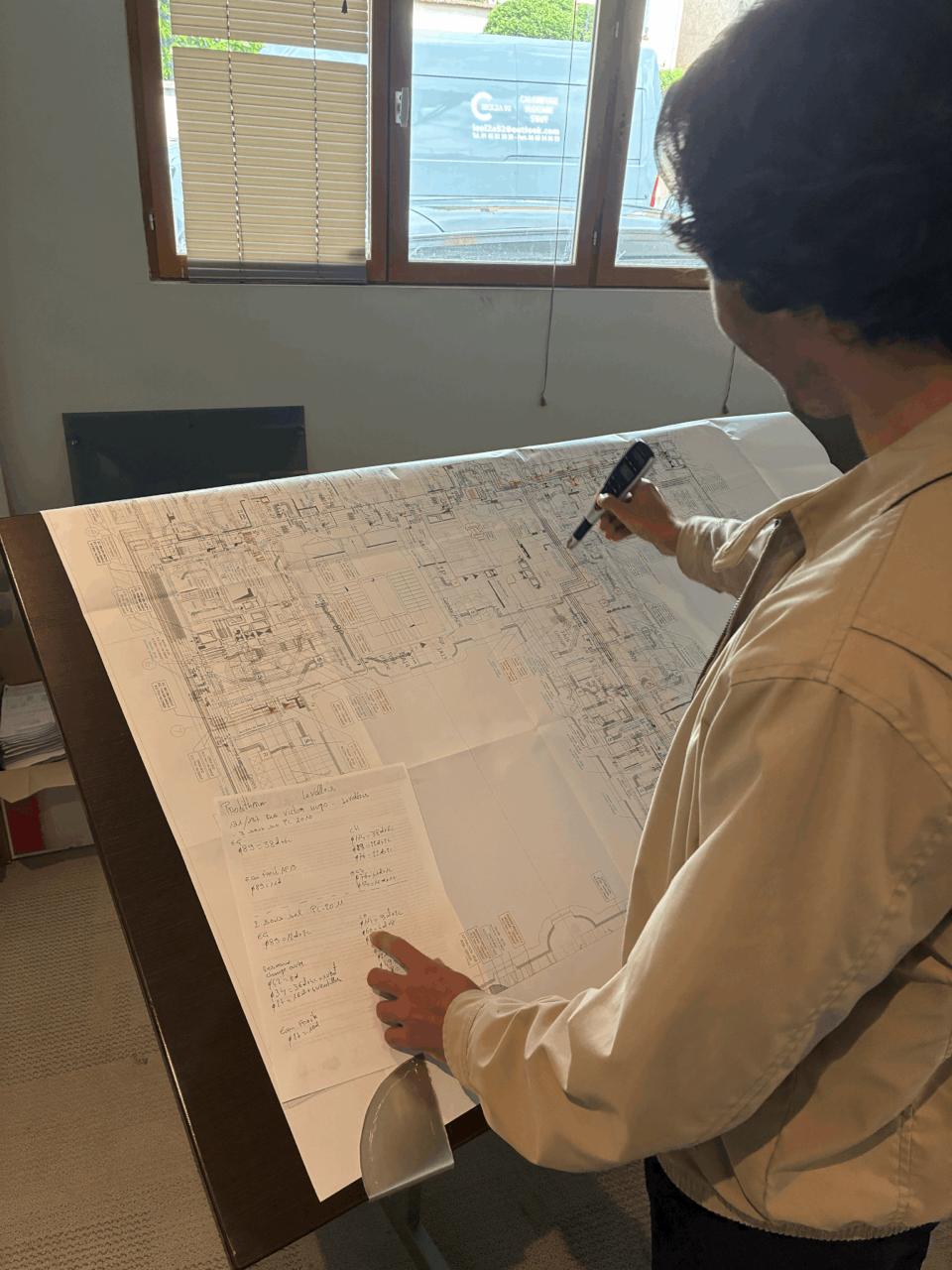
Louis Pires learned construction estimating long before he started a software company. Growing up around his family's HVAC business, he watched his father spend early mornings measuring drawings and eventually helped with quantity takeoffs himself. Constor, the company he founded with Dany Delacour and Elio Delacour, now aims to automate that repetitive work while leaving the estimator responsible for the finished bid.
The Fall 2026 Y Combinator startup starts with a concrete task: extracting quantities from construction plans. Contractors upload drawings and specifications, and the software identifies, measures and counts the relevant elements. An estimator reviews the results against the plans, makes adjustments and applies the appropriate prices. The launch targets both subcontractors preparing offers and general contractors managing estimates.
Constor's website describes a PDF-based workflow that detects piping, ducts, surfaces and equipment. It says users can inspect a three-dimensional representation of the systems after checking the takeoff, then export a structured table for a quote or enterprise resource planning system. Those steps position the product as an input to estimating, rather than a substitute for every decision involved in quoting a construction job.
Watch the original Constor launch video
The distinction matters because a drawing is not always a complete set of instructions. Constor's launch describes missing specifications, errors in plans and practical knowledge that experienced estimators carry without writing it down. Counting an element correctly does not settle how it should be installed or what a contractor should charge. Keeping the extracted quantities visible for review is therefore central to the workflow the company describes.
Speed is the headline promise. Constor says a project that takes days to measure manually can be analyzed in minutes. Its website advertises takeoffs for as many as 50 plans in under 30 minutes. These are company claims, not independently verified turnaround or accuracy guarantees. The launch does not provide a controlled evaluation showing how performance varies across trades, drawing quality or project complexity.
Pires's connection to the problem predates the company. According to the founders' account, he met Elio Delacour, a former ETH researcher, and Dany Delacour, who previously worked in Adobe sales, at a San Francisco hacker house they started last spring. A dinner conversation about the work in Pires's family business led to Constor. The product's starting point reflects that history: reduce the hours spent measuring before an estimate can even be priced.
The company website includes named testimonials from construction business owners who describe shorter takeoffs and less weekend work. Those accounts offer examples of how customers use the tool, but they do not establish a typical time saving or a verified increase in successful bids. Constor has not supplied a customer count or revenue figure in the launch materials.
The larger plan reaches beyond measurement. Constor describes a future workflow spanning subcontractor bids, general contractor comparisons and drawing revisions, along with supplier pricing and fulfillment. Those are expansion ambitions, not a reason to assume every part is already available. For now, the company invites contractors to bring their own plans to a 20-minute demonstration, where the immediate test is whether the extracted quantities hold up to an estimator's inspection.
Lorem ipsum dolor sit amet, consectetur adipiscing elit. Suspendisse varius enim in eros elementum tristique. Duis cursus, mi quis viverra ornare, eros dolor interdum nulla, ut commodo diam libero vitae erat. Aenean faucibus nibh et justo cursus id rutrum lorem imperdiet. Nunc ut sem vitae risus tristique posuere.

Built for Delaware C-Corps. Trusted by 2,000+ startups.












Copyright © Fondo (BloomJoy, Inc.)