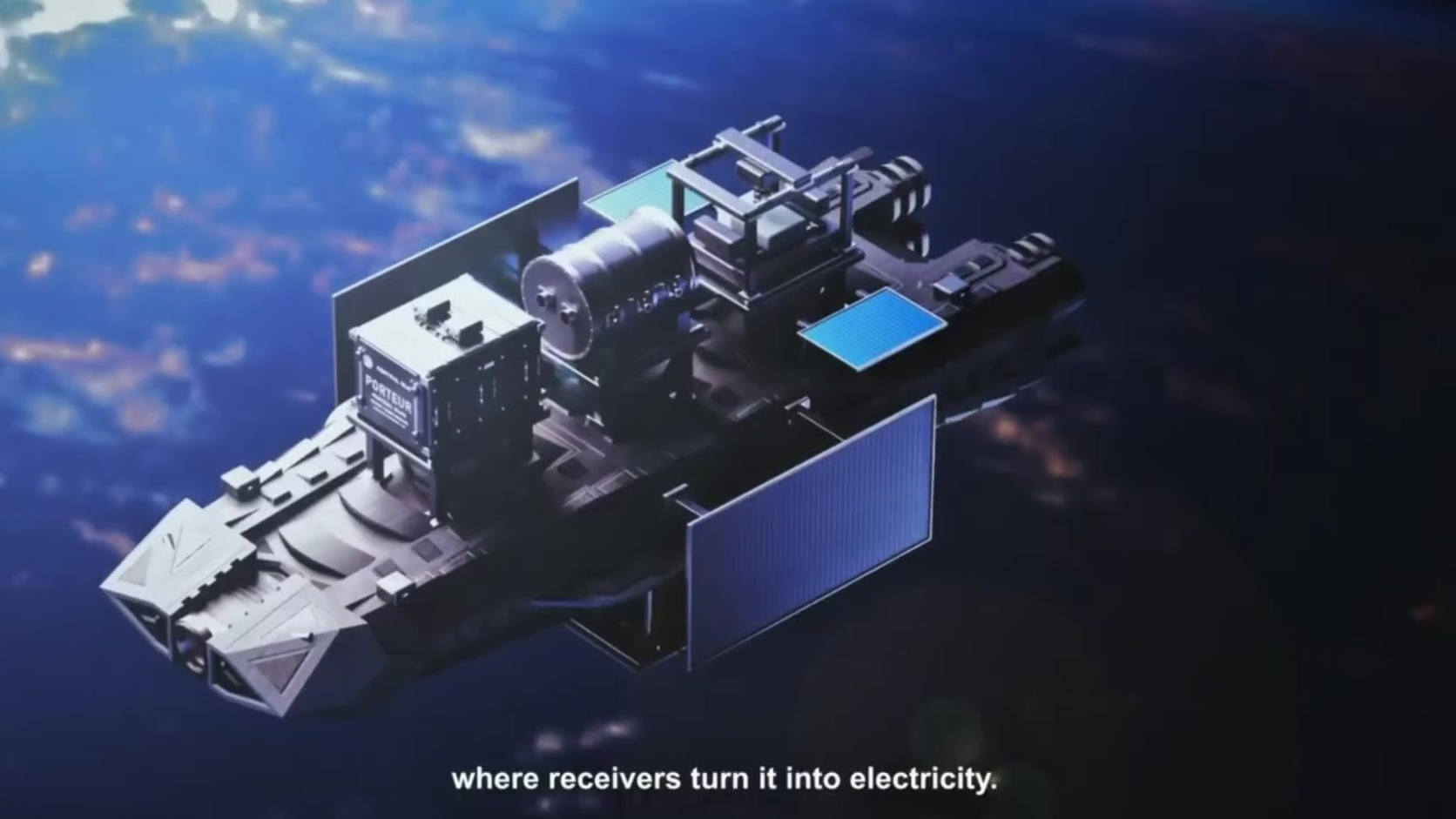
Central Blue is developing satellites that would collect sunlight and transmit energy to other spacecraft using near-infrared lasers. Its proposed customers would receive that energy through dedicated panels, converting the incoming light into electricity instead of generating every watt themselves.
The Fall 2026 Y Combinator company's ambition is an orbital power network. Its immediate milestone is on the ground: a power-beaming prototype in Seattle and a demonstration planned for early December, according to its launch announcement.
The demonstration involves Wave Motion Launch Technologies, which is supplying a thruster. Central Blue plans to use a kilowatt-class fiber laser to heat a graphite block inside the device to roughly 1,000 degrees Celsius. Gas passing through the heated block would then exit a nozzle and produce thrust.
That experiment is narrower than demonstrating a working electricity network in orbit. It is designed to test whether transmitted energy can directly power propulsion, giving the team a concrete early use of its beaming technology while the broader architecture remains under development.
Central Blue's starting observation is that spacecraft generally carry their own power supply. Solar arrays and batteries compete for mass with instruments and other mission equipment. Additional power available as a service could, in the company's proposed model, let an operator run instruments or electric propulsion for longer without assigning all that generating capacity to each spacecraft.
The launch describes possible applications ranging from disaster mapping to orbital manufacturing and lunar operations. These are future uses of the proposed network, not customers or operational deployments established by the announcement. The company is asking spacecraft builders and operators to describe the power needs and schedules of missions that could benefit.
Its development plan proceeds in stages. After the first demonstration, Central Blue intends to beam power to drones and remote locations, including places where transporting fuel is difficult. Those tests would help it refine lasers, receivers and beam tracking before extending the system to spacecraft.
The planned orbital rollout would begin with links between satellites in low Earth orbit and eventually expand toward the Moon. The company is also developing spacecraft recovery software, called CORE, to help satellites respond to faults without waiting for intervention from Earth. It says it is preparing to flight-test that software with Satlyt.
Founders Brian Wu and Jeewoo Choi met while studying engineering at Stanford. Wu worked on visual navigation for NASA's Perseverance mission at JPL, as well as AI at Apple and robotics at Field AI. Choi worked on thermal, airflow and environmental testing at Boeing Defense, Space & Security. Their respective computer-science and mechanical-engineering backgrounds reflect the software and physical-system work required by the project.
For now, Central Blue's announcement is a development roadmap with a near-term test, rather than evidence that customers can already purchase power in orbit. The December demonstration will examine one link in that roadmap: converting a laser beam into useful propulsion. The company is looking for mission operators whose power requirements can help define the next ones.
Lorem ipsum dolor sit amet, consectetur adipiscing elit. Suspendisse varius enim in eros elementum tristique. Duis cursus, mi quis viverra ornare, eros dolor interdum nulla, ut commodo diam libero vitae erat. Aenean faucibus nibh et justo cursus id rutrum lorem imperdiet. Nunc ut sem vitae risus tristique posuere.

Built for Delaware C-Corps. Trusted by 2,000+ startups.












Copyright © Fondo (BloomJoy, Inc.)