Caveman began with a deliberately crude way to reduce AI spending: make the model use fewer words. Its new Caveman Code application takes aim at a less visible source of cost, the context and tools an agent repeatedly processes while working.
Founder Julius Brussee says the project started when his AI bill exceeded his grocery spending as a university student. He wrote a Markdown instruction that made Claude respond in caveman-style shorthand. According to his launch account, the project spread through Hacker News and accumulated 120,000 GitHub stars. What began as a joke became his full-time work.
The next problem was that shorter answers mattered less as the work became more agentic. Brussee says his measurements on Claude Opus 5.5 found the agent’s own responses accounted for less than a tenth of total cost. Much of the bill came from the harness: the prompts, tools and execution loop determining what the model must read again.
Watch the original launch video
Caveman Code is the application built around his response to that finding. Available for Mac and in a browser, it puts Claude, Codex and Cursor alongside one another using customers’ existing subscriptions or keys. Its stated advantage is infrastructure that selects relevant context and changes how an agent interacts with data, rather than merely shortening the final answer.
The application includes a coordinating agent called Chief. A user describes a task, and Chief starts conversations, handles questions from the agents and reports back. Caveman also presents pull requests with a short guide covering the overall change, the decision requiring human input, and before-and-after explanations next to the code.
The launch describes computer access across connected machines and a cloud-computer feature that remains in beta. Brussee says agents can use desktops and browsers to check their work, and that conversations transfer to the cloud when a laptop closes. These are product claims from the announcement, not a guarantee that every workflow or local dependency transfers without constraints.
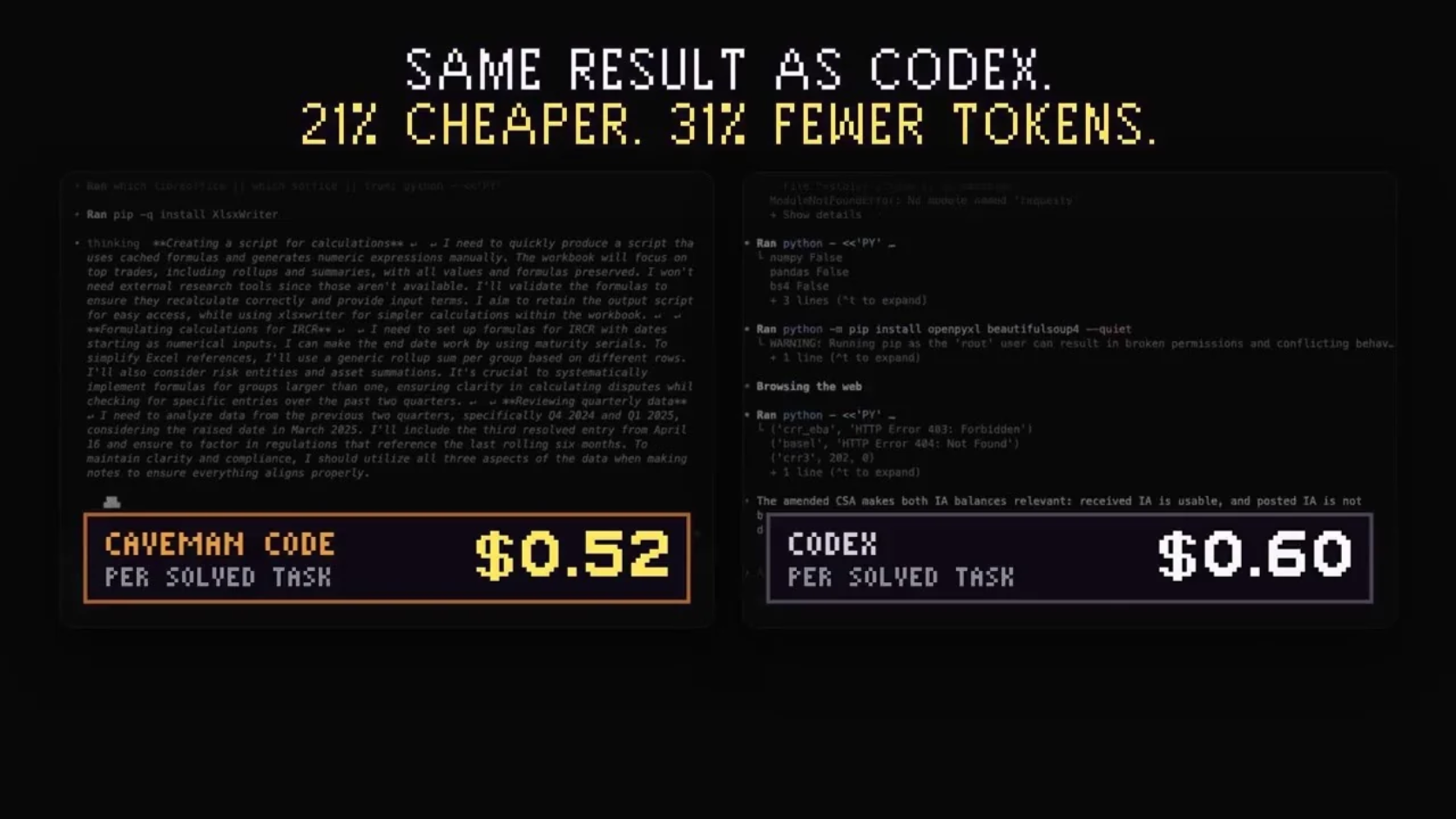
For its cost argument, Caveman reports comparisons using the same underlying models with different harnesses. On Terminal-Bench 4 with GPT-6.1 Sol, Brussee reports 21% lower cost and 31% fewer tokens, with both systems solving 90 of 192 runs. On the Claude Opus 5.5 comparison, he reports lower cost and a higher solved-run count than Claude Code.
The largest reported saving comes from day-long connected-app sessions: 76% lower cost and 83% fewer tokens, with Caveman completing 48 steps against Claude Code’s 46. Brussee explicitly identifies these as his own runs at list prices, without a router. They are not independently reproduced results, and do not establish the same savings for every workload.
The company says the application is free for users bringing their own keys and logins. Existing model or subscription costs still matter: a free interface does not make the underlying inference free. The launch directs users to a download or browser signup rather than presenting a new model of its own.
Caveman’s shift captures a specific infrastructure bet. As agents do more work, efficiency depends on the execution loop as well as the model. The company is trying to make that loop less repetitive while giving users a place to coordinate and review the resulting work.
Lorem ipsum dolor sit amet, consectetur adipiscing elit. Suspendisse varius enim in eros elementum tristique. Duis cursus, mi quis viverra ornare, eros dolor interdum nulla, ut commodo diam libero vitae erat. Aenean faucibus nibh et justo cursus id rutrum lorem imperdiet. Nunc ut sem vitae risus tristique posuere.

Built for Delaware C-Corps. Trusted by 2,000+ startups.












Copyright © Fondo (BloomJoy, Inc.)