
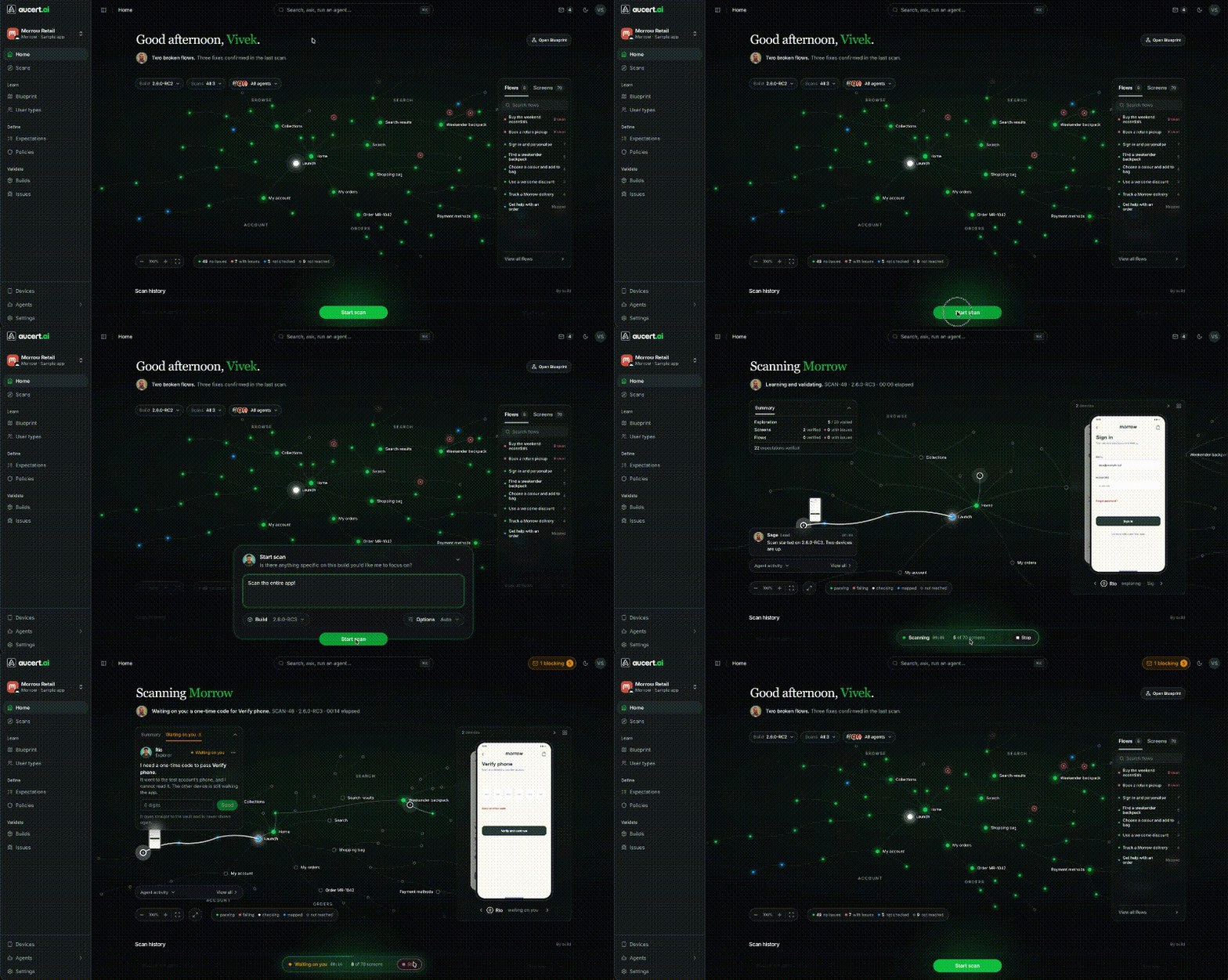
Aucert wants mobile developers to hand over an app build and receive evidence of problems without first writing a suite of test scripts. Its AI agents explore the app, checking user flows, accessibility and app-store policies before a team decides whether to release it.
The Fall 2026 Y Combinator company is launching with three agents that divide up the work. Genie explores screens and interactions, Iris focuses on accessibility, and Pax checks Google Play and App Store policy requirements. The product is designed to investigate how an app behaves, rather than simply replay a sequence a developer has already specified.
That distinction matters for mobile teams shipping frequent changes. A scripted test can establish whether a known path still works. A tester exploring the product may encounter a different path, a confusing screen or an interaction that the original script never covered. Aucert is trying to automate more of that exploratory work.
Its workflow begins with an app build. The system learns the app and its expected behavior, proposes standards for approval, and produces findings with supporting evidence. The developer remains responsible for the release decision; an agent’s report is an input to that decision, not an automatic assurance that an app is ready.
Watch Aucert’s mobile app testing demonstration.
The launch dashboard maps screens and flows, making the exploration visible alongside scan findings. That gives teams a way to inspect what the agents examined, rather than receiving only a list of conclusions. The useful question is whether a finding can be reproduced and connected to a behavior the team actually wants to change.
Aucert says its approach can complete checks in less than two hours that might otherwise take teams weeks. That is a company claim, not an independently verified comparison. The announcement does not provide a benchmark covering different app sizes or a measured rate of missed issues, so the speed claim should not be read as a guarantee for every build.
The founders have worked on mobile products where release mistakes reach large audiences. Vivek Soneja was a founding mobile architect at PhonePe and describes contributing from its first commit through its growth to 500 million users. His background also includes WhatsApp at Meta. Co-founder Rajesh Kumar spent 11 years at PayPal and worked at Multiplier, with experience that includes a patent related to automated payment testing.
That history helps explain the emphasis on verification evidence. Finding a potential issue is only part of the job; an engineering team also needs enough context to judge its severity and decide what to fix. Aucert’s proposed standards and approval step make the intended behavior something the team can review before treating it as a testing rule.
The current launch covers functional behavior, accessibility, design and store-policy checks. Performance and security testing are described as next steps, and should not be assumed to be part of the present product.
For now, the company’s test is whether its agents can turn an unfamiliar build into a useful, inspectable set of findings. Developers still make the release call, but Aucert wants them to make it with more of the app already explored.
Lorem ipsum dolor sit amet, consectetur adipiscing elit. Suspendisse varius enim in eros elementum tristique. Duis cursus, mi quis viverra ornare, eros dolor interdum nulla, ut commodo diam libero vitae erat. Aenean faucibus nibh et justo cursus id rutrum lorem imperdiet. Nunc ut sem vitae risus tristique posuere.

Built for Delaware C-Corps. Trusted by 2,000+ startups.












Copyright © Fondo (BloomJoy, Inc.)