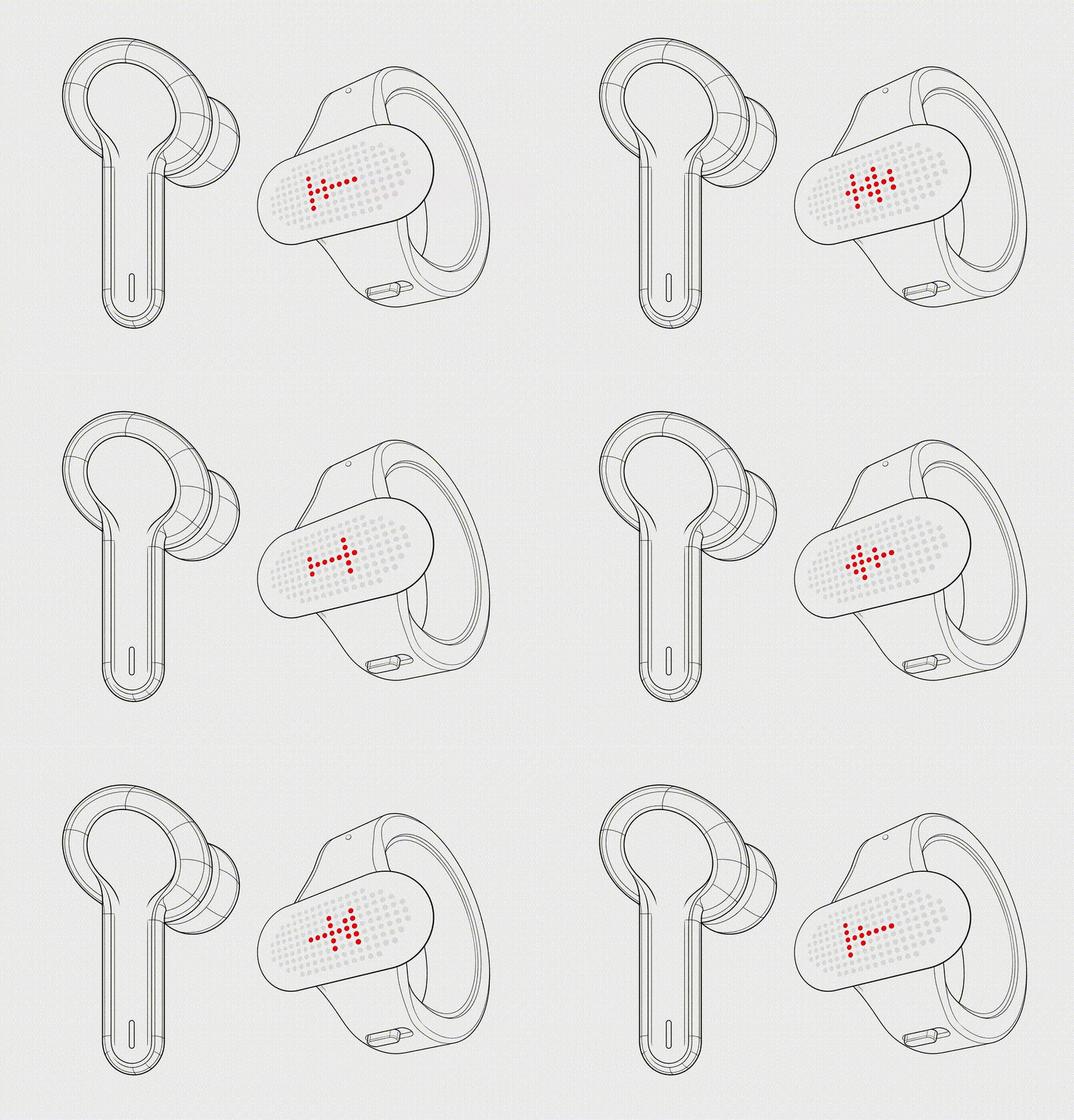
antimattr began with earbuds and a camera. Its early users were more interested in being heard clearly than in the camera, so the founders narrowed the product around voice isolation and added a ring to control AI agents.
The Fall 2026 YC company's Project Mnemosyne pairs earbuds designed to isolate the wearer's voice with a controller worn on a finger. It is intended for people who want to dictate, capture thoughts or interact with agents without repeatedly reaching for a screen.
The problem, in the founders' account, emerged while they were building voice-AI products. Systems worked in quiet rooms but became unreliable outside them, where background sound led to transcription errors. Their response was to work on the incoming audio rather than build another voice model.
Watch the original antimattr launch video
antimattr says its earbuds use proprietary isolation technology to improve speech capture in noisy environments. Its launch claims a word-error rate below 5%, compared with roughly 30% in an AirPods comparison, and describes filtering background noise near 90 decibels. The announcement does not provide a complete testing protocol, so those numbers remain company-reported comparisons rather than independently verified product performance.
The ring grew from a different piece of feedback. Users wanted to know when an agent was working or stuck, and wanted a quick way to communicate with it. The company describes the ring as a way to trigger agents, capture a thought and keep track of activity without opening a conventional application.
There is a distinction between early sales and the full system now being promoted. The founders say their first hardware batch shipped in June and sold out, and that they have more than 2,000 preorders. The current product page still presents Project Mnemosyne through an early-access reservation flow and says it will be unveiled in the fourth quarter of 2026.
That leaves important details about the complete earbud-and-ring experience to be established. The launch does not specify how many units were in the first batch, which features those units included or when every preorder will ship. Preorders show interest, but should not be treated as delivered systems or retained users.
Founders Sridipto Ghosh and Sirsho C bring manufacturing and software backgrounds. Ghosh studied metallurgical and manufacturing engineering at IIT-BHU, while Sirsho studied computer science and AI and worked on autonomous cars and robots, according to the launch. They say a previous bootstrapped business reached $250,000 in revenue in a year.
The founders' account includes a manufacturing search in China, an unsuccessful YC interview and a move to the United States with less than three months of runway before joining the Fall batch. Those details explain why the current product is the result of successive changes rather than the original camera concept.
The near-term test is less abstract than whether voice becomes the dominant computer interface. It is whether people can reliably get their own speech into an agent, know what that agent is doing and control it discreetly in the places where they already spend time. The team has chosen the ear and the hand as its starting points.
Lorem ipsum dolor sit amet, consectetur adipiscing elit. Suspendisse varius enim in eros elementum tristique. Duis cursus, mi quis viverra ornare, eros dolor interdum nulla, ut commodo diam libero vitae erat. Aenean faucibus nibh et justo cursus id rutrum lorem imperdiet. Nunc ut sem vitae risus tristique posuere.

Built for Delaware C-Corps. Trusted by 2,000+ startups.












Copyright © Fondo (BloomJoy, Inc.)