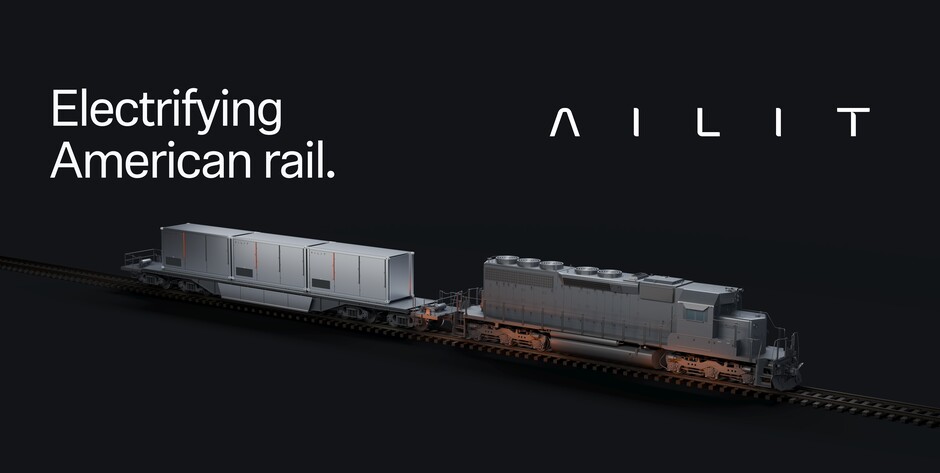
Ailit is taking a retrofit approach to freight-rail electrification: keep the locomotive and replace some of the energy feeding its motors. Its first product, Superwagon, carries swappable battery packs on a tender coupled to an existing diesel-electric locomotive.
That distinction is central to the company's design. A diesel-electric locomotive already uses electric traction motors; its onboard diesel engine supplies the energy. Ailit proposes feeding those motors from batteries while retaining the diesel engine as backup. The railroad would not need to replace the whole locomotive to begin using battery power.
The Fall 2026 Y Combinator company says it has completed a full-scale prototype with a swappable pack. At launch, it describes that prototype as ready for its first locomotive movements. That is an engineering milestone, but not yet evidence of sustained commercial operation on a freight route.
The batteries would be exchanged at stops trains already make, rather than requiring the entire train to wait while a depleted pack recharges. Discharged packs would recharge off the train. Ailit says swaps can take minutes, making turnaround time part of the product rather than treating charging as a separate problem for the operator.
Watch the original launch video.
The business model is as important as the tender. Ailit plans to finance and operate both the batteries and the swapping sites, charging railroads for electricity by the kilowatt-hour. Its launch quotes pricing approximately 20% below the equivalent diesel cost, with no upfront equipment purchase by the railroad.
That figure is the company's proposed comparison, not an independently measured saving across routes. The announcement does not supply a route-level operating model, utilization assumptions or a customer contract establishing that result. Actual economics would have to cover the packs, charging, spare inventory and the physical work of swapping them, as well as electricity itself.
Moving those responsibilities to Ailit could make the buying decision simpler for a railroad. Instead of owning and maintaining unfamiliar battery infrastructure, it would purchase an energy service. In return, Ailit would take on the challenge of keeping charged packs and functioning swap equipment available when the trains need them.
The company argues that rail offers useful conditions for batteries: trains can carry their weight, and existing electric motors offer a path into the installed fleet. But the relevant standard is operational rather than theoretical. Freight equipment has to deliver the power, range and availability required by a particular service, not merely demonstrate that it can move under battery power.
YC identifies Christian Lind and Emil Tagesson as Ailit's founders. The launch points to team experience in electric marine transport, high-performance drivetrains and autonomous systems, including work at Candela and Koenigsegg. That background connects vehicle engineering with the practical work of moving hardware beyond a prototype.
Superwagon's next test is therefore the transition from a completed pack to repeated locomotive movements and, eventually, a dependable energy service. Ailit says its completed full-scale prototype is ready for its first locomotive movements, using swappable batteries to power an existing locomotive.
Lorem ipsum dolor sit amet, consectetur adipiscing elit. Suspendisse varius enim in eros elementum tristique. Duis cursus, mi quis viverra ornare, eros dolor interdum nulla, ut commodo diam libero vitae erat. Aenean faucibus nibh et justo cursus id rutrum lorem imperdiet. Nunc ut sem vitae risus tristique posuere.

Built for Delaware C-Corps. Trusted by 2,000+ startups.












Copyright © Fondo (BloomJoy, Inc.)