Acyclic Labs started with a scaling question: if one AI agent can do useful work, why not run thousands at once? Its launch now centers on the complication that followed. Adding agents can make a system perform worse when the models fail to coordinate.
The company is building infrastructure, benchmarks, reinforcement-learning environments and models around that problem. Rather than treating swarm performance as a direct function of how much compute is available, it is trying to identify which workloads benefit from delegation and what the agents need to learn to work together.
Cofounders Ram Vinjamuri and Varun Latthe studied at Cambridge. Their public profiles describe experience spanning machine-learning research, parallel programming and enterprise agent systems. That background informs the company’s attempt to connect a systems problem, running many agents, with a model-behavior problem, deciding what those agents should do.
Watch the original launch video
Acyclic says its initial open-source infrastructure could run 10,000 agents in one session. That is a capacity claim, not a claim that 10,000 agents reliably outperform one. According to the launch, increasing the number of workers exposed failures in coordination that could erase the expected benefit of parallel execution.
The response was SwarmBench, a benchmark for how models delegate and speculate. Delegation concerns dividing work among agents. Speculation, as the company describes it, means anticipating work that will be needed later and starting it early. Both can reduce elapsed time when they are used effectively, but also create unnecessary work or dependencies when used badly.
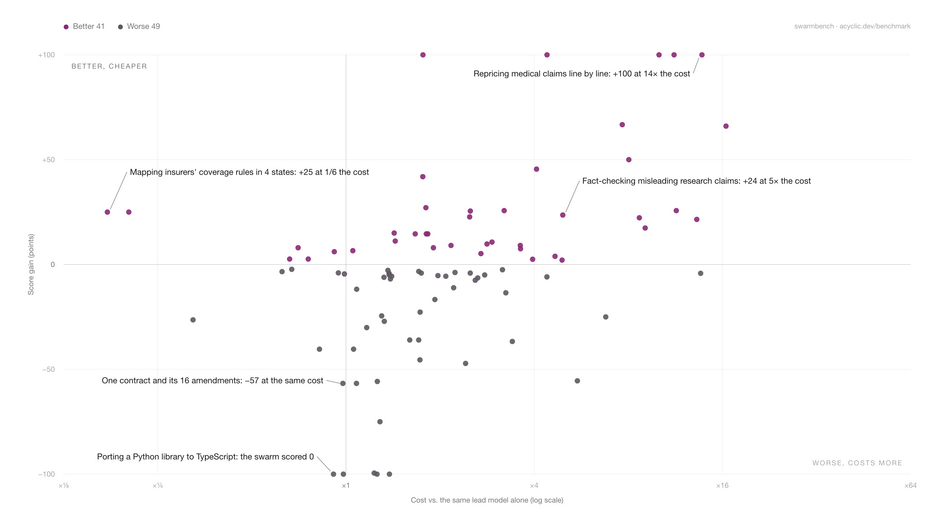
The company says its evaluations isolate coordination bottlenecks across different architectures and models. Its published launch graphic plots score changes against cost relative to the same model working alone, and includes outcomes on both sides of the improvement line. That presentation supports the narrower message of the launch: benefits depend on the task, not simply the size of the swarm.
The findings remain Acyclic’s own benchmark results. The announcement does not establish a universal threshold at which parallel agents become useful, nor does it show that adding workers is always cheaper. A team assessing a swarm system would need to consider its own workload, the quality of the result and the extra computation together.
Acyclic is also building reinforcement-learning environments for coordination and says it has begun training models to work better together. Its proposed loop is to measure failures in delegation and parallel exploration, turn those failures into training environments, and then evaluate again. The launch describes an ongoing development process rather than a completed solution to every coordination problem.
This gives the infrastructure a different role from a simple scheduler. Running many agents is the substrate; learning when and how to divide their work is the objective. The company wants its benchmarks and environments to supply feedback for that learning, alongside the systems needed to execute larger workloads.
Acyclic is part of YC’s Fall 2026 batch and is inviting conversations with model developers and teams building with agents. The announcement does not disclose commercial pricing or customer outcomes. Its immediate contribution is a concrete challenge to a common assumption about agent scaling: more concurrent reasoning is not automatically more useful reasoning.
Lorem ipsum dolor sit amet, consectetur adipiscing elit. Suspendisse varius enim in eros elementum tristique. Duis cursus, mi quis viverra ornare, eros dolor interdum nulla, ut commodo diam libero vitae erat. Aenean faucibus nibh et justo cursus id rutrum lorem imperdiet. Nunc ut sem vitae risus tristique posuere.

Built for Delaware C-Corps. Trusted by 2,000+ startups.












Copyright © Fondo (BloomJoy, Inc.)