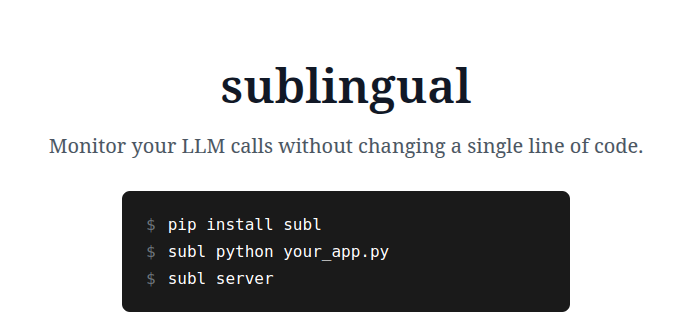
"Monitor your LLM calls without changing a single line of code."
TLDR: Skipping evals, testing on vibes, and ripping it straight to prod. Integrating observability and evals can be a lot of work, which is why Sublingual gives you deep insights into how your LLMs perform without touching your code. It works across a wide range of environments, capturing extensive logs including LLM interactions, inputs, outputs, and server call data. Just pip install subl and you’re live.
Dylan (CTO): previously LLM research at UIUC Kang Lab and Dept. of Defense
Matthew (CEO): previously TikTok ML on the recommendation algorithm and ads engine, LLM research for rec-sys at Nextdoor
How they got here:
The team has spent years building and researching LLM applications, and they have seen firsthand how developers handle evaluation: sifting through logs, relying on intuition, and struggling with the friction of integrating existing observability tools when they just want to focus on building. Through conversations with numerous founders, they have learned that they're often too busy building to establish robust evaluation systems. So, they end up relying on a couple vibe tests before crossing their fingers and pushing to prod.
That’s why they built Sublingual—effortless LLM observability that works out of the box. No code changes, no distractions, just the insights you need to ship with confidence.
Their approach:
Minimize onboarding overhead: They have hacked away at the complexity of automating integration so you can start collecting insights instantly. Their design prioritizes minimal friction, ensuring observability works out of the box without interrupting your workflow.
Minimize intrusiveness: Disentangle logging and LLM serving logic to ensure logging server failures never impact LLM serving reliability. Sublingual is designed to be plugged in or removed without affecting any functionality of your code.
Easy local hosting: Their tool and stored logs are entirely local, so there’s no risk of data leakage.
Code insights: They use a mix of static and dynamic code analysis to deeply understand your program, extracting details that other platforms can’t like automatically finding prompt templates.
Lorem ipsum dolor sit amet, consectetur adipiscing elit. Suspendisse varius enim in eros elementum tristique. Duis cursus, mi quis viverra ornare, eros dolor interdum nulla, ut commodo diam libero vitae erat. Aenean faucibus nibh et justo cursus id rutrum lorem imperdiet. Nunc ut sem vitae risus tristique posuere.
.png)