.png)

🍯 Honeycomb recently launched!

Founded by Andrew Liu & Ishank Agrawal
The founders met during their first year at MIT. Since then, they’ve done research spanning statistics, machine learning, algorithms, and astrophysics. Through research and side projects, Andrew and Ishank have spent a lot of time thinking about ways to program better and eventually realized that the intersection between AI and programming is a future that they’d like to build towards.
On average, developers spend more than a third of their time on maintenance, testing, documentation, code review, and other tedious work. This work is necessary but contributes to slower cycles—this problem is exacerbated with larger engineering teams.
While many large companies are working to automate their development processes with AI, this integration is challenging. Creating robust, functional workflows requires significant time and effort. Honeycomb is developing a solution that works for everyone.
The company founders built a coding engine that allows Honeycomb agents to make efficient, precise, and accurate changes to large codebases.
Here, the founders asked the Honeycomb agent to make some quick improvements to its own UI. This is just one use case for the Honeycomb engine; its capable of implementing agents across the entire software stack, from testing, documentation, and code reviews to more complex bug fixes and even 0-to-1 development.
The founders have been working hard to ensure that their agents deliver on real-world issues. They've evaluated the system on SWE-Bench, a dataset that tests the capabilities of agentic systems against GitHub issues:
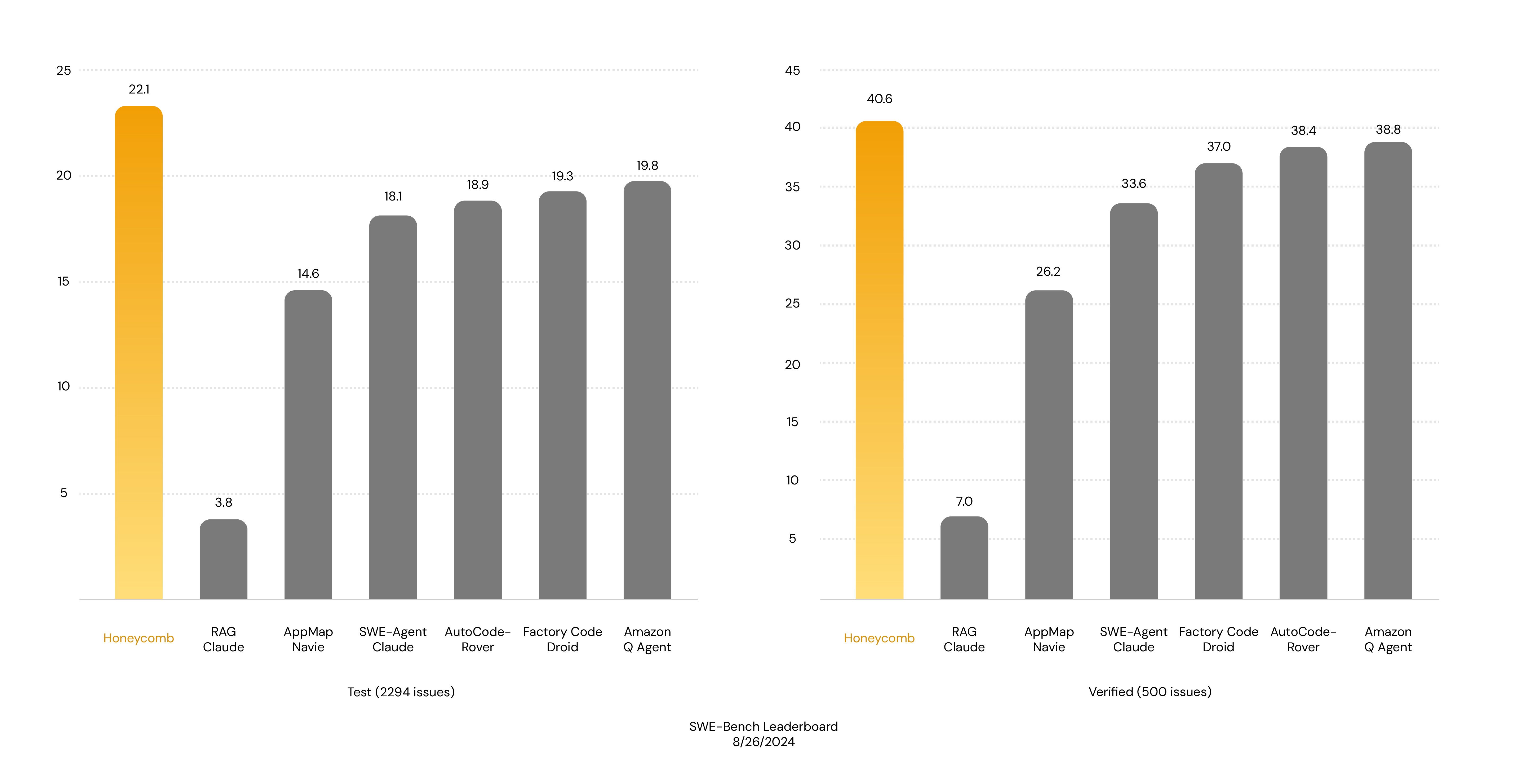
The Honeycomb engine resolved 22.06% of the 2,294 issues in SWE-bench's test set, surpassing the previous state-of-the-art Amazon Q Developer Agent (19.75%). It additionally resolved 40.6% of the 500 issues in SWE-bench’s verified set, also surpassing previous state-of-the-art (38.8%).
The Initial Set of Developer Tools Includes:
Honeycomb also seamlessly integrates with GitHub, GitLab, Slack, and Discord— with more to come—allowing teams to solve bugs or query their code with just a single command.
Lorem ipsum dolor sit amet, consectetur adipiscing elit. Suspendisse varius enim in eros elementum tristique. Duis cursus, mi quis viverra ornare, eros dolor interdum nulla, ut commodo diam libero vitae erat. Aenean faucibus nibh et justo cursus id rutrum lorem imperdiet. Nunc ut sem vitae risus tristique posuere.

Built for Delaware C-Corps. Trusted by 2,000+ startups.












Copyright © Fondo (BloomJoy, Inc.)